

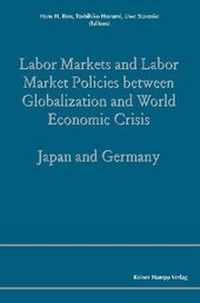
Labor Markets and Labor Market Policies between Globalization and World Economic Crisis
Japan and Germany
1. Auflage
Erschienen am 10. Oktober 2010
275 Seiten
978-3-86618-579-1 (ISBN)
Beschreibung

This publication focuses on studies on Japan and Germany, as well as on comparative studies. The consequences of globalization and of the world economic and financial crisis are the recurrent theme: How did the labor markets cope with the crisis and what are the resulting challenges for labor market policy and social policy? On the brink of a global employment crisis following the global financial and economic crisis, this pub-lication analyzes the development of labor markets and labor market policies in two countries which during the second half of the 20th century were among the most suc-cessful in terms of economic growth and social inclusion. The recent history of labor markets and labor market policies in Germany and Japan can be divided into four phases: (1) a phase of strong institutional co-ordination of labor markets before the on-set of globalization; (2) the emergence of an employment crisis related to both the chal-lenges of globalization and to nation-specific factors, notably the burst of the real estate speculation bubble in Japan and reunification in Germany; (3) since 2003 an attempt to solve the employment crisis by a market-optimistic approach; and (4) finally new chal-lenges arising from the Global Financial and Economic Crisis of 2009. This book is the outcome of the conference "The flexibilization of labor markets between globaliza-tion and the global economic crisis: Comparing Japan and Germany" which was held at the Bremen University of Applied Sciences in June 2009.
Weitere Details
Weitere Ausgaben
Andere Ausgaben
Hans H. Bass | Toshihiko Hozumi | Uwe Staroske
Labor Markets and Labor Market Policies between Globalization and World Economic Crisis
Japan and Germany
Buch
09/2010
1. Auflage
Edition Rainer Hampp
29,80 €
Artikel ist vergriffen; siehe andere Ausgabe
Inhalt
1 - Contents [Seite 6]
2 - Foreword of the Vice President, Research and Development, Bremen University of Applied Sciences [Seite 10]
3 - Foreword of the Vice President, International Affairs, Bremen University of Applied Sciences [Seite 12]
4 - Foreword of the President of Aichi University, Toyohashi and Nagoya [Seite 14]
5 - Welcoming Speech of the President of the Bremen Chapter of the German Confederation of Trade Unions [Seite 16]
6 - I. Comparative Studies [Seite 16]
7 - German and Japanese labor markets and labor market policies between globalization and world economic crisis - Towards a comparison [Seite 20]
8 - World Economic Crisis - Globalization - Global Employment Crisis - Challenges for the Reform of Labour and Employment Policies in Japan and in Germany [Seite 52]
9 - Der Wohlfahrtsstaat in Deutschland und Japan im Vergleich - Veränderung und Diversifizierung des Wesens der "sozial eingebetteten Gemeinschaftlichkeit" [Seite 96]
10 - II. Studies on Japan [Seite 132]
11 - Reform des Beschäftigungssystems und ihre Resultate in Japan seit der zweiten Hälfte der 1980er Jahre [Seite 132]
12 - Deregulation of Employment Law after 1990 and Its Effects on Japanese Corporate Governance [Seite 148]
13 - The present situation in the Japanese employment system, with special reference to the problems regarding temporary workers [Seite 174]
14 - Japans Beschäftigungspolitik und die Weltfinanzen: Mit Keynes aus der Krise? [Seite 194]
15 - III. Studies on Germany [Seite 213]
16 - Mismatch-Arbeitslosigkeit in Deutschland - ein neuer Erklärungsansatz [Seite 213]
17 - Goodbye Schumpeter!? - Hello again Keynes? Old and new strategies to cope with crisis, unemploment und social insecurity [Seite 238]
18 - Inflexibilität des Arbeitsmarktes oder falsche makroökonomische Politik für deutsche Wachstumsschwäche und Arbeitslosigkeit verantwortlich? [Seite 252]
2 - Foreword of the Vice President, Research and Development, Bremen University of Applied Sciences [Seite 10]
3 - Foreword of the Vice President, International Affairs, Bremen University of Applied Sciences [Seite 12]
4 - Foreword of the President of Aichi University, Toyohashi and Nagoya [Seite 14]
5 - Welcoming Speech of the President of the Bremen Chapter of the German Confederation of Trade Unions [Seite 16]
6 - I. Comparative Studies [Seite 16]
7 - German and Japanese labor markets and labor market policies between globalization and world economic crisis - Towards a comparison [Seite 20]
8 - World Economic Crisis - Globalization - Global Employment Crisis - Challenges for the Reform of Labour and Employment Policies in Japan and in Germany [Seite 52]
9 - Der Wohlfahrtsstaat in Deutschland und Japan im Vergleich - Veränderung und Diversifizierung des Wesens der "sozial eingebetteten Gemeinschaftlichkeit" [Seite 96]
10 - II. Studies on Japan [Seite 132]
11 - Reform des Beschäftigungssystems und ihre Resultate in Japan seit der zweiten Hälfte der 1980er Jahre [Seite 132]
12 - Deregulation of Employment Law after 1990 and Its Effects on Japanese Corporate Governance [Seite 148]
13 - The present situation in the Japanese employment system, with special reference to the problems regarding temporary workers [Seite 174]
14 - Japans Beschäftigungspolitik und die Weltfinanzen: Mit Keynes aus der Krise? [Seite 194]
15 - III. Studies on Germany [Seite 213]
16 - Mismatch-Arbeitslosigkeit in Deutschland - ein neuer Erklärungsansatz [Seite 213]
17 - Goodbye Schumpeter!? - Hello again Keynes? Old and new strategies to cope with crisis, unemploment und social insecurity [Seite 238]
18 - Inflexibilität des Arbeitsmarktes oder falsche makroökonomische Politik für deutsche Wachstumsschwäche und Arbeitslosigkeit verantwortlich? [Seite 252]
Deregulation of Employment Law after 1990 and Its Effects on Japanese Corporate Governance (S. 139-140)
Toshihiko Hozumi, Aichi University
1 Introduction
In this paper, I will investigate the Japanese labor market, focusing on the the area of non-regular employment1 after 1990 against the background of globalization and the deregulation of employment law. In the first part, I will investigate the process of the deregulation of the Japanese labor market after 1990 and the increase of non-regular employment in Japanese enterprises as a result of this deregulation. Following the boom period with high inflation from 1985 to 1990, the bubble economy crashed in 1990 and the Heisei depression began. Many enterprises, including large ones, stopped recruiting new college graduates as employees. Instead they took on more non-regular workers. The deregulation of the labor market in the 1990s was carried out against the background of the globalization of this period.
Manufacturing enterprises wished to cut the production costs of their companies under the pressure of international competition from other countries where wages were lower. Furthermore, the ideas of neo-liberalism influenced Japanese enterprises and politicians. The Japanese government under Prime Minister Koizumi (26 April 2001 - 26 September 2006) and the finance minister Tanigaki tried to loosen eonomic regulations such as employment laws. As a result of this deregulation, nonregular employment increased not only in certain sectors but also in the manufacturing industry as a whole.
In the second part, I will investigate the effect of the world financial crisis upon nonregular employment in Japan after 2008 and the increase in job losses amongst nonregular employees with inadequate social security safety nets. 2 The increase of non-regular employment in the manufacturing industry after the revision of the Worker Dispatching Law in 2004 was too rapid and the social security safety net was not sufficient for this atypical employment.
From September 2008 many non-regular employees lost their jobs, for example in the automobile industry and electronics industry and today the situation is dire for many (Ogura, 2006). In the third part I will investigate how Japanese corporate governance has changed as a result of the increasing numbers of non-regular employees. Today the new government of Japan under Prime Minister Hatoyama of the Democratic Party (since 16 September 2009) has already expressed an intention to revise the way in which workers are dispatched by agencies and to regulate this procedure. I would like to explain this new regulation and its impact. In the fourth part, I will compare the Japanese labor market with the German labor market, especially the deregulation of employment law and the active labor policies of Japan and Germany.
Toshihiko Hozumi, Aichi University
1 Introduction
In this paper, I will investigate the Japanese labor market, focusing on the the area of non-regular employment1 after 1990 against the background of globalization and the deregulation of employment law. In the first part, I will investigate the process of the deregulation of the Japanese labor market after 1990 and the increase of non-regular employment in Japanese enterprises as a result of this deregulation. Following the boom period with high inflation from 1985 to 1990, the bubble economy crashed in 1990 and the Heisei depression began. Many enterprises, including large ones, stopped recruiting new college graduates as employees. Instead they took on more non-regular workers. The deregulation of the labor market in the 1990s was carried out against the background of the globalization of this period.
Manufacturing enterprises wished to cut the production costs of their companies under the pressure of international competition from other countries where wages were lower. Furthermore, the ideas of neo-liberalism influenced Japanese enterprises and politicians. The Japanese government under Prime Minister Koizumi (26 April 2001 - 26 September 2006) and the finance minister Tanigaki tried to loosen eonomic regulations such as employment laws. As a result of this deregulation, nonregular employment increased not only in certain sectors but also in the manufacturing industry as a whole.
In the second part, I will investigate the effect of the world financial crisis upon nonregular employment in Japan after 2008 and the increase in job losses amongst nonregular employees with inadequate social security safety nets. 2 The increase of non-regular employment in the manufacturing industry after the revision of the Worker Dispatching Law in 2004 was too rapid and the social security safety net was not sufficient for this atypical employment.
From September 2008 many non-regular employees lost their jobs, for example in the automobile industry and electronics industry and today the situation is dire for many (Ogura, 2006). In the third part I will investigate how Japanese corporate governance has changed as a result of the increasing numbers of non-regular employees. Today the new government of Japan under Prime Minister Hatoyama of the Democratic Party (since 16 September 2009) has already expressed an intention to revise the way in which workers are dispatched by agencies and to regulate this procedure. I would like to explain this new regulation and its impact. In the fourth part, I will compare the Japanese labor market with the German labor market, especially the deregulation of employment law and the active labor policies of Japan and Germany.
