

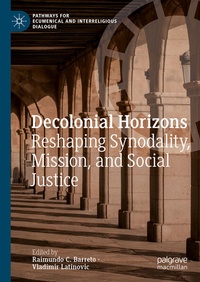
Decolonial Horizons
Beschreibung
This is the second of two volumes of essays from the Ecclesiological Investigations International Research Network's 14th International Conference focused on decolonizing churches and theology, addressing oppressions based on gender, racial, and ethnic identities; economic inequality; social vulnerabilities; climate change and global challenges such as pandemics, neoliberalism, and the role of information technology in modern society, all connected with the topic of decolonization.
The essays in this volume focus on decoloniality in empire, family, and mission, written from historical, dogmatic, social scientific, and liturgical perspectives.Weitere Details
Weitere Ausgaben
Personen
Raimundo C. Barreto is an associate professor of World Christianity at Princeton Theological Seminary, USA. His most recent publications include Protesting Poverty: Protestants, Social Ethics and the Poor in Brazil (2023) and the co-edited volume Alterity and the Evasion of Justice in World Christianity (2023).
Vladimir Latinovic is a lecturer in Dogmatics, Ecumenism, and Orthodox theology in the Catholic Theological Faculty at the University of Tübingen, Germany. His recent noteworthy contribution involves the publication of a three-volume monograph series titled Christology and Communion (Aschendorff, 2018-2022).
