

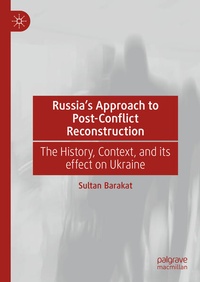
Russia's Approach to Post-Conflict Reconstruction
Beschreibung

Soon after Russia invaded Ukraine in February 2022, Vladimir Putin expressed Russia's commitment for the reconstruction of the war-devasted Eastern regions of Ukraine. It is surprising how little analytical and comparative literature exists about Russia's experience in post-conflict recovery despite its involvement in a large number of conflict areas, both as an intervenor and as a donor.
Against this backdrop, this book explores the role of Russia in the reconstruction of a range of countries and territories including Crimea, the North Caucasus and Chechnya as well as Syria. Based on the author's three decades-long experience in research and engagement in post-conflict reconstruction, the book offers a valuable overview of the main lessons learned that will be of relevance to Ukraine. The case selection is not intended to offer an exhaustive account of all the recent or contemporary conflicts in which Russia has involved itself. Rather the cases have been selected to illustrate a range of interventions across different periods and geographical areas, highlighting the spectrum of Russian reconstruction policies and strategies.Weitere Details
Weitere Ausgaben
Andere Ausgaben
Person
Sultan Barakat is Senior Professor in Public Policy at Qatar Foundation's Hamad Bin Khalifa University, and Honorary Professor at the University of York. His research focuses on the study of war-torn societies and their recovery. Professor Barakat founded the Center for Conflict and Humanitarian Studies at the Doha Institute for Graduate Studies and directed it between 2016 and 2022. Previously he served as Director of Research at the Brookings Institution's center in Doha. At the University of York, he founded and led the Post-war Reconstruction and Development Unit between 1993 and 2019.
