

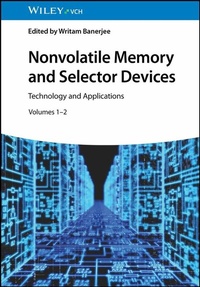
Nonvolatile Memory and Selector Devices
Technology and Applications
1. Auflage
Erschienen am 11. Mai 2026
880 Seiten
978-3-527-84740-2 (ISBN)
Beschreibung

The book reviews the current developments in nonvolatile memory technology that employs novel materials such as phase-change materials and two-dimensional materials. It puts a particular emphasis on the so-called selectors, intricate nanostructures that enable the functioning of the advanced memory devices in the first place. The book concludes with an overview of the application of non-volatile memory devices in computer science, hardware security, sensing and wearable electronics.
Weitere Details
Weitere Ausgaben
Andere Ausgaben
Buch
ca. 07/2026
1. Auflage
Wiley-VCH
319,00 €
Noch nicht erschienen
Person
Writam Banerjee is working as the Principal Engineer of technology development for emerging nonvolatile memories (NVM) at GlobalFoundries Dresden, Germany. Having obtained his academic degrees in physics and semiconductor devices, he spent almost 15 years working in academic positions for emerging NVM devices before joining his current role at GlobalFoundries. Dr. Banerjee has authored over 100 scientific publications and has received several awards in his career.
Inhalt
PART I: INTRODUCTION TO NONVOLATILE MEMORY
Introduction
3-D NAND Flash memories: technological evolution and prospective applications
Reliability Challenges of NAND Flash Memory in Harsh Environments
Two-Dimensional Materials for Future Transistors
PART II: NONVOLATILE MEMORY BASED ON VARIOUS MECHANISMS
Phase-Change Memory
Magnetic Random Access Memory: Past, Present and Future
HfO2 in Ferroelectric Devices key physics and critical challenges
Hafnium Oxide-Based Ferroelectric Memories: Applications and Future Prospect
Programmable Read-Only Memory (PROM)
NRAM: a disruptive carbon-nanotube nonvolatile resistance-change memory
Photonic Nonvolatile Memory
PART III: REDOX-BASED EMERGING NONVOLATILE MEMORY DEVICES
Conductive Bridge Random Access Memory (CBRAM) Devices - Materials, Filament Scaling, and Performance
OxRAM
Modeling and HRRAM
Two-dimensional (2D) Materials for Scalable Resistive Switching Devices
Reliability and Variability Analysis of Resistive Switching Memory Devices
Productization of ReRAM, from concept to market
PART IV: SELECTOR DEVICES, AND CHARACTERIZATION TECHNIQUES
Electrical characterization, modeling, and simulation of HfO2-based CRS devices
Switching Dynamics of Ag- and Cu-based Diffusive Memristors
Amorphous chalcogenide-based threshold switches for selector and memory applications
Strategies for the nanoscale characterization of volatile and nonvolatile filaments
PART V: APPLICATIONS OF EMERGING NONVOLATILE MEMORY DEVICES
Emerging Devices for Neuromorphic Sensing and Computing
Nonvolatile Resistive Memory Technology for Deep Neural Network Hardware Applications
Accelerating Algorithms using Emerging Nonvolatile Memory Subsystems for Edge Computing
Hardware Security using Emerging Nonvolatile Memories
Evolution of Optoelectronics with Memristors: From Advanced Photodetection to Eye-Like Processing and Beyond
Adapting Emerging NonVolatile Memristor Technology for RF Applications
Introduction
3-D NAND Flash memories: technological evolution and prospective applications
Reliability Challenges of NAND Flash Memory in Harsh Environments
Two-Dimensional Materials for Future Transistors
PART II: NONVOLATILE MEMORY BASED ON VARIOUS MECHANISMS
Phase-Change Memory
Magnetic Random Access Memory: Past, Present and Future
HfO2 in Ferroelectric Devices key physics and critical challenges
Hafnium Oxide-Based Ferroelectric Memories: Applications and Future Prospect
Programmable Read-Only Memory (PROM)
NRAM: a disruptive carbon-nanotube nonvolatile resistance-change memory
Photonic Nonvolatile Memory
PART III: REDOX-BASED EMERGING NONVOLATILE MEMORY DEVICES
Conductive Bridge Random Access Memory (CBRAM) Devices - Materials, Filament Scaling, and Performance
OxRAM
Modeling and HRRAM
Two-dimensional (2D) Materials for Scalable Resistive Switching Devices
Reliability and Variability Analysis of Resistive Switching Memory Devices
Productization of ReRAM, from concept to market
PART IV: SELECTOR DEVICES, AND CHARACTERIZATION TECHNIQUES
Electrical characterization, modeling, and simulation of HfO2-based CRS devices
Switching Dynamics of Ag- and Cu-based Diffusive Memristors
Amorphous chalcogenide-based threshold switches for selector and memory applications
Strategies for the nanoscale characterization of volatile and nonvolatile filaments
PART V: APPLICATIONS OF EMERGING NONVOLATILE MEMORY DEVICES
Emerging Devices for Neuromorphic Sensing and Computing
Nonvolatile Resistive Memory Technology for Deep Neural Network Hardware Applications
Accelerating Algorithms using Emerging Nonvolatile Memory Subsystems for Edge Computing
Hardware Security using Emerging Nonvolatile Memories
Evolution of Optoelectronics with Memristors: From Advanced Photodetection to Eye-Like Processing and Beyond
Adapting Emerging NonVolatile Memristor Technology for RF Applications
