

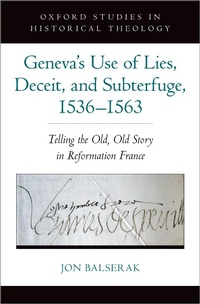
Geneva's Use of Lies, Deceit, and Subterfuge, 1536-1563
Telling the Old, Old Story in Reformation France
Erschienen am 3. September 2024
320 Seiten
978-0-19-767232-7 (ISBN)
Beschreibung
Geneva was hated and loved in sixteenth-century France. Representing those who hated them were the French Catholic government, who tried desperately to eradicate Genevan Calvinism from its borders--for good reason, as it was growing significantly within France between 1540 and 1563. This book presents a new reading of the battle that raged between the Genevan ministers and the French government during this period. It argues that Calvin, after fleeing France in 1534, began during his wanderings to devise plans to establish Christ's kingdom in his homeland, rescuing it from the "idolatrous" Catholicism imposed on the French people by their monarchs. It shows that Calvin's plans entailed the systematic use of lying and deception which were necessary in order to evade detection from the French authorities. These mendacious means were employed by the Genevans to hide their support of the French Reformed congregations, to conceal political maneuvering among the French nobility who could open France to reform, and to cloak their assisting of the Huguenots during the first French civil war.
Jon Balserak sets out the character of Calvin's plans and argues that even the formation of the Genevan company of pastors and the Bourse française were, in part, designed to assist Calvin with his proselytizing goals. The last third of this volume examines the ways in which Calvin adapted Geneva's missionary efforts to deal with three unexpected circumstances that arose between 1559 and 1563: the rise to the throne of Francis II, the assuming of the regency government by Catherine de Medici, and the beginning of war. Though they continued their clandestine operations in support of the Reformed faith in France, these challenges called forth from the Genevans' new efforts, which Balserak analyzes. Calvin's call to the Huguenots to cease fighting and humble themselves before God following Louis of Condé's disastrous signing of the 1563 Peace of Amboise brilliantly illustrates the complex godliness that characterized this entire operation.
Weitere Details
Weitere Ausgaben
Person
Jon Balserak is a Senior Lecturer in the Department of Religion and Theology at the University of Bristol. He earned his PhD at the University of Edinburgh in 2002 and his research focuses on Christian history and thought in the Renaissance and Early Modern periods, with an emphasis on the Reformations in France and Geneva, John Calvin, Theodore Beza, dissimulation and lying, divine accommodation, the history of prophecy, and the interpretation of the Bible. His prior publications include Calvinism: A Very Short Introduction (2017) and John Calvin as Sixteenth-Century Prophet (2014).
Inhalt
Abbreviations
Preface
I. Introduction
1. What this Study Argues
2. Review of Scholarship
3. Lies, Self-Presentation, and Early Modern Culture
II. Devising and Implementing Calvin's Plans, 1536-1560
4. Why did Calvin Write his Prefatory Letter to King Francis I?
5. Deception and Clandestine Ministry
III. Negotiating Three Challenges, 1559-1563
6. King Francis II's Reign (and Youth); Political Plotting up through 1560
7. Catherine's Policy of Toleration; Growing the Church and Fighting the Devil
8. The Advent of War; Establishing Christ's Kingdom in France in Wartime
Conclusion
Bibliography
Index
