

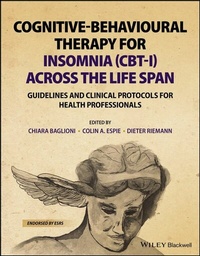
Cognitive-Behavioural Therapy for Insomnia (CBT-I) Across the Life Span
Beschreibung

A comprehensive presentation of the use of CBT in patients experiencing insomnia
In Cognitive-Behavioural Therapy for Insomnia (CBT-I) Across the Life Span: Guidelines and Clinical Protocols for Health Professionals, a team of distinguished medical researchers delivers a comprehensive exploration of various treatment protocols used by health professionals treating patients with insomnia from several different populations. The included treatment protocols are written by members of the European Academy for Cognitive-Behaviour Treatment for Insomnia and reflect the most current practice and theoretical models.
The editors have included contributions from leading scholars throughout Europe, as well as up-and-coming researchers with new and exciting data and conclusions to share with the community of health practitioners treating patients experiencing insomnia. In the book, readers will find discussions of the presentation of insomnia in different professional populations - including healthcare workers and shift workers - as well as the presence of common comorbidities. They'll also discover:
* A thorough introduction to the disorder of insomnia, as well as the use of cognitive-behavioural therapy in the treatment of insomnia patients
* Comprehensive explorations of the influence of the lifespan and professional factors on the presentation and impact of insomnia on paediatric and adult patients
* In-depth discussions of frequently occurring comorbidities, including affective disorders, mental disorders, somatic disorders and chronic pain
* Fulsome treatments of the emotional processes associated with insomnia, including acceptance and commitment therapy and mindfulness training
Perfect for psychologists, psychiatrists, social workers and other clinicians engaged in the treatment of insomnia, Cognitive-Behavioural Therapy for Insomnia (CBT-I) Across the Life Span: Guidelines and Clinical Protocols for Health Professionals will also earn a place in the libraries of medical researchers with a professional interest in CBT, insomnia and other sleep disorders.
Weitere Details
Weitere Ausgaben
Andere Ausgaben
Personen
Chiara Baglioni, is a Professor in the Department of Human Sciences at the University of Rome G. Marconi in Italy and the Department of Psychiatry and Psychotherapy, Medical Center at the University of Freiburg in Germany.
Colin A. Espie, PhD, DSc(Med) is Professor of Sleep Medicine in the Sir Jules Thorn Sleep & Circadian Neuroscience Institute at the Nuffield Department of Clinical Neurosciences, University of Oxford, UK.
Dieter Riemann, MD, is a Professor in the Department of Psychiatry and Psychotherapy, Medical Center at the Faculty of Medicine, University of Freiburg in Germany.
Inhalt
INTRODUCTION
INTRODUCTION TO INSOMNIA DISORDER
SECTION I: COGNITIVE-BEHAVIOUR THERAPY FOR INSOMNIA (CBT-I). AN INTRODUCTION FOR HEALTH PROFESSIONALS:
1) THE STANDARD CBT-I PROTOCOL 2) EFFICACY OF CBT-I AND ITS SINGLE COMPONENTS 3) PSYCHOPHYSIOLOGICAL MECHANISMS OF CBT-I 4) CBT-I INSTRUMENTS 5) CBT-I AND PHARMACOLOGICAL TREATMENT
SECTION II: A FOCUS ON THE AGE/SEX SPAN
6) PROTOCOLS FOR SLEEP INITIATING AND MAINTAINING PROBLEMS IN PEDIATRIC POPULATIONS 7) CBT-I PROTOCOLS FOR ELDERLY 8) CBT-I PROTOCOLS FOR WOMEN'S AGE SPAN 9) CBT-I PROTOCOLS FOR SHIFT WORKERS
SECTION III: A FOCUS ON COMORBIDITIES
10) CBT-I PROTOCOLS FOR INSOMNIA COMORBID WITH AFFECTIVE OR OTHER MENTAL DISORDERS 11) CBT-I PROTOCOLS FOR INSOMNIA COMORBID WITH SOMATIC DISORDERS 12) CBT-I PROTOCOLS FOR INSOMNIA COMORBID WITH SLEEP DISORDERS
SECTION IV: A FOCUS ON EMOTIONAL PROCESSES AND NEW AVENUES
13) ACCEPTANCE COMMITMENT THERAPY (ACT) FOR INSOMNIA: Theoretical issues and principles. Interventional strategies and instruments 14) TRAINING FOR EMOTION REGULATION AND MINDFULNESS FOR INSOMNIA: Theoretical issues and principles. Interventional strategies and instruments 15) NEW BEHAVIOURAL INTERVENTIONS: e.g. INTENSIVE SLEEP RE-TRAINING: Theoretical issues and principles. Interventional strategies and instruments.
SECTION V: DEVELOPING AND DELIVERING SERVICES FOR PEOPLE WITH INSOMNIA: A FOCUS ON THE STEPPED CARE MODEL
16) A CBT-I PROTOCOL FOR GPs 17) CBT-I PROTCOL FOR ACUTE INSOMNIA 18) ISSUES RELATED TO GROUP CBT-I 19) DIGITAL CBT-I
SECTION VI: TRAINING IN CBT-I
20) PRECONDITIONS FOR HEALTH PROFESSIONALS TO CONDUCT AND TEACH CBT-I 21) LEVELS OF EXPERTISE 22) TRAINING PRINCIPLES AND CHARACTERISTICS
1
Introduction to Insomnia Disorder
Dieter Riemann, Kai Spiegelhalder, Colin A. Espie, Dimitri Gavriloff, Lukas Frase and Chiara Baglioni
Key points
- Insomnia, encompassing day- and night-time symptoms, is a frequent health complaint with manifold negative consequences for somatic and mental health and for quality of life.
- The evaluation of insomnia includes a clinical interview, a physical and psychiatric examination, sleep diaries and questionnaires. Technical procedures like actigraphy or polysomnography may be used in certain circumstances and differential-diagnosis needs to evaluate medical and psychiatric co-morbidities, as well as other sleep disorders.
- Etiological and pathophysiological insomnia concepts range from genetic and neurobiological to cognitive-behavioural models.
- Cognitive-behavioural therapy for insomnia (CBT-I) is presently considered world-wide as first line treatment.
Learning objectives
- To understand the importance of insomnia for somatic and mental health and quality of life.
- To be able to conduct an appropriate clinical evaluation including differential-diagnosis of patients with insomnia.
- To understand the present illness concepts of insomnia ranging from neurobiology to cognitive-behavioural concepts.
- To be familiar with the ingredients of CBT-I and to understand why CBT-I is presently the first line of treatment for insomnia.
Abstract
The clinical picture of insomnia encompasses day- and night-time symptoms. Typical night-time complaints are prolonged sleep latency, increased frequency of awakenings, difficulties getting back to sleep and early morning awakening. Day-time sequelae encompass fatigue, tiredness, reduced attention, impaired cognition, irritability, nervousness, anxiety and mood swings, including dysphoric or even depressed mood. DSM-5 (Diagnostic and Statistical Manual of the American Psychiatric Association, 5th edition), ICSD-3 (International Classification of Sleep Disorders, 3rd edition) and ICD-11 (International Classification of Diseases, 11th edition) summarise this condition as Insomnia Disorder (ID). Epidemiological studies demonstrated that ID is an important risk factor for somatic and mental health. The prevalence of ID is higher in women than in men and increases with age. Apart from a clinical interview, questionnaires should be used for the evaluation of insomnia. The core instrument is a standardised 7-14 day sleep diary that includes questions on sleep-related and daytime symptoms. Actigraphy and polysomnography can be considered for a subgroup of patients presenting with therapy-refractory insomnia or suspected occult sleep disorders. A thorough medical and psychiatric evaluation is advisable to evaluate clinically relevant comorbidities. Present illness concepts range from genetic and neurobiological to cognitive-behavioral models, forming the basis for Cognitive Behavioural Therapy for insomnia (CBT-I) encompassing sleep hygiene and education, relaxation methods, stimulus control, sleep restriction and cognitive techniques to reduce nocturnal ruminations. Recently published guidelines agree that CBT-I should be the first line treatment for insomnia.
Keywords: insomnia; night-time complaints; day-time symptoms; sleep diary; insomnia models; CBT-I; guidelines;
Introduction
This chapter serves as an introduction to the topic of insomnia and to prepare the ground for the reader to understand why Cognitive Behavioural Therapy for Insomnia (CBT-I) is presently considered to be the gold standard and first line treatment for this disorder. As the main focus of this book is on CBT-I, other aspects concerning insomnia, such as diagnosis and differential-diagnosis, epidemiology and costs/ risks of the disorder, as well as pathophysiological and aetiological concepts, are summarised here in order to provide a concise overview. Readers who want to broaden their horizon beyond this are referred to our previous work (Baglioni et al., 2020; Espie, 2002, 2007, 2009, 2022; Espie, Broomfield, MacMahon, Macphee & Taylor, 2006; Harris et al., 2015; MacMahon, Broomfield, & Espie, 2006; Morin et al., 2015; Perlis, Ellis, Spiegelhalder & Riemann, 2022; Riemann et al., 2010, 2011, 2015, 2017a, 2017b; Riemann, Krone, Wulff & Nissen, 2020;). These texts go into further detail concerning the above-mentioned aspects of insomnia (please note that there is some unavoidable overlap between these published works and the present book chapter).
Insomnia definition/diagnostic criteria
In the last five decades several diagnostic systems have been developed that include chapters on insomnia. Whereas the DSM (Diagnostic and Statistical Manual of the American Psychiatric Association) in its previous versions, DSM-III-R or DSM-IV, suggested a distinction between primary and secondary insomnias, DSM-5 (American Psychiatric Association, 2013) established a change of paradigm by introducing 'insomnia disorder' (ID) as an overarching diagnostic category, removing distinctions in primary/secondary forms of insomnia. ICSD (International Classification of Sleep Disorders) in its third version followed this approach; the diagnostic criteria for chronic insomnia disorder according to ICSD-3 (American Association of Sleep Medicine, 2014) are shown in Table 1.1.
ICD-10, in contrast, still distinguishes between organic and non-organic sleep disorders, but ICD-11 will follow the path taken by DSM-5 and ICSD-3. It is noteworthy, when considering the criteria for insomnia disorder (ID), that both night-time and day-time symptoms are listed. Furthermore, concerning night-time symptoms, non-restorative sleep has been dropped from the catalogue of criteria due to its lack of specificity for insomnia.
Giving up the distinction between primary and secondary insomnia was a tremendous step forward in acknowledging that insomnia in many cases is not just a symptom of any other somatic or mental disorder, but constitutes a distinct disease entity in its own right, deserving specific consideration in clinical practice. Formerly held widespread beliefs that treating the 'underlying' disorder would eliminate the insomnia 'symptoms' had turned out not to be valid and an increasing literature (see below) indicates that by detecting and properly treating insomnia disorder with CBT-I, a significant positive effect can be exerted on somatic/mental co-morbidities and quality of life with the additional benefit of having a preventive effect on future somatic/mental disorders as well.
Diagnostic and differential diagnostic procedure for insomnia
Clinical picture and complaints
Insomnia is seen primarily as a sleep disorder. Parameters of sleep continuity, such as sleep onset latency (SOL), wake-time after sleep onset (WASO), number of awakenings (NOA), early morning awakening (EMA), sleep efficiency (SE) and total sleep time (TST), are usually altered in insomnia and are used to describe the sleep of afflicted patients. Most insomnia patients will display both symptoms of difficulties initiating and maintaining sleep. However, subgroups of patients will be characterised by distinct complaints of only prolonged sleep latency or only trouble in maintaining sleep, which may inform the therapeutic process. Clinicians should probe differentially for information about sleep on weekends compared to weekdays and daytime sleep episodes (i.e., naps). Overall sleep quality may be altered and be described as poor. A general subjective judgement of sleep parameters during a clinical interview may yield rather inaccurate or distorted values. Thus, this information should be complemented by data from a sleep diary (see below), which is typically filled out over a period of 2 weeks on a day-to-day basis. Patients suffering from insomnia may complain of symptoms relating to a nocturnal hyperactivity of the autonomous nervous system, presenting as increased heart rate, palpitations, sweating or general restlessness, which have been interpreted as reflecting a chronic psychophysiological hyperarousal (Perlis, Giles, Mendelson, Bootzin & Wyatt, 1997; Riemann et al., 2010, 2015; Kyle & Espie, 2014; Morin et al., 2015). It is also important to ask about night-time behaviours when awake (clock watching, going to the toilet, etc.). Beyond, it is essential to evaluate cognitive-emotional aspects of insomnia; e.g., what thoughts, emotions, ruminations and worries are experienced when the patient is unable to sleep. These complaints are related to cognitive aspects (for cognitive models of insomnia see Harvey, 2002; Espie, 2002), including worries, ruminations or specific dysfunctional sleep-related thoughts. Many of these cognitions will be accompanied by unpleasant emotions like anxiety, anger, frustration or dysphoria. It is important to evaluate how intense these feelings are during the night, as insomnia is linked with emotion regulation (Baglioni, Spiegelhalder, Lombardo & Riemann, 2010) and constitutes an independent risk...
