

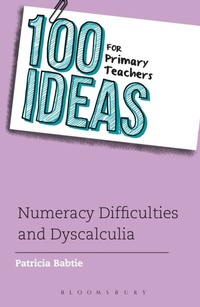
100 Ideas for Primary Teachers: Numeracy Difficulties and Dyscalculia
1. Auflage
Erschienen am 20. April 2017
192 Seiten
978-1-4411-9248-6 (ISBN)
Beschreibung

100 Ideas for Primary Teachers: Numeracy Difficulties and Dyscalculia provides specially-designed games and activities to help build firm foundations in basic number concepts. All the ideas have been tried-and-tested
in specialist and mainstream schools and are designed to encourage children to talk about numbers in a natural way using everyday contexts.
The book begins with a focus on counting skills, before moving on to place value structure, multiplication and division. As well as teaching key facts, the ideas in this book will develop pupils' understanding so that they become flexible thinkers who can use numbers to solve a variety of mathematical problems. The ideas require minimum preparation and resources, and are perfect for use in mainstream and specialist classrooms,
individual tuition sessions or as homework assignments.
in specialist and mainstream schools and are designed to encourage children to talk about numbers in a natural way using everyday contexts.
The book begins with a focus on counting skills, before moving on to place value structure, multiplication and division. As well as teaching key facts, the ideas in this book will develop pupils' understanding so that they become flexible thinkers who can use numbers to solve a variety of mathematical problems. The ideas require minimum preparation and resources, and are perfect for use in mainstream and specialist classrooms,
individual tuition sessions or as homework assignments.
Rezensionen / Stimmen
100 ideas for Primary Teachers: Numeracy Difficulties and Dyscalculia is rather more than its title implies .The activities can stand alone if the practice of a concept is needed but it is also a structured, cumulative guide to teaching children the basic underlying skills needed to develop a maths sense and ability, and enable them to reason. The activities are concrete and multisensory, particularly the early section on developing visual perception and directional language. It is an invaluable resource to use alongside maths teaching. This is an excellent book for all teachers of mathematics, from the earliest stages up until the point where children learn to use formal methods of calculations. One of the great things about this book is the way that it not only explains why some children may be having difficulties in maths, but takes you through the developmental steps they need to go through in order to achieve success in maths. This book is set out clearly and sequentially so that, as well as demonstrating the importance of foundation skills in maths, when you know what difficulties a child is experiencing you can go straight to the part of the book that will give you ideas in how to address them.This book isn't just a book for teachers of children who are struggling with maths, this book is for everyone. All the games and activities have been tried-and-tested in specialist and mainstream schools and the excellent approach puts numbers into everyday contexts, removing the fear. Simple, straightforward and effective * Parents in Touch * Let's face it, time is a premium for teachers and other education professionals. So having a book that so easy to browse and discover tried and tested suggestions - is incredible value.
Weitere Details
Reihe
Auflage
1. Auflage
Sprache
Englisch
Verlagsort
London
Großbritannien
Verlagsgruppe
Bloomsbury Publishing PLC (Digital)
Zielgruppe
Für Beruf und Forschung
Illustrationen
50
ISBN-13
978-1-4411-9248-6 (9781441192486)
Copyright in bibliographic data and cover images is held by Nielsen Book Services Limited or by the publishers or by their respective licensors: all rights reserved.
Schweitzer Klassifikation
Weitere Ausgaben
Andere Ausgaben
Buch
04/2017
Continuum Publishing Corporation
19,00 €
Versand in 15-20 Tagen
Person
Patricia Babtie is an SEN teacher, lecturer and author who specialises in dyscalculia and numeracy difficulties. She has worked at Emerson House, a specialist centre in London, and in state and independent schools.
Inhalt
- Cover
- Half-title
- Title
- Copyright
- Contents
- Acknowledgements
- Introduction
- How to use this book
- Part 1: Numeracy basics
- 1 Daily number
- 2 What is a number?
- 3 Numerosity curiosity
- 4 Directional language
- 5 Elbow tickle
- 6 Arm swing
- 7 Tick tock
- 8 Pattern practice
- 9 Barrier games
- 10 Learning to look
- 11 Puzzle time
- 12 Classroom design
- 13 Number toolkit
- Part 2: Numbers to 10
- 14 How many are there?
- 15 Dice patterns
- 16 Number components
- 17 Three in a row
- 18 Dot patterns: numbers to 10
- 19 Visualising dot patterns
- 20 The memory game
- 21 Shut the box
- 22 Writing numbers
- 23 The estimation game to 10
- 24 Tracking
- 25 Calculation: doubles and near doubles
- 26 Get them questioning
- Part 3: Bonds of 10
- 27 Caterpillar tracks
- 28 Fun beads
- 29 Bonds of 10 triads
- 30 Testing positive
- 31 Clear the deck
- 32 Ten in a bed
- 33 The memory game: bonds of 10
- 34 Subtraction tally game
- 35 A message to you
- 36 A minute or few
- 37 All the number bonds
- 38 Slow snap
- 39 Question the question
- Part 4: Cuisenaire rods
- 40 Curious Cuisenaire
- 41 Pattern analysis
- 42 The key to patterns
- 43 Secret sequences
- 44 Refl ect on symmetry
- 45 The staircase game
- 46 Pyramids and stairs
- 47 Double plus one
- 48 Number sandwiches
- 49 Inside 10
- 50 Charting chatter
- Part 5: Numbers to 20
- 51 Taming the teens
- 52 The 20 bead string
- 53 First past the post
- 54 10 plus
- 55 Up the stairs
- 56 Bridging through 10
- 57 Counting back
- 58 Backtrack
- 59 Tracks and lines
- 60 The grid game
- 61 Addition tally game
- 62 Odd and even search
- Part 6: Numbers to 100
- 63 Counting to 100
- 64 The 'teen' and 'ty' tangle
- 65 The 100 counter dash
- 66 Locate my number
- 67 Digit swap
- 68 Card wars
- 69 Numbers on number lines
- 70 Zooming in
- 71 Bring it together
- 72 Introducing the 100 square
- 73 Demon dice
- 74 The estimation game to 100
- Part 7: Multiplication and division
- 75 Times tables strategy
- 76 Five times a number
- 77 Step into repeated addition
- 78 Repeated reasoning
- 79 Find the rule
- 80 Memorable times
- 81 The array model
- 82 The area model
- 83 Boxing clever
- 84 Fair shares
- 85 Groupings
- 86 Hailstone numbers
- Part 8: Place value
- 87 It's all in the name
- 88 A sense of size
- 89 Three-digit swap
- 90 Zero holds the place
- 91 Zero wars
- 92 Rolling towards 999
- 93 Clapping cue game
- 94 The rule of HTO
- 95 Getting formal: addition
- 96 Getting formal: subtraction
- 97 The stubborn number
- 98 The constant number
- 99 Getting formal: multiplication
- 100 Multiplication puzzles
