

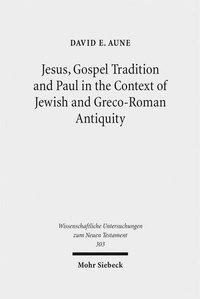
Jesus, Gospel Tradition and Paul in the Context of Jewish and Greco-Roman Antiquity
Collected Essays II
1. Auflage
Erschienen am 15. März 2013
614 Seiten
978-3-16-152353-3 (ISBN)
Beschreibung

Dieser Band enthält 22 Aufsätze von David E. Aune, deren thematischer Schwerpunkt auf der Auslegung der Evangelien, Evangelientradition und der Paulusbriefe liegt. In den meisten der Aufsätze konzentriert sich der Autor auf die Exegese besonders problematischer Passagen in den Evangelien, der Apostelgeschichte und der Paulusbriefe. In einigen Texten befasst er sich mit der Anthropologie des Paulus, in anderen untersucht er das Phänomen der mündlichen Überlieferung in der antiken Welt und in den Evangelien oder behandelt das Problem der Gattung der Evangelien (Markus und Matthäus) und der Römerbriefe. Er überprüft die neuesten Forschungsansätze zur Rechtfertigung durch den Glauben bei Paulus und untersucht die Bedeutung von
euaggelion
in den Überschriften der Evangelien. Außerdem beschäftigt sich David E. Aune auch mit historischen und kontextuellen Problemen wie Jesu Beziehung zum Kynismus, die ihm im Palästina des ersten Jahrhunderts nachgesagt wurde, der Jesustradition im Thomasevangelium und den Dualismus im Johannesevangelium.
Weitere Details
Weitere Ausgaben
Andere Ausgaben
David E. Aune
Jesus, Gospel Tradition and Paul in the Context of Jewish and Greco-Roman Antiquity
Collected Essays II
Buch
03/2013
1. Auflage
Mohr Siebeck
194,00 €
Artikel ist vergriffen; siehe andere Ausgabe
Person
Inhalt
- Cover
- Preface
- Table of Contents
- I. Jesus of Nazareth and Gospel Traditions
- 1. The Meaning of ??a??????? in the Inscriptiones of the Canonical Gospels
- Introduction
- ??a??????? in Early Christian Literature
- A Lexical Overview
- ??a??????? in Paul
- ??a??????? in Mark
- ??a??????? in Second Century Christianity
- The Gospel Subscriptiones and Inscriptiones
- The Development of the Fourfold Gospel
- Conclusions
- 2. Genre Theory and the Genre-Function of Mark and Matthew
- Introduction
- The Beginnings of Genre Criticism in Biblical Studies
- Relevant Aspects of Modern Genre Theory for the Toolkits of New Testament Scholars
- Paratextual Features of the Gospels
- Introduction
- Subscriptiones and Superscriptiones
- The Title of Mark
- The Genre-Function of Mark
- Genre-Salient Features
- The Macro-Genre of Mark
- Mark as a Parody of Biography
- The Genre-Function of Matthew
- Matthew's Transformation of Mark
- The Title of Matthew
- Matthew's Deconstruction of Q
- Concluding Summary
- 3. The Forgiveness Petition in the Lord's Prayer: First Century Literary, Liturgical and Cultural Contexts
- Introduction
- The Forgiveness Petition in the Context of the Lord's Prayer
- Meanings and Functions of the Forgiveness Petition
- The Meaning of the Forgiveness Petition in Matthew
- The Meaning of the Forgiveness Petition in Luke
- The Meaning of the Forgiveness Petition in the Didache
- The Forgiveness Maxim
- Reading the Forgiveness Petition in a Greek Cultural Context
- Concluding Summary
- 4. Apocalyptic and the Lord's Prayer
- Introduction
- Constructing a Profile of Apocalyptic
- Reading the Matthaean Lord's Prayer in the Context of Apocalyptic Eschatology
- Our Father in heaven, hallowed be your name
- Your kingdom come
- Your will be done, on earth as it is in heaven
- Give us this day our daily [epiousion] bread
- And forgive us our debts, as we also have forgiven our debtors
- And do not bring us to the time of trial [peirasmon], but rescue us from the evil one
- 5. "The Spirit is Willing, but the Flesh is Weak" (Mark 14:38b and Matthew 26:41b)
- Introduction
- The Form and Function of the Dominical Proverb
- Spirit and Flesh in the Hebrew Bible and Judaism
- Analogous Hellenistic Anthropological Dualities
- ??e?µa and S??? in Pauline Anthropology
- Early Christian Appropriations of Mark 14:38 and Matt 26:41
- Concluding Summary
- 6. Luke 1:1-4: Historical or Scientific Prooimion?
- 1.
- 2.
- 3.
- 4.
- 7. Luke 20:34-36: A "Gnosticized" Logion of Jesus?
- 1.
- 2.
- 3.
- 4.
- 5.
- 8. Dualism in the Fourth Gospel and the Dead Sea Scrolls: A Reassessment of the Problem
- Introduction
- Methodological Considerations
- The Problem of Dualism
- Johannine Dualism
- Dualism in Qumran Literature
- The Spirit-Paraclete and the Spirit of Truth
- Comparing Dualisms in John and Qumran
- Concluding Reflections
- 9. Christian Beginnings and Cognitive Dissonance Theory
- Introduction
- Cognitive Dissonance Theory
- Testing the "Failed Prophecy" Aspect of Cognitive Dissonance Theory
- Failed prophecy in the Lubavitcher Chabad
- Christian Beginnings in the Light of Dissonance Theory and Rumor Theory
- The Jesus Movement as a Millenarian Movement
- Jesus in the Disciples' Belief System
- The Mutual Social Reinforcement of Jesus' Disciples
- Rumor Theory and the Empty Tomb
- Wider Social Reinforcement through Mass Proselytism
- Conclusions
- 10. Assessing the Historical Value of the Apocryphal Jesus Traditions: A Critique of Conflicting Methodologies
- Introduction
- Assessing the Methodology of John P. Meier
- The Methodology of John Dominic Crossan
- Methodological Reflections
- 11. Jesus and Cynics in First-Century Palestine: Some Critical Considerations
- Introduction
- Relevant Aspects of Cynicism
- Problematic Features of the Hypothesis
- Conclusions
- 12. Prolegomena to the Study of Oral Tradition in the Hellenistic World
- Introduction
- Defining Oral Tradition
- Memorized Speech
- Accounts of Events
- Epic
- Tales, Proverbs, and Sayings
- The Oral-formulaic Theory
- Travel Guides and Local Oral Traditions
- The Fountain of the Sun
- First and Second Century Travel Guides
- Pausanias, Periegetes
- Oral Tradition and Hellenistic Historiography
- Oral Traditions and Religious Cults
- Memory and Rhetoric
- Oral Tradition in Philosophical Schools
- The ß??? of the Hero
- Chreiai or Anecdotes
- Stories
- Conclusions
- 13. Oral Tradition and the Aphorisms of Jesus
- Introduction
- The Function of Aphorisms
- Identifying Aphorisms
- Methodological Considerations
- Morphology of the Aphorism
- Types and Forms of Aphorisms
- Makarisms or Beatitudes
- "Whoever," or "the one who" sayings
- Conditional sayings
- Aphorisms in synonymous couplets
- Antithetical and paradoxical aphorisms
- The wisdom admonition
- Aphoristic sentences
- Statements of reciprocity
- Compositional Tendencies in Aphorisms
- Conclusions
- Appendix: Inventory Of Aphorisms Of Jesus
- 14. Jesus Tradition and the Pauline Letters
- Introduction
- The Project of Birger Gerhardsson
- The Problem of Paul and Oral Tradition
- Birger Gerhardsson
- Werner Kelber
- Traugott Holtz
- John D. Harvey
- Paul and the Jesus Tradition
- Paul's Letters as "aides-mémoire" and "lieux de mémoire"
- II. Pauline Studies
- 15. Two Pauline Models of the Person
- Introduction
- The Problem of Pauline Anthropology
- Ancient Monistic and Dualistic Views of Human Nature
- Pauline Anthropological Dualism
- The Irrational Behavior Model in Hellenistic Psychology
- The Irrational Behavior Model in Paul
- Human Nature and the Macrocosm-Microcosm Analogy in Antiquity
- Hellenistic Macrocosm-Microcosm Homologies
- The Spatial Macrocosm-Microcosm Homology
- The Temporal Macrocosm-Microcosm Analogy
- The Systemic Macrocosm-Microcosm Analogy
- Paul's Apocalyptic Macrocosm-Microcosm Homology
- Theological Reflections
- 16. Anthropological Duality in the Eschatology of 2 Corinthians 4:16-5:10
- 1. Introduction
- 2. Apocalyptic and Hellenistic Eschatologies
- 3. Approaches to 2 Corinthians 4:16-5:10
- 4. Interpreting Selected Themes in 2 Corinthians 4:16-5:10
- The Outer Person and the Inner Person (4:16)
- From an Earthly House to a Heavenly House (5:1)
- Though Unclothed, We Shall Not Be Found Naked (5:3)
- At Home or Away from Home (5:6-10)
- 5. Concluding Arguments
- 17. Human Nature and Ethics in Hellenistic Philosophical Traditions and Paul: Some Issues and Problems
- Introduction
- Complexities in Hellenistic Views of Human Nature
- Pauline Perspectives on Human Nature
- Paul and the Hellenistic Philosophical "Practice of Death"
- 18. The Judgment Seat of Christ (2 Corinthians 5:10)
- The Problem
- The Immediate Context: 2 Corinthians 4:16-5:10
- The Thematic Context: Judgment in Paul
- ?? ß?µa t?? ???st?? and / or t? ß?µa t?? ?e???
- Judgment Scenarios in Jewish Apocalyptic
- Conclusions
- 19. Paul, Ritual Purity and the Ritual Baths South of the Temple Mount (Acts 21:15-27)
- Introduction
- What Do We Know about the Nazirite Vow?
- The Biblical Evidence
- Post-Biblical Evidence
- Interpretations of Acts 21:15-27
- The View of Paul Billerbeck
- The Proposal of Ernst Haenchen
- The Proposals of Michael Bachmann and Friedrich Horn
- The Proposal of Volker Stolle
- Did Paul Contract Corpse Impurity by Traveling Abroad?
- Summary Observations
- Purification through Ritual Immersion in Miqwa?ôt
- The Meaning of ?????es?a? in Acts 21:24, 26
- 24:18
- The Relevance of Miqwa?ôt
- Why Did Paul Purify Himself?
- Reinterpreting Acts 21:15-28
- Appendix: Early Christian References to Miqwa?ôt
- 20. Romans as a Logos Protreptikos in the Context of Ancient Religious and Philosophical Propaganda
- Introduction
- ???t??pe?? and Cognates in Rhetoric and Philosophy
- Generic Features of the ????? p??t?ept????
- The History of the ????? p??t?ept????
- Judaism and Christianity as "Philosophies"
- The Problem of the Genre of Romans
- The Protreptic Character of Romans
- Conclusions
- Appendix: Seneca Ep. 90 and Rom 1:18-2:16
- 21. Recent Readings of Paul Relating to Justification by Faith
- Introduction
- The Hellenistic Paul or the Jewish Paul?
- Paul's Damascus Experience and Justification by Faith
- Conversion or Calling?
- Paul's "Conversion" and his Mission to the Gentiles
- Christological Implications: Recognizing Jesus as the Messiah
- Soteriological Implications: Recognizing the Limitations of the Law
- Origin of Paul's Theology?
- Particularism and Universalism in Pauline Thought
- The "New Perspective" on Paul
- The "New View" of Paul
- Justification by Faith
- Aspects of the Lutheran-Catholic Debate
- Justification and the New Perspective
- The Evangelical Debate on Imputation
- Justification and the Center of Pauline Thought
- The p?st?? [??s??] ???st?? Debate
- Conclusions
- 22. Galatians 3:28 and the Problem of Equality in the Church and Society
- Introduction
- Jesus of Nazareth and Human Rights
- Pauline Conceptions of Equality and Their Influence
- "There is neither Jew nor Greek"
- "There is neither slave nor free"
- "There is neither male nor female"
- Summary
- Indices Sources
- Old Testament
- New Testament
- Early Christian Literature
- Nag Hammadi Library
- Early Jewish Literature
- Dead Sea Scrolls
- Josephus
- Philo of Alexandria
- Greek and Latin Sources
- Papyri
- Inscriptions
- Index of Authors
- Index of Subjects
