

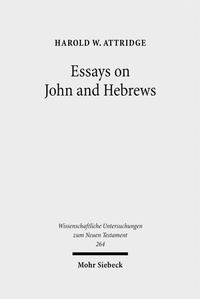
Essays on John and Hebrews
1. Auflage
Erschienen am 5. November 2010
443 Seiten
978-3-16-151553-8 (ISBN)
Beschreibung
Harold W. Attridge untersucht die literarischen und kulturellen Traditionen, die im Johannesevangelium und im Hebräerbrief wirksam sind, sowie die Rhetorik der beiden Schriften, die darauf zielt, den Glauben an Christus zu vertiefen, indem sie seinem Tod und seiner Erhöhung eine neue Bedeutung zuschreiben. Attridges Studien zu Johannes konzentrieren sich auf die literarische Kunstfertigkeit der letzten Fassung des Evangeliums, auf die spielerische Annäherung an literarische Genera, seine einnehmende Rhetorik und seine Freude Visualität. Er plaziert die literarische Analyse beider Werke innerhalb des religions- und kulturgeschichtlichen Kontexts des ersten Jahrhunderts unter Berücksichtigung der jüdischen und griechisch-römischen Welt. Einige Aufsätze, die das Phänomen im Zusammenhang mit dem Gnostizismus thematisieren, erweitern den religionsgeschichtlichen Horizont in das Leben der Frühkirche hinein und tragen zum Verständnis der Rezeption dieser zwei frühchristlichen Meisterwerke bei.
Weitere Details
Weitere Ausgaben
Person
Inhalt
- Cover
- Foreword
- Table of Contents
- Abbreviations
- A. Essays on John
- Introductory Issues
- 1. Johannine Christianity
- The literary evidence for Johannine Christianity
- Sources
- A possible history of Johannine Christianity
- Distinctive features of Johannine Christianity
- Christology
- Eschatology
- Ethics and religious practice
- Conclusion
- 2. The Restless Quest for the Beloved Disciple
- Conclusion: Techniques of Reader-Engagement
- Religio-historical Issues
- 3. The Gospel of John and the Dead Sea Scrolls
- 4. Philo and John: Two Riffs on One Logos
- Sequential roster of passages on the Logos in the Allegorical Commentary
- Conclusion
- A Literary Orientation to the Fourth Gospel
- 5. Genre Bending in the Fourth Gospel
- 6. The Cubist Principle in Johannine Imagery: John and the Reading of Images in Contemporary Platonism
- Examples of the phenomenon
- Conclusion
- Specific Analyses
- 7. Argumentation in John 5
- Literary Structure of John 5
- The Rhetoric of the Discourse on Work
- The Discourse on Witnesses
- Rhetorical Principles and Anti-Rhetoric
- 8. Thematic Development and Source Elaboration in John 7:1-36
- I. Thematic Development
- II. Source Elaboration
- 9. "Seeking" and "Asking" in Q, Thomas, and John
- I. A "Q" Saying
- II. Asking and Seeking in John
- III. Seeking, (Asking) and Knocking in Thomas
- IV. The Thomasine Reworking of John 7,34
- V. John and Thomas in Dialogue?
- 10. An "Emotional" Jesus and Stoic Tradition
- The Gospel of John and Ancient Philosophy
- The Emotions of Jesus
- The Stoics on Emotions
- How to Handle Emotions
- Positive "Emotion"
- Summary
- 11. "Don't Be Touching Me": Recent Feminist Scholarship on Mary Magdalene
- Traditional and Historical-Critical Exegesis
- Feminist Readings: The Apostle to the Apostles
- 'Don't Touch': A Hidden Moral
- 'Don't Touch': The Marginalization of Mary
- 'Don't Touch': Putting Uppity Women in their Place
- 'Don't Touch': A Warning for a Liminal Moment
- Concluding Reflection
- 12. From Discord Rises Meaning: Resurrection Motifs in the Fourth Gospel
- 1. The Tensive Elements in John's Gospel
- 2. The Principal Resurrection Texts in John
- Resurrection and the Son's Equality with the Father
- Resurrection and the Bread of Life
- Raising a Friend from the Dead
- Anointing for Resurrection
- Resolution Anticipated: The Farewell Discourses?
- The Resurrection Accounts
- 3. The Tension Resolved?
- History of Interpretation and Gnosticism
- 13. The Gospel of Truth as an Exoteric Text
- Preface
- I. Introduction
- II. The "Familiar" Features
- III. The "Unfamiliar" Features
- IV. Conclusion
- 14. Heracleon and John: Reassessment of an Early Christian Hermeneutical Debate
- 1. Origen's Commentary on John
- 2. Heracleon: Origen's Assessment
- 3. Heracleon: A New Assessment
- 4. Origen and Heracleon: Theological Comparison
- 5. Origen and Heracleon: Philosophical Comparison
- 6. Summary
- 15. Valentinian and Sethian Apocalyptic Traditions
- Recent Discussion
- Regional and Group Variation
- I. The Start of the Valentinian Tradition: Valentinus
- The Fragments of Valentinus
- II. Valentinians
- a. Apocalypses?
- b. "Apocalyptic" Eschatology
- III. Sethians
- a. Sethian Apocalypses
- b. Cosmic Eschatology
- c. Sethians and an Ongoing Quest for Vision
- IV. Continuity and Discontinuity
- A Parallel Phenomenon: The "Elchasaite Apocalypses" of the Cologne Mani Codex
- Sethian Ascent Apocalypses and Jewish Apocalyptic
- Conclusion
- Appendix I: "Apocalyptic" Eschatological Passages From Nag Hammadi
- 1. On the Origin of the World 2.5: 125.14-127.17
- 2. Concept of the Great Power 6.4: 43.26-47.32 (NHLE2 315-17)
- 3. The Paraphrase of Shem 7.1: 43.28-45.31 (NHLE2 359-60)
- Appendix II: Gnostic "Apocalypses"
- Appendix III: Elchasaite Apocalypses (from the Cologne Mani Codex)
- 1. Apocalypse of Adam
- 2. Apocalypse of Sethel
- 3. Apocalypse of Enosh
- 4. Apocalypse of Shem
- 5. Apocalypse of Enoch
- B. Essays on Hebrews
- 16. Liberating Death's Captives: Reconsideration of anEarly Christian Myth
- 17. "Let Us Strive to Enter That Rest": The Logic of Hebrews 4:1-11
- Conclusion
- 18. "Heard Because of His Reverence" (Heb 5:7)
- 19. The Uses of Antithesis in Hebrews 8-10
- 20. New Covenant Christology in an Early Christian Homily
- Hebrews 1:1-4
- 2:9-11
- Hebrews 4:1-3
- 9-13
- Hebrews 4:14-16
- Hebrews 5:1-6
- 21. Paraenesis in a Homily (????? pa?a???se??): The Possible Locationof, and Socialization in, the "Epistle to the Hebrews"
- Abstract
- 22. God in Hebrews: Urging Children to Heavenly Glory
- Basic Dogmatic Claims
- A Short Story of God
- Imaging God
- God's Dialogue with the Son and His Siblings
- Conclusion
- 23. Giving Voice to Jesus: Use of the Psalms in the New Testament
- 24. How the Scrolls Impacted Scholarship on Hebrews
- The Epistle to the Hebrews
- Hebrews and the History of Scrolls Research
- Angels and the Son
- Messianism in the Scrolls and in Hebrews: Son and High Priest
- Melchizedek in the Scrolls and in Hebrews
- The New Covenant and the Atoning Cult
- The Coming Judgment
- Some Terminological Parallels
- Interpretation of Scripture
- Conclusion
- Bibliography
- First Publications
- Index of Citations
- Hebrew Bible
- Apocrypha
- Post-Biblical Jewish Literature
- Dead Sea Scrolls
- New Testament
- Early Christian Writings
- Greek And Roman Authors
- Nag Hammadi and Gnostic Literature
- Index of Modern Authors
- Index of Subjects
