

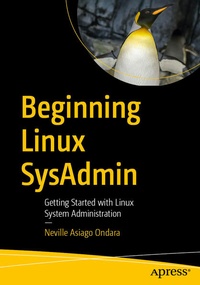
Beginning Linux SysAdmin
Beschreibung
As enterprises around the globe rely increasingly on Linux servers, understanding the basics of managing these systems effectively is more relevant than ever. This book provides a thorough introduction to Linux system administration, exploring the foundational terms and concepts needed for modern IT system administrators.
You'll start with the fundamentals of Linux and its ecosystem, looking at Linux distributions, tools, and concepts before moving on to user accounts, filesystem management, and configuration. Once you have aced these rudimentary elements, you'll explore Shell scripting and learn how to write and execute simple code scripts. The book then, explores concepts like system monitoring and performance, common Linux testing, security tools, and best practices.
You'll finish by looking at networking and remote access, configuration and VPNs, as well as disaster recovery, including backup strategies, automation, and executing data recovery. Beginning Linux SysAdmin is your pathway to everything from initial system setup and configuration to basic security and troubleshooting techniques.
What You Will Learn
- Install and configure a Linux system
- Manage users, groups, and permissions effectively
- Monitor, secure, and maintain system performance
- Troubleshoot basic issues in Linux environments
- Automate routine tasks using shell scripting
Who This Book Is For
IT professionals, system administrators, and developers who want to build a strong foundation in Linux administration. It is also suitable for students and hobbyists looking to enhance their skills in managing Linux systems
Weitere Details
Weitere Ausgaben
Person
Neville Asiago Ondara is an experienced IT professional with more than a decade of experience in Linux system administration. Passionate when it comes to sharing knowledge, he has authored numerous technical articles and contributed to various open-source projects. This book is a culmination of his extensive expertise and dedication to the field and has contributed to publications like Linux Buzz and Geeksmint .
Inhalt
Chapter 1: Introduction to Linux Administration.- Chapter 2: Managing User Accounts.- Chapter 3: Filesystem Management.- Chapter 4: Basic System Configuration.- Chapter 5: Package Management.- Chapter 6: Introduction to Shell Scripting.- Chapter 7: System Monitoring and Performance.- Chapter 8: Introduction to Security.- Chapter 9: Networking and Remote Access.- Chapter 10: Backup and Disaster Recovery.
