

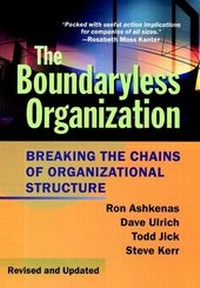
The Boundaryless Organization
Beschreibung

Rezensionen / Stimmen
Winner of the Executive Leadership Award "If your organization is ready for transformation, TheBoundaryless Organization will provide a simple but provocativeframework either for getting started or for accelerating thepace." -- from the foreword by Lawrence A. Bossidy, chairman andCEO, Honeywell Corporation "This is the best book on globalization and the seamlessorganization that I have read." -- David H. Komansky, chairman and CEO, Merrill Lynch &Co., Inc. "A very important contribution." -- from the foreword by C. K. Prahalad, coauthor ofCompeting for the Future "Attacks the very core of traditional management structure, withall of its walls, boundaries, and limitations." -- Quality Progress "Outlines how companies can make the change from rigidstructures to ones where ideas, resources, and information can flowfreely." -- HR Strategies & Tactics "A refreshing guide to innovative ways to do business . . . .Each part includes a questionnaire that readers can use todetermine where they stand on a continuum between boundaried andboundaryless status." -- Journal of Management Consulting "Recommended reading." -- CIO "Outlines how companies can make the change from rigidstructures to ones where ideas, resources, and information can flowfreely." -- HR Strategies & Tactics "A refreshing guide to innovative ways to do business . . . .Each part includes a questionnaire that readers can use todetermine where they stand on a continuum between boundaried andboundaryless status." -- Journal of Management Consulting "Recommended reading." -- CIOWeitere Details
Weitere Ausgaben
Andere Ausgaben
Personen
Inhalt
Preface
In the five years since The Boundaryless Organization first appeared, we have seen the themes it describes play out time after time on the organizational stage. Firms that managed to loosen their boundaries and operate with greater speed, flexibility, and innovation have tended to be more successful at navigating the white water of the global economy. Conversely, organizations that have maintained more rigid internal and external boundaries have struggled.
At the same time, the world continues to change with lightning speed. When we wrote The Boundaryless Organization in 1993 and 1994, the Internet was just beginning to enter our consciousness. E-mail had not yet become a way of life, and globe-spanning wireless communication was only a dream for most people. Since then, thousands of dot-com companies full of entrepreneurial energy have burst on the scene. And though many have fallen by the wayside, together they have heralded the dawn of a new economic and organizational era. People struggling to define the new reality constantly refer to virtual, networked, wired, horizontal, knowledge-based organizations.
Also in the past five years, the tiger economies of Asia emerged with a roar that influenced firms everywhere, then collapsed in the midst of currency crises, and then recovered faster than anyone thought possible. And while regional conflicts continue to flame across the world, a truly global economy has become a reality. In today's world, a consumer in Boise might easily talk to a customer service representative in India about a product manufactured in Mexico-without realizing that the transaction has spanned the globe.
Pushed by the burgeoning global economy and the technological innovation rate, the pace of mergers, acquisitions, and alliances has climbed to unheard-of levels, with trillions of dollars worth of deals reshaping the corporate landscape and dislocating millions of people. Yet at the same time, even as companies connect more with each other, they are simultaneously engaged in an unprecedented war for talent as human capital becomes one of the scarcest resources on the planet.
So clearly, in the past five years, the pace of change has accelerated. Yet in the midst of this new environment, the fundamental capabilities of human beings have not changed. Human brains have not grown larger to be able to absorb the Web-based sea of information, and the ability to engage in dialogue has not grown along with all the technologies that could support it twenty-four hours a day. Thus organizations still need to function at the human scale-to take advantage of technology and globalization while basing themselves on human capabilities. And in that context, we firmly believe that the concepts and principles laid out in The Boundaryless Organization are still on target.
The Essence of a Boundaryless World
For those who are picking up the book for the first time, here are the key ideas:
- Success factors in the twenty-first century include speed, flexibility, integration, and innovation-in addition to the traditional success factors of size, role definition, specialization, and control-even when these factors seem to contradict each other. Managers must create organizations with sufficient critical mass that can also move quickly and nimbly through the changing business terrain.
- To achieve these success factors, every firm needs to reshape four types of boundaries:
- Vertical boundaries (the floors and ceilings of organizations), which separate people by hierarchical levels, titles, status, and rank.
- Horizontal boundaries (the internal walls), which separate people in organizations by function, business unit, product group, or division.
- External boundaries (the external walls), which divide companies from their suppliers, customers, communities, and other external constituencies.
- Geographic boundaries (the cultural walls), which include aspects of the other three but are applied over time and space, often across different cultures.
- Each of these boundaries needs appropriate permeability and flexibility-so that ideas, information, and resources can flow freely up and down, in and out, and across the organization. The idea is not to have totally permeable boundaries or no boundaries-that would be "disorganization." Rather, you want sufficient permeability to allow the organization to quickly and creatively adjust to changes in the environment.
- Leaders can use a number of levers to foster appropriate permeability-almost like fine-tuning the dial on a radio. These are the four most powerful levers:
- Information: Foster access to information across all boundaries.
- Authority: Give people the power to make independent decisions about action and resources.
- Competence: Help people develop the skills and capabilities to use information and authority wisely.
- Rewards: Provide proper shared incentives that promote organizational goals.
- Leaders themselves need to adopt new ways of working to lead boundaryless organizations. They need to shift from command and control to methods that rely more on creating shared mindsets, stretch goals, and empowered colleagues. They need to shift from having the right answers to asking the right questions. But at the same time, they need to keep the focus on results, maintain clear accountability for performance, and make tough decisions.
Origins of the Concept
The first edition of this book grew out of our experiences with one of the largest and most ambitious organizational change efforts ever attempted, the General Electric Work-Out process. Late in 1988, GE CEO Jack Welch asked Dave Ulrich to pull together a team of academics and consultants who could help GE transform the way it did business. Among others, Ulrich enlisted Ron Ashkenas, Todd Jick (then at Harvard University), and Steve Kerr (then at the University of Southern California). For the next several years, we worked intensively with a variety of GE businesses to reduce bureaucracy, shorten cycle times, and increase capabilities for change. Periodically, we met with others involved in Work-Out to share experiences and learn from each other.
It was at GE that we first heard the term boundaryless organization, which Jack Welch had been using since 1990. It sounded like just another buzzword at first, but we kept encountering aspects of the boundaryless theme. For example, in the early days of Work-Out, we conducted hundreds of "town meetings"-attempts at direct dialogue between managers and their employees-and we saw how hard it was to overcome these vertical boundaries. At the same time, we began to see the disconnections, the horizontal boundaries, between functions and departments.
As Work-Out progressed and GE's internal boundaries became increasingly permeable, we began to focus on relationships with customers and suppliers, the external boundaries. Dave Ulrich had written extensively on how human resource practices could create greater customer commitment. Building on these ideas, we began helping GE businesses hold town meetings with customers and suppliers. Todd Jick conducted the first one, between GE Appliances and Sears, and it was followed by many more.
By 1991, we were looking at global linkages, as GE businesses shifted from domestic to worldwide concerns. For example, Ron Ashkenas took part in an extended effort to integrate GE Lighting's domestic business with its European acquisitions-including its new Hungarian partner, Tungsram Ltd., the first major acquisition of an Eastern bloc company by a Western concern.
By 1992, we realized that GE was engaged in a paradigm shift, altering multiple organizational boundaries at the same time. With that shift in mind, Kerr, Jick, and Ulrich began creating a conceptual framework that would shape managers' understanding of the boundaryless organization and what they could do to achieve it. This framework became the GE program known as the Change Acceleration Process (CAP). Since 1992, hundreds of GE managers and many of their customers and suppliers have used CAP to break down boundaries of all sorts.
By 1993, we realized that more and more organizations were struggling with the same issues, and that the insights we had gained could form an action framework for them. To make the framework useful, we set out to create not only a conceptual model of the boundaryless organization but also a set of simple tools that managers could tailor to their individual requirements. The first edition of this book was the result.
Nonetheless, the framework we have created is not based on GE, nor is The Boundaryless Organization a book about GE. Since GE was a leader in creating a boundaryless organization and a formative learning site for all of us, we have drawn on its experience and a number of GE examples. However, we have also drawn on the experience of numerous other organizations, and GE examples form only a small part of the total.
In the five years since writing the original book, we've observed that boundaryless organizations-or those that strive to be so-improve their chances of success in the global Internet era. Indeed, organizations must have some degree of boundarylessness to function effectively today. And that applies equally to a large firm trying to shake free from long-standing bureaucracy and to a start-up firm struggling to find an...
