

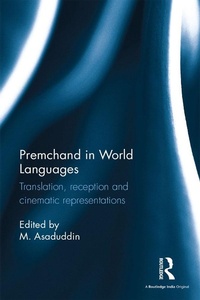
Premchand in World Languages
Translation, reception and cinematic representations
1. Auflage
Erschienen am 20. Mai 2016
298 Seiten
978-1-317-20572-2 (ISBN)
Beschreibung

This volume explores the reception of Premchand's works and his influence in the perception of India among Western cultures, especially Russian, German, French, Spanish and English. The essays in the collection also take a critical look at multiple translations of the same work (and examine how each new translation expands the work's textuality and annexes new readership for the author) as well as representations of celluloid adaptations of Premchand's works.
An important intervention in the field of translation studies, this book will interest scholars and researchers of comparative literature, cultural studies and film studies.
An important intervention in the field of translation studies, this book will interest scholars and researchers of comparative literature, cultural studies and film studies.
Rezensionen / Stimmen
'The name Premchand inspires affection, a feeling of one's ownness, more than anything else. He is, and has been, respected and admired perennially: as a writer of an India that was in turmoil and transition. More than almost any other writer, Premchand was aware of both.Any examination or re-examination of Premchand is always welcome. He has been translated copiously, some in languages which have little in common with the Urdu/Hindi that he wrote in. He himself ventured into the world of films (with scant success) and films based on his fiction have been made (though with scant success, again).
From all points of view: translation, interpretation, mediation through performing arts, the instant collection of essays is a valuable contribution to Premchand studies.'
- Shamsur Rahman Faruqi, Urdu writer, poet and critic
'World writers become so by fame or through translation - sometimes both. To what extent is Premchand a world writer? This volume brilliantly opens up the question by exploring the many dimensions of translation across media and across languages - English, other European languages, Soviet Russian - as well as paying attention to Premchand's own multiple translation practices. A pathbreaking book, meticulously researched, it brings the most famous Hindi-Urdu writer of the early twentieth century bang into current debates on translation and world literature. A must for students of translation studies, comparative literature and world literature.'
- Francesca Orsini, Professor of Hindi and South Asian Literature, School of Oriental and African Studies, London
'Premchand in World Languages tells a captivating story about the uneven fortunes of an Indian vernacular author on the global stage, offering startling insight into the creation of national literary culture in colonial and post-colonial India, and the currency of world literature in its many avatars (including in television and film). M. Asaduddin has assembled a rich array of contributions that treat translation as a dynamic, multidirectional negotiation. Together these articles demonstrate how Premchand's popularity in Russian vs. Spanish, German or French reveals as much about the shifting ideological commitments of the home audience itself as the quality of the source text or the translated versions, and likewise force us to question the terms we should use when the "translation" is never called that as such but skillfully mediates political differences and artistic visions both nationally and internationally. This volume promises to edify both specialists of South Asia and non-specialists alike, especially anyone interested in the complex circulations of world literature.'
- Christi A. Merrill
, Associate Professor of South Asian Literature and Postcolonial Theory, University of Michigan Ann Arbor
'A valuable contribution to Premchand studies in general, this anthology is an important intervention in the field of translation studies. It will interest scholars and researchers of comparative literature, cultural studies and film studies.'
- The Sunday Statesman
Weitere Details
Auflage
1. Auflage
Sprache
Englisch
Verlagsort
London
Großbritannien
Verlagsgruppe
Taylor & Francis Ltd
Zielgruppe
Für höhere Schule und Studium
Dateigröße
1,22 MB
ISBN-13
978-1-317-20572-2 (9781317205722)
Copyright in bibliographic data and cover images is held by Nielsen Book Services Limited or by the publishers or by their respective licensors: all rights reserved.
Schweitzer Klassifikation
Weitere Ausgaben
Andere Ausgaben
Buch
06/2019
1. Auflage
Routledge India
51,84 €
Versand in 15-20 Tagen
Premchand in World Languages
Translation, Reception and Cinematic Representations
Buch
06/2016
Routledge
146,65 €
Keine Lieferinformation verfügbar
Buch
05/2016
1. Auflage
Routledge India
233,10 €
Versand in 10-20 Tagen
Person
M. Asaduddin is Professor of English and Dean, Faculty of Humanities and Languages at Jamia Millia Islamia, New Delhi, India, and Director, Jamia Centenary History Project. He writes on literature, language politics and translation studies. He was a Fulbright Scholar-in-Residence at Rutgers University, New Jersey, USA (2008-9), and Visiting Professor/Fellow at several universities in India and outside. His publications include Filming Fiction: Tagore, Premchand and Ray (2012), A Life in Words (2012), For Freedom's Sake: Manto (2002) and Lifting the Veil: Selected Writings of Ismat Chughtai (2001). He has received several prizes for his translations including the Katha Award, the Dr A. K. Ramanujan Award, the Sahitya Akademi (National Academy of Letters) Award and the Crossword Book Award.
Inhalt
Notes on contributors Introduction Part 1 Premchand in Translation: Surveys, Histories, Receptions 1. Premchand in English: One Translation, Two Originals 2. Premchand in English Translation: The Story of an 'Afterlife' 3. Premchand in German Language:Texts, Paratexts and Translations 4. Premchand in Russian: Translation, Reception, Adaptation 5. Beyond Orientalism: Premchand in Spanish Translations 6. Premchand in French & the French for Premchand 7. French Translations Of Munshi Premchand's Short Stories: A Critical Enquiry Part 2 Premchand on Translation: Formulations and Praxis 8. Premchand on/in Translation 9. Premchand and the Politics of Language: On Translation, Cultural Nationalism, and Irony 10. Translation as New Aesthetic: Premchand's Translation of Shab-e Taar and European Modernism 11. Experiencing Premchand Through Translation of Three Stories: Culture, Gender, History Part 3 Premchand and Cinematic Adaptation: Two Stories 12. In Quest of a Comparative Poetics: A Study of Sadgati 13. Politics of Language, Cultural Representation and Historicity: "Shatranj ke Khiladi" in (Self-) Translation and Adaptation Part 4 Premchand's Thematics: Two Essays 14. Kashi as Gandhi's City: Personal and Public Lives in Premchand's Karmabhumi 15. Demystifying the Sanctity of the Village Council: 'Ghareeb Ki Haaye' as a Counter-Narrative to 'Panch Parmeshwar' Index
