

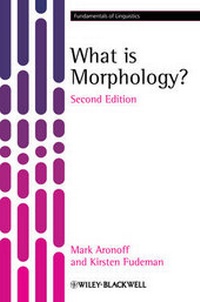
What is Morphology?
2. Auflage
Erschienen am 20. August 2010
312 Seiten
978-1-4443-2791-5 (ISBN)
Beschreibung

What is Morphology? is a concise and critical introductionto the central ideas of morphology, which has been revised andexpanded to include additional material on morphologicalproductivity and the mental lexicon, experimental and computationalmethods, and new teaching material.
* Introduces the fundamental aspects of morphology to studentswith minimal background in linguistics
* Includes additional material on morphological productivity andthe mental lexicon, and experimental and computational methods
* Features new and revised exercises as well as suggestions forfurther reading at the end of each chapter
* Equips students with the skills to analyze a wide breadth ofclassic morphological issues through engaging examples
* Uses cross-linguistic data throughout to illustrate concepts,specifically referencing Kujamaat Joola, a Senegalese language
* Includes a new answer key, available for instructors online athttp://www.wiley.com/go/aronoff
Rezensionen / Stimmen
"This characteristic of the book particularly recommendsit for teaching, as it is often the case that undergraduatestudents are reluctant to engage in argumentation and favorprescriptive contents. This book manages to lure the student intothinking and arguing rather than learning definitions." (Anglistik, 2 September 2012) "The intended audience is undergraduate students in linguisticsbut the text is accessible enough for a person from a generalaudience wanting to understand the basic concepts in morphologicaltheory and practice in linguistics." (Linguist, 25 June 2011) "Aronoff and Fudeman have produced a clear and jargon-freeintroduction to contemporary morphological theory and practice. Thebook succeeds particularly in clarifying the empirical content,organizational principles and analytic techniques that distinguishmorphology from other areas of linguistics." --James P. Blevins, University of CambridgeAronoff and Fudeman have produced a clear and jargon-freeintroduction to contemporary morphological theory and practice. Thebook succeeds particularly in clarifying the empirical content,organizational principles and analytic techniques that distinguishmorphology from other areas of linguistics. James P. Blevins, University of Cambridge PRAISE FOR PREVIOUS EDITION "Aronoff and Fudeman have provided an extremely pleasant tour ofthe issues in modern morphological theory for beginning students.The rich collection of exercises will be a godsend to instructorsand students alike, and the thread of discussion of a singlelanguage throughout the book is a brilliant stroke that other textsshould emulate." Stephen R. Anderson, Yale University "This unusual book combines a basic start on morphology with anintroduction to Kujamaat Jóola. It is a fine addition toteaching materials on morphology: a book for beginners to use witha teacher, yet one from which any linguist could learn. The authorsintend students to develop 'a lasting taste for morphology'.I think many will." Greville Corbett, University of Surrey, Guildford "Morphology has its own organizing principles, distinct fromthose of syntax, phonology, and the lexicon. Too many morphologytextbooks obscure this fascinating fact, but Aronoff and Fudemanrefreshingly make it the cornerstone of their exposition." Andrew Carstairs-McCarthy, University of CanterburyWeitere Details
Weitere Ausgaben
Andere Ausgaben
Mark Aronoff | Kirsten Fudeman
What is Morphology?
Buch
11/2010
2. Auflage
Wiley
Preis leider unbekannt
Artikel ist vergriffen; siehe Neuauflage
Personen
Mark Aronoff isProfessor of Linguistics at Stony Brook University (SUNY). He isco-editor, with Janie Rees-Miller, of The Handbook ofLinguistics (Wiley-Blackwell, 2001), and served as editor ofthe journal Language from 1995 to 2000.
Kirsten Fudemanis Professor of French at the University of Pittsburgh. She is theauthor of Vernacular Voices: Language and Identity in MedievalFrench Jewish Communities (2010).
Inhalt
Preface viii
Acknowledgments xiv
Abbreviations xv
Remarks on Transcription xviii
The International Phonetic Alphabet xx
1 Thinking about Morphology and Morphological Analysis1
1.1 What is Morphology? 1
1.2 Morphemes 2
1.3 Morphology in Action 4
1.4 Background and Beliefs 10
1.5 Introduction to Morphological Analysis 12
1.6 Summary 22
Introduction to Kujamaat Jóola 23
Further Reading 26
Exercises 27
2 Words and Lexemes 33
2.1 What is a Word? 34
2.2 Empirical Tests for Wordhood 38
2.3 Types of Words 40
2.4 Inflection vs. Derivation 47
2.5 Two Approaches to Morphology: Item-and-Arrangement,Item-and-Process 49
2.6 The Lexicon 54
2.7 Summary 57
Kujamaat Jóola Noun Classes 58
Further Reading 67
Exercises 68
3 Morphology and Phonology 73
3.1 Allomorphs 74
3.2 Prosodic Morphology 78
3.3 Primary and Secondary Affixes 82
3.4 Linguistic Exaptation, Leveling, and Analogy 86
3.5 Morphophonology and Secret Languages 93
3.6 Summary 95
Kujamaat Jóola Morphophonology 96
Further Reading 103
Exercises 104
4 Derivation and the Lexicon 109
4.1 The Saussurean Sign 109
4.2 Motivation and Compositionality 110
4.3 Derivation and Structure 123
4.4 Summary 130
Derivation in Kujamaat Jóola 131
Further Reading 132
Exercises 133
5 Derivation and Semantics 136
5.1 The Polysemy Problem 137
5.2 The Semantics of Derived Lexemes 139
5.3 Summary 147
Derivation and Verbs in Kujamaat Jóola 148
Further Reading 151
Exercises 152
6 Inflection 157
6.1 What is Inflection? 159
6.2 Inflection vs. Derivation 168
6.3 Inventory of Inflectional Morphology Types 171
6.4 Syncretism 177
6.5 Typology 178
6.6 Summary 180
Agreement in Kujamaat Jóola 182
Further Reading 187
Exercises 189
7 Morphology and Syntax 196
7.1 Morphological vs. Syntactic Inflection 197
7.2 Structural Constraints on Morphological Inflection 198
7.3 Inflection and Universal Grammar 201
7.4 Grammatical Function Change 203
7.5 Summary 209
Kujamaat Jóola Verb Morphology 212
A Brief Survey of Kujamaat Jóola Syntax 219
Further Reading 222
Exercises 223
8 Morphological Productivity and the Mental Lexicon226
8.1 What is Morphological Productivity? 227
8.2 Productivity and Structure: Negative Prefixes in English230
8.3 Degrees of Productivity 231
8.4 Salience and Productivity 236
8.5 Testing Productivity 238
8.6 The Mental Lexicon, Psycholinguistics, and Neurolinguistics246
8.7 Conclusion 252
Further Reading 253
Exercises 254
Glossary 258
References 273
Index 280
