

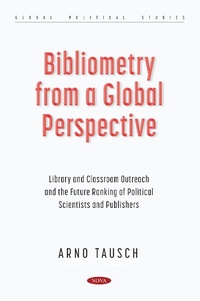
Bibliometry from a Global Perspective: Library and Classroom Outreach and the Future Ranking of Political Scientists and Publishers
Erschienen am 13. September 2023
364 Seiten
979-8-89113-114-9 (ISBN)
Beschreibung

This book, written by a political scientist born in the global North but now based in one of the departments of his discipline in the Republic of South Africa, is an attempt to focus on the global geography of political science and its global reach. All too often, the world view of scholars is shaped by the ''lens'' of the global North, and there is little awareness of how the products of our scholarship are distributed in the world''s libraries and classrooms, and of the structures of centre and periphery that characterise the field. At the heart of our bibliometric considerations, beyond the usual citation indicators based on Scopus, arguably the most complete database of its kind in the world, is the idea of measuring the presence of scientific authors and/or book publishers in the world''s library systems as well as in the world''s lecture halls. These indicators - called Libcitation and Classroom Citation - are discussed and developed in the various sections of our book. As we show, the claim of "global political science" must now be challenged by the harsh reality of the regional concentration of our discipline in the Western countries of the world, as evidenced by the fact that the Netherlands, the United Kingdom, and the United States alone account for two-fifths of all political science titles recorded worldwide in Scopus-indexed journals from 1996 to 2021, and, also for more than 50% of the world''s academic libraries recorded in OCLC WorldCat. Worse still, no less than two-thirds of the "global" political science journals indexed in Scopus are published in these three countries! With all the weaknesses of our new evaluation systems, which were first presented in German in a series of articles in the Gruyter journal Bibliotheksdienst, and which are now being presented step by step in an expanded English version, substantially supplemented by new contributions and perspectives, claim to be an innovation in a global academic world in which the "ranking" of scholarly communities and academic book publishers is unfortunately becoming more and more important. Our ranking systems focus on the real presence of scholarship around the globe.
Weitere Details
Weitere Ausgaben
Andere Ausgaben
Buch
09/2023
Nova Science Publishers Inc
191,10 €
Versand in 10-20 Tagen
Inhalt
- Intro
- Contents
- List of Figures
- List of Tables
- Preface
- Chapter 1
- By Way of Introduction
- Abstract
- Chapter 2
- The Book Publications of Nobel Prize Economists and the Discipline's Leading Book Publishers. A Bibliometric Analysis
- Abstract
- We Are Concerned with "Hard" Questions About the Future of Scientific Locations
- Methods Used Here
- Results
- Chapter 3
- The Book Publications of the "Academic Communities" in Denmark and the Netherlands: Inferences for Global Publication Strategies
- Abstract
- Introduction
- On the Research Strategy
- The Academic Communities Compared Are among the Best in Europe
- Of the Usefulness of the Considerations Made Here
- Background
- First Results of Comparisons on Publishing Behaviour in Denmark and the Netherlands
- Methods for Multivariate Analysis
- Results
- Discussion of the Results
- Factor Correlations
- High Global Library Outreach
- Global Opinion Leader
- Size and High Quality
- Size of the Publishing House and High Quality
- DK/NL Factor
- Average Citations
- High Standing in the Global Top Scholarly Community
- Implications for the Academic Community
- Implications for Future Bibliometric and Scientometric Studies
- Comparison with the Implications from the Publisher's Assessment by the Spanish Academic Community
- Implications for the Library Service of the Future
- Chapter 4
- "Classroom Citation": The Worldwide "Open Syllabus" Project as a Third Pillar of Bibliometric Performance Comparisons of Scientific Communities and Publishing Companies
- Abstract
- Introduction
- Three Pillars of Future Bibliometrics: Citations in Global Courses, Global Library Presence, and Citations in Journals
- Research Impact Services
- Classroom Citation ( The Open Syllabus Platform
- Classroom Citation, Libcitation, Citations in Journals ( Applied to Skytte Prize Winners in Political Science
- First Final Results of a Test Run of the Bibliometric Significance of the "Classroom Citation" According to the "Open Syllabus" with 104 Austrian Political Scientists
- Some Performance Comparisons of Austrian Political Science
- First Final Results of a Test Run of the Bibliometric Significance of "Classroom Citation" According to the "Open Syllabus" with Well-Known Worldwide Publishing Companies
- Outlook
- Chapter 5
- Citations Are Not Everything: Classroom Citation, Libcitation, and the Future of Bibliometric and Scientometric Benchmarking
- Abstract
- Introduction
- The Future Three Pillars of Bibliometrics and Scientometrics
- How Do Our Metrics Register on Indisputable Academic Excellence - Time Series on the Skytte Prize Winners in Political Science?
- Cautious Use of Instruments in the Humanities Is Appropriate
- The Correlations of the Three Pillars of Future Bibliometrics: Citations in Global Courses, Global Library Presence, and Citations in Journals
- Multivariate Analysis of the Bibliometric and Scientometric Significance of the "Classroom Citation" According to the "Open Syllabus" for 104 Austrian Political Scientists
- Final Results of the Multivariate Analysis of the Bibliometric and Scientometric Meaningfulness of the "Classroom Citation" According to the "Open Syllabus" with Well-Known Worldwide Publishing Ventures
- Outlook
- Chapter 6
- OCLC Worldcat Identities: An Ideal Tool for Assessing the Significance of a Scholarly Body of Work?
- Abstract
- Introduction and Background to This Study
- Some Examples of Results According to OCLC Worldcat Identities
- Empirical Study with Two Samples of Political Science Communities
- How Reliable Is the New OCLC Index of the Market Value of Scholars?
- Outlook
- Chapter 7
- Beyond "Channel Registers." Ways and Aberrations of Ranking International Academic Book Publishers
- Abstract
- Introduction
- Thumbs Up - Thumbs Down? The "Canal Register" and the Ancient Roman Circus Maximus
- The Winners of the Nobel Prize in Economics and the Skytte Prize in Recent Years, However, Cared Little About Such Lists
- On an Alternative Methodology
- First Results
- On a Non-Parametric Overall Indicator of Publishing Presence in the World Market of Ideas
- Implications for International Political Science
- Benchmarks for the Assessment of Publishing Companies Not Yet Included in This Comparison
- Conclusion
- Chapter 8
- Global Political Science Has to Become Truly Global
- Abstract
- Introduction and Background to This Study
- "Business as Usual" Reaches Its Limits
- The Evidence from 54 National Union Catalogues, 76 National Libraries, 15 Parliamentary Libraries and 9 International Organization Libraries Confirms Our Pessimistic Expectation: Large Areas of Our Planet Have No Access to English Language Standard Co...
- Scopus as the Alternative? A Critical Reflection on the Web of Science - a Reliable Source for University Rankings or a Data Graveyard?
- Researchgate Is Also Unreliable as a Tool for Making Things Visible
- With the End of the America-Centred World System, However, the Global Science System Is Also Facing Gigantic Changes, and Austria Is in Danger of Losing out if We Do Not Face up to the New Geography of the World System
- Constitutive, Well and Immediately Realizable Elements of a Counter-Strategy
- Conclusion
- Chapter 9
- For Whom Are We Writing? An Updated List of International Union and National Library Catalogues
- Abstract
- National Library Associations
- National Libraries
- Libraries of the Legislative Assemblies
- Holdings in the Libraries of International Organisations
- The Master Lists of 165 International Libraries - A Key for Possible Further Searches
- Analysis of OCLC Worldcat Data - 70,000 Libraries in 170 Countries with 450 Billion Records at the Click of a Button
- Chapter 10
- The Integration of Arab Libraries into International Library Networks: Trends, Perspectives and Contradictions
- Abstract
- Introduction
- Arab Union Catalogues
- Knowledge Accumulation
- The Growth of OCLC Worldcat in the Region
- The Positive Aspects of Integrating Arab Libraries into the Structures of International Knowledge Transfer
- Arab Libraries and the International Concentration of Global Scientific Know-How
- More Pessimism: The Arab Union Catalogue ARUC and the Scientific Structures in "Deep Arabia"
- Conclusion and Perspectives
- Chapter 11
- The Integration of the Libraries of Algeria and Tunisia into the Structures of International Social Sciences
- Abstract
- Introduction
- The Library Union Catalogues of Algeria and Tunisia
- The Colossal Achievement of Establishing Library Union Catalogues in a Developing Country
- Which Comparisons Would Be Possible in Principle for the Readers of this Chapter
- Background and Method
- A Union Catalogue Provides the Ultrasound of the Thinking of a Large Organisation - Our Method Explicated in the Case of the Vatican
- Identify Classics of the 21st Century: Popper and Piketty
- On the Selection of the Presence of Journals to Be Compared
- Estimates of Knowledge Accumulated in Arab Libraries in English in Global Comparison
- Integration in the Globalised Development of Science in the Muslim World -Comparisons with Turkey?
- Results on the Stock of International Journals
- Library Holdings on Essential Concepts of Today's Social Sciences
- Perspectives
- The Unequal Distribution of Knowledge on This Globe
- Chapter 12
- A Virtual Walk through Church Libraries in the German-Speaking World and the Libraries of the Vatican
- Abstract
- Introduction
- The Knowledge of Mankind
- Church Libraries
- The Libraries of the Vatican
- Tasks of the Pontifical Universities
- Problem Areas - Behind the Façade of Splendour
- Appendix to Chapter 12. Electronically Accessible Library Catalogues of the Catholic Church
- Chapter 13
- Political Science and Global Development
- Abstract
- Introduction
- Assessing the Geographical Distribution of the Global Political Science 280288 Articles, Published from 1996 to 2021 in the 597 Political Science and International Relations Journals, Indexed in Scopus, by the 207 Political Science Communities of Our...
- Political Science, Global Inequality, and Development
- The Beneficial Effects of Political Science
- The Global Inequality of Our Political Science Profession
- Appendix 1 to Chapter 13: Political Science and Economics Laureates and Their Overall Libcitation (Global Library Presence) According to the OCLC Worldcat Identities Data Base
- Appendix 2 to Chapter 13: Political Science and Economic Indicators and Bibliometric Indicators
- References
- Index of Persons
- Index of Subjects
- About the Author
- Blank Page
- Blank Page
