

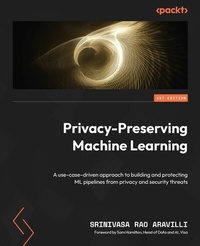
Privacy-Preserving Machine Learning
A use-case-driven approach to building and protecting ML pipelines from privacy and security threats
Erschienen am 23. September 2024
402 Seiten
978-1-80056-422-0 (ISBN)
Beschreibung

No detailed description available for "Privacy-Preserving Machine Learning".
Weitere Details
Auflage
Digital original
Sprache
Englisch
Verlagsort
Birmingham
Großbritannien
Zielgruppe
Für Beruf und Forschung
US School Grade: College Graduate Student
Editions-Typ
Digitale Ausgabe
Dateigröße
11,68 MB
ISBN-13
978-1-80056-422-0 (9781800564220)
Copyright in bibliographic data and cover images is held by Nielsen Book Services Limited or by the publishers or by their respective licensors: all rights reserved.
Schweitzer Klassifikation
Weitere Ausgaben
Andere Ausgaben
Srinivasa Rao Aravilli
Privacy-Preserving Machine Learning
A use-case-driven approach to building and protecting ML pipelines from privacy and security threats
Buch
05/2024
Packt Publishing
52,80 €
Versand in 3-4 Wochen
Personen
Aravilli Srinivasa Rao :
Srinivasa Rao Aravilli boasts 27 years of extensive experience in technology, research, and leadership roles, spearheading innovation in various domains such as Information Retrieval, Search, ML/AI, Distributed Computing, Network Analytics, Privacy, and Security. Currently working as a Senior Director of Machine Learning Engineering at Capital One, Bangalore, he has a proven track record of driving new products from conception to outstanding customer success. Prior to his tenure at Capital One, Srinivasa held prominent leadership positions at Visa, Cisco, and Hewlett Packard, where he led product groups focused on data privacy, machine learning, and Generative AI. He holds a Master's Degree in Computer Applications from Andhra University, Visakhapatnam, India.
Srinivasa Rao Aravilli boasts 27 years of extensive experience in technology, research, and leadership roles, spearheading innovation in various domains such as Information Retrieval, Search, ML/AI, Distributed Computing, Network Analytics, Privacy, and Security. Currently working as a Senior Director of Machine Learning Engineering at Capital One, Bangalore, he has a proven track record of driving new products from conception to outstanding customer success. Prior to his tenure at Capital One, Srinivasa held prominent leadership positions at Visa, Cisco, and Hewlett Packard, where he led product groups focused on data privacy, machine learning, and Generative AI. He holds a Master's Degree in Computer Applications from Andhra University, Visakhapatnam, India.
Inhalt
Table of Contents
Introduction to Data Privacy, Privacy threats and breaches
Machine Learning Phases and privacy threats/attacks in each phase
Overview of Privacy Preserving Data Analysis and Introduction to Differential Privacy
Differential Privacy Algorithms, Pros and Cons
Developing Applications with Different Privacy using open source frameworks
Need for Federated Learning and implementing Federated Learning using open source frameworks
Federated Learning benchmarks, startups and next opportunity
Homomorphic Encryption and Secure Multiparty Computation
Confidential computing - what, why and current state
Privacy Preserving in Large Language Models
Introduction to Data Privacy, Privacy threats and breaches
Machine Learning Phases and privacy threats/attacks in each phase
Overview of Privacy Preserving Data Analysis and Introduction to Differential Privacy
Differential Privacy Algorithms, Pros and Cons
Developing Applications with Different Privacy using open source frameworks
Need for Federated Learning and implementing Federated Learning using open source frameworks
Federated Learning benchmarks, startups and next opportunity
Homomorphic Encryption and Secure Multiparty Computation
Confidential computing - what, why and current state
Privacy Preserving in Large Language Models
