

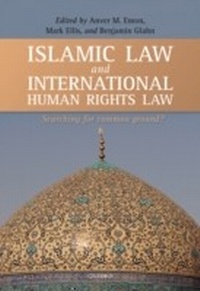
Islamic Law and International Human Rights Law
1. Auflage
Erschienen am 11. Oktober 2012
417 Seiten
978-0-19-164569-3 (ISBN)
Beschreibung

The relationship between Islamic law and international human rights law has been the subject of considerable, and heated, debate in recent years. The usual starting point has been to test one system by the standards of the other, asking is Islamic law 'compatible' with international human rights standards, or vice versa. This approach quickly ends in acrimony and accusations of misunderstanding. By overlaying one set of norms on another we overlook the deeply contextual nature ofhow legal rules operate in a society, and meaningful comparison and discussion is impossible. In this volume, leading experts in Islamic law and international human rights law attempt to deepen the understanding of human rights and Islam, paving the way for a more meaningful debate. Focusing on central areas of controversy, such as freedom of speech and religion, gender equality, and minority rights, the authors examine the contextual nature of how Islamic law and international human rights law are legitimately formed, interpreted, and applied within a community. They examine how thesefundamental interests are recognized and protected within the law, and what restrictions are placed on the freedoms associated with them. By examining how each system recognizes and limits fundamental freedoms, this volume clears the ground for exploring the relationship between Islamic law and international human rights law on a sounder footing. In doing so it offers a challenging and distinctive contribution to the literature on the subject, and will be an invaluable reference for students, academics, and policy-makers engaged in the legal and religious debates surrounding Islam and the West.
Weitere Details
Weitere Ausgaben
Andere Ausgaben
Anver M. Emon | Mark Ellis | Benjamin Glahn
Islamic Law and International Human Rights Law
Buch
10/2012
1. Auflage
Oxford University Press
181,20 €
Versand in 15-20 Tagen
Inhalt
- Cover
- Contents
- List of Contributors
- Editors' Introduction-From 'Common Ground' to 'Clearing Ground': A Model for Engagement in the 21st Century
- PART I: ISLAMIC LAW AND INTERNATIONAL HUMAN RIGHTS LAW
- 1 Narrating Law
- 2 Shari'a and the Modern State
- 3 Commentary to 'Shari'a and the Modern State' and 'Narrating Law'
- 4 Islamic and International Law: Convergence or Confiict?
- 5 Clearing Ground: Commentary to 'Shari'a and the Modern State'
- 6 Commentary: Shari'a as Rule of Law
- PART II: FREEDOM OF SPEECH
- 7 Rethinking the Universality of Human Rights: A Comparative Historical Proposal for the Idea of 'Common Ground' with Other Moral Traditions
- 8 Negotiating Speech in Islamic Law and Politics: Flipped Traditions of Expression
- 9 Freedom of Speech: The Great Divide and the Common Ground between the United States and the Rest of the World
- PART III: FREEDOM OF RELIGION
- 10 Freedom of Religion and Belief in International Law: A Comparative Analysis
- 11 Pre-Modern Islamic Legal Restrictions on Freedom of Religion, with Particular Reference to Apostasy and its Punishment
- 12 Freedom of Religion and Expression: A 'Rule of Law' Perspective
- 13 Freedom of Conscience and Religion: A Brief Reflection
- PART IV: GENDER EQUALITY
- 14 Un-Veiling Equality: Disciplining the 'Other' Woman Through Human Rights Discourse
- 15 Women in Search of Common Ground: Between Islamic and International Human Rights Law
- 16 Commentary: Women and Islamic Law
- 17 Musawah, CEDAW, and Muslim Family Laws in the 21st Century
- PART V: MINORITY RIGHTS
- 18 Religious Minorities and Islamic Law: Accommodation and the Limits of Tolerance
- 19 The Dialectic of International Law and the Contested Approaches to Minority Rights
- 20 Commentary: Religious Minorities and Islamic Law
- 21 Islam vs the Shari'a: Minority Protection within Islamic and International Legal Traditions
- Epilogue-Common Ground or Clearing Ground?
- Index
- A
- B
- C
- D
- E
- F
- G
- H
- I
- J
- K
- L
- M
- N
- O
- P
- Q
- R
- S
- T
- U
- V
- W
- Y
- Z
