

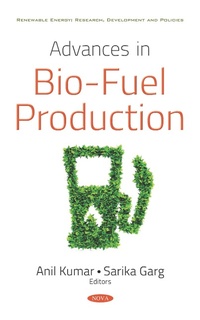
Advances in Bio-Fuel Production
Erschienen am 17. Januar 2019
352 Seiten
978-1-5361-4672-1 (ISBN)
Beschreibung

Petroleum has played a crucial role in the socio-economic and political welfare of the world. It is a non-renewable form of energy and has an increasing demand in this modern era. To fulfil the demands, the conventional sources of oil reserves are being stressed and are nearly drought. Also, the burning of fossil fuel emits toxic gases contributing to environmental pollution and global warming. The concern about environmental deterioration helped scientists to invent ways to make bio-based products. These bio-based products can replace the use of gasoline, diesel, oil, plastics and much more. Among all the bio-based products, biofuel is the most noticed one for being humanity's first liquid fuel. Biofuels are important for various reasons including reduced environmental impact, an alternative source of energy, and a boost in economic development. In this book, detailed production of biofuels from non-conventional bio-feedstocks and advanced biofuels production have been discussed.
Weitere Details
Weitere Ausgaben
Andere Ausgaben
Anil Kumar | Sarika Garg
Advances in Bio-Fuel Production
Buch
02/2019
Nova Science Publishers Inc
302,92 €
Versand in 15-20 Tagen
Inhalt
- Intro
- Contents
- Preface
- Acknowledgements
- Chapter 1
- Introduction to Biofuels Production
- Abstract
- Introduction
- Acknowledgments
- References
- Websites
- Chapter 2
- Importance of Cellulosic Bioethanol and Pre-Treatment Methods for Separating Lignin from Lignocellulosic Biomass
- Abstract
- 2.1. Introduction
- 2.2. Methods of Pretreatment
- 2.2.1. Physical Pretreatment
- 2.2.1.1. Mechanical Extrusion
- 2.2.1.1.1. Procedure 1
- 2.2.1.1.2. Procedure 2
- 2.2.1.1.3. Procedure 3
- 2.2.1.1.4. Procedure 4
- 2.2.1.1.5. Procedure 5
- 2.2.2. Chemical Pretreatment
- 2.2.2.1. Procedure 1
- 2.2.2.2. Procedure 2
- 2.2.2.3. Procedure 3
- 2.2.2.4. Procedure 4
- 2.2.2.5. Procedure 5
- 2.2.2.6. Procedure 6
- 2.2.2.7. Procedure 7
- 2.2.2.8. Procedure 8
- 2.2.2.9. Procedure 9
- 2.2.2.10. Procedure 10
- 2.2.3. Thermochemical Pretreatment
- 2.2.3.1. Procedure 1
- 2.2.3.2. Procedure 2
- 2.2.3.3. Procedure 3
- 2.2.3.4. Procedure 4
- 2.2.3.5. Procedure 5
- 2.2.4. Ionic Liquid Fractionation
- 2.2.4.1. Procedure 1
- 2.2.4.2. Procedure 2
- 2.2.4.3. Procedure 3
- 2.2.4.4. Procedure 4
- 2.2.4.5. Procedure 5
- 2.2.5. Biological Pretreatment
- 2.2.5.1. Procedure 1
- 2.2.5.2. Procedure 2
- 2.2.5.3. Procedure 3
- 2.2.5.4. Procedure 4
- 2.2.6. Co-Solvent Fractionation
- Conclusion
- Acknowledgments
- References
- Chapter 3
- Hexose Fermentation for Ethanol Production
- Abstract
- 3.1. Introduction
- 3.2. Glucose Utilization in the Metabolic Pathways
- 3.3. Micro-Organisms Involved in Hexose Fermentation
- 3.4. Ethanol Fermentation
- 3.5. Lactic Acid Fermentation
- 3.6. Heterolactate Fermentation
- 3.7. Butanol/Butyric Acid Fermentation
- 3.8. Formic Acid Fermentation
- 3.9. Butanediol Fermentation
- 3.10. Mixed Acids Fermentation
- 3.11. Propionic Acid Fermentation
- Conclusion
- Acknowledgments
- References
- Chapter 4
- Biofuel Production from Pentose Sugars
- Abstract
- 1. Introduction
- 2. Pentose Sugars
- 3. Sources of Pentose Sugars
- 4. Pre-Treatment of Hemicelluloses
- 4.1. Dilute Acid
- 4.2. Alkali
- 4.3. Sulfur Dioxide (SO2)
- 4.4. Hydrogen Peroxide
- 4.5. Steam Explosion
- 4.6. Ammonia Fiber Explosion (AFEX)
- 4.7. Wet Oxidation
- 4.8. Lime
- 4.9. Liquid Hot Water
- 4.10. CO2/ Freeze Explosion
- 5. Bioconversion of Pentose Sugars into Ethanol
- 6. Biofuel from D-Xylose
- 7. Biofuel from Arabinose
- 8. Pentose Fermenting Microorganisms
- 9. Filamentous Fungi
- 10. Bacteria
- 11. Yeasts
- 12. Strain Improvement
- 13. Mutation
- 14. Protoplast Fusion
- 15. Genetic Engineering
- Conclusion
- References
- Chapter 5
- Genetic and Metabolic Engineering of Microbes for Efficient Lignocellulosic Ethanol
- Abstract
- 5.1. Introduction
- 5.2. LCB as Substrate for Biofuel Production- Benefits, and Challenges
- 5.3. Potential Ethenologenic Microoganisms
- 5.4. Strategies to Improve Xylose Utilization for Ethanol Production
- 5.4.1. Non-Targeted Engineering
- 5.4.1.1. Evolutionary Engineering
- 5.4.1.2. Enhancement of Xylose Uptake
- 5.4.1.3. Enhancement of Stress Tolerance
- 5.4.1.4. Strain Hybridization
- 5.4.1.4.1. Protoplast Fusion
- 5.4.1.4.2. Genome Shuffling
- 5.4.2. Targeted Engineering
- 5.4.2.1. Engineering XR/XDH Pathway
- 5.4.2.2. Engineering XI Pathway
- 5.4.2.3. Engineering Non-Oxidative Pathway
- Conclusion
- References
- Chapter 6
- Microalgae Based Biofuels: Production, Improvement, Processing and Extraction
- Abstract
- 6.1. Introduction
- 6.2. Potential Role of Microalgal Biodiesel
- 6.3. Technologies for Microalgal Cultivation
- 6.3.1. Photoautotrophic Cultivation
- 6.3.1.1. Open Pond Cultivation
- 6.3.1.1.1. Unstirred Open Ponds
- 6.3.1.1.2. Circular Ponds
- 6.3.1.1.3. Raceway Ponds
- 6.3.2. Closed Photobioreactor Systems
- 6.3.2.1. Tubular Photobioreactor
- 6.3.2.2. Flat-Plate Photobioreactor
- 6.3.2.3. Vertical Column Photobioreactors
- 6.3.3. Hybrid Production Systems
- 6.3.4. Heterotrophic Production
- 6.3.5. Mixotrophic Production
- 6.4. Improvement Strategies for Microalgae Fuel Production
- 6.4.1. Strain Selection
- 6.4.2. Metabolic Engineering Approach
- 6.4.3. In silico Metabolic Engineering
- 6.4.4. Genetic Engineering
- 6.4.4.1. Transformation Techniques
- 6.4.4.2. Transgenic Microalgal Strains, Stability, and Antibiotic R esistant
- 6.4.4.3. CRISPR Technology for Genome Editing in Microalgae
- 6.5. Processing of Biofuels
- 6.5.1. Thermochemical Processing
- 6.5.1.1. Thermochemical Liquefaction
- 6.5.1.2. Gasification
- 6.5.1.3. Pyrolysis
- 6.5.2. Biochemical Processing
- 6.5.2.1. Transesterification
- 6.5.2.2. Fermentation
- 6.5.2.3. Anaerobic Digestion
- 6.5.2.4. Hydroprocessing
- 6.6. Extraction of Biofuels
- 6.6.1. Cell Disruption Methods for Lipid Extraction
- 6.6.1.1. Mechanical Methods
- 6.6.1.2. Bead Beating
- 6.6.1.3. Microwave
- 6.6.1.4. Ultrasonication
- 6.6.1.5. High-Pressure Homogenization
- 6.6.1.6. Electroporation
- 6.6.2. Chemical Method
- 6.6.2.1. Chemical Treatments
- 6.6.2.2. Osmotic Shocks
- 6.6.3. Biological Method
- 6.6.4. Total Lipid Extraction Methods
- 6.6.4.1. Folch Method
- 6.6.4.2. Bligh and Dyer Method
- 6.6.4.3. Extraction of All Classes of Lipids
- 6.7. Economics of Biodiesel Production
- Conclusion
- References
- Chapter 7
- Prospects and Problems in the Bioconversion of Hemicellulose of Agro-Residues into Ethanol
- Abstract
- 7.1. Introduction
- 7.2. Hemicelluloses
- 7.3. Hemicellulose-Hydroyzing Microbial Enzymes
- 7.3.1. Xylanases
- 7.3.2. a-L-Arabinofuranosidase (E.C. 3.2.1.55) (AFase)
- 7.3.3. a-D-Glucuronidase (E.C. 3.2.1.139)
- 7.3.4. ß-Mannanases
- 7.3.5. Acetylxylan esterases
- 7.4. Effect of Enzyme Dose and Pretreatment Methods
- 7.5. Impact of Lignocellulose Pretreatment Method
- 7.6. Enzyme Production
- 7.7. Methods for Improving Enzyme Hydrolysis
- 7.8. 'Omic' Approach for Studying Hemicellulases
- 7.9. Synergistic Action of Hemicellulases
- 7.10. Naturally Occurring Pentose Fermenting Microorganisms
- 7.11. Xylose Metabolizing Pathways
- 7.12. Strain Improvement for Pentose Fermentation
- 7.13. Metabolic Engineering of S. Cerevisiae for Efficient Pentose Fermentation
- 7.14. Consolidated Biomass Processing (CBP)
- Future Perspectives and Conclusion
- Acknowledgments
- References
- Chapter 8
- Recent Advancements in the Engineering of ß-Glucosidase for Biomass Degradation
- Abstract
- 8.1. Introduction
- 8.2. Distribution and Function
- 8.3. Classification
- 8.4. Applications of ß-Glucosidase
- 8.5. Structural Diversity in ß-Glucosidase
- 8.6. ß-Glucosidase Substrate Recognition, Binding, Hydrolysis and Product Release
- 8.6.1. Substrate Recognition
- 8.6.2. Molecular Basis of the Glycone Specificity
- 8.6.3. Molecular Basis of the Aglycone Specificity
- 8.7. Activation of ß-Glucosidase by Glucose
- 8.7.1. Transglycosylation of Glucose
- 8.7.2. Glucose Binding to an Allosteric Regulatory Binding Site
- 8.7.3. Glucose Relieves Enzyme from Substrate Inhibition
- 8.8. Inhibition by Substrate and Product
- 8.8.1. Inhibition by Product
- 8.8.2. Types of Product Inhibition in BGs
- 8.9. Glucose Tolerant ß-Glucosidase
- 8.10. GH1 BGs Are More Glucose Tolerant Than GH3 BGs
- 8.11. Role of Enzyme Engineering
- 8.11.1. Rational Design
- 8.11.2. Directed Evolution
- 8.11.3. Transgenic Approaches
- 8.11.4. Examples of Engineering Better ß-Glucosidase
- 8.12. Future Work
- Acknowledgments
- References
- Chapter 9
- Fuels from Photosynthesis for Combustion Engines
- Abstract
- 9.1. Introduction
- 9.2. Calculation of the Energy Content of Photosynthesis Products
- 9.2.1. The Chemical Sign Language
- 9.2.2. Calculation of Energy Content
- 9.3. Fuel Requirements by the Internal Combustion Engine
- 9.3.1. Combustion Kinetics
- 9.3.2. Modern Combustion Engines
- 9.3.3. Spark Ignition and/or Self-Ignition in Internal Combustion Engines
- 9.3.4. Economic Evaluation of Internal Combustion Engines with the Use of Different Fuels
- 9.4. Conversion of Photosynthesis Products into Fuels
- 9.4.1. Fuel from Photosynthesis Products
- 9.4.2. Direct Oil Production of 4th Generation Oil
- 9.4.3. Biogas Production by Wet and Dry Fermentation
- 9.4.4. Gases from Thermal Gasification of 4th Generation Energy Products
- 9.4.5. Alcoholic Fermentation of 4th Generation Energy Products
- 9.4.6. Fuels from 4th Generation Solids
- 9.5. Economic Considerations on Fuels from Natural Products of Photosynthesis
- 9.5.1. Fuel Energy from Fats and Proteins
- 9.5.2. Fuel Energy from Carbohydrates by Means of Thermal Gasification
- 9.5.3. Fuel Energy from Land and Water Plants
- 9.6. Future Prospects for These Fuels
- References
- Websites:
- About the Editors
- Index
- Blank Page
- Blank Page
