

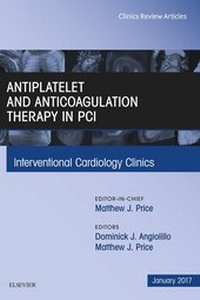
Antiplatelet and Anticoagulation Therapy In PCI, An Issue of Interventional Cardiology Clinics
1. Auflage
Erschienen am 26. November 2016
100 Seiten
978-0-323-48282-0 (ISBN)
Beschreibung

This issue of Interventional Cardiology Clinics, edited by Drs. Dominick Angiolillo and Matthew Price, will focus on Antiplatelet and Anticoagulation Therapy in PCI. The topics covered in this volume will span across pretreatment with antiplatelet agents; optimal duration of antiplatelet therapy after PCI; Cangrelor and its role in percutaneous coronary intervention; Ticagrelor and its effects beyond the P2Y12 receptor; dyspnea and Reversibly-binding P2Y12 antagonists; PAR receptor inhibition post-PCI; switching P2Y12 receptor inhibiting therapies; antiplatelet and antithrombotic therapy in patients with atrial fibrillation undergoing coronary stenting; antithrombotic therapy to reduce ischemic events in ACS patients undergoing PCI; and the current role of platelet function testing in PCI and CABG, among other topics.
Weitere Details
Weitere Ausgaben
Andere Ausgaben
Dominick J. Angiolillo | Matthew J. Price
Antiplatelet and Anticoagulation Therapy In PCI, An Issue of Interventional Cardiology Clinics: Volume 6-1
Volume 6-1
Buch
03/2017
Elsevier
70,00 €
Versand in 15-20 Tagen
Inhalt
- Front Cover
- INTERVENTIONAL CARDIOLOGY CLINICS
- Copyright
- CONTRIBUTORS
- EDITOR-IN-CHIEF
- EDITORS
- AUTHORS
- CONTENTS
- Preface: Antiplatelet and Anticoagulation Therapy in Percutaneous Coronary Intervention
- Regulation of Platelet Activation and Coagulation and Its Role in Vascular Injury and Arterial Thrombosis
- Pretreatment with Antiplatelet Agents in the Setting of Percutaneous Coronary Intervention: When and Which Drugs?
- Optimal Duration of Dual Antiplatelet Therapy After Percutaneous Coronary Intervention
- Cangrelor: Pharmacology, Clinical Data, and Role in Percutaneous Coronary Intervention
- Ticagrelor: Effects Beyond the P2Y12 Receptor
- Protease-Activated Receptor-1 Antagonists Post-Percutaneous Coronary Intervention
- Switching P2Y12 Receptor Inhibiting Therapies
- Antiplatelet and Antithrombotic Therapy in Patients with Atrial Fibrillation Undergoing Coronary Stenting
- Antiplatelet Therapy for Secondary Prevention After Acute Myocardial Infarction
- Antithrombotic Therapy to Reduce Ischemic Events in Acute Coronary Syndromes Patients Undergoing Percutaneous Coronary Inte ...
- Genetic Determinants of P2Y12 Inhibitors and Clinical Implications
- Current Role of Platelet Function Testing in Percutaneous Coronary Intervention and Coronary Artery Bypass Grafting
- ANTIPLATELET AND ANTICOAGULATION THERAPY IN PCI
- FORTHCOMING ISSUES
- RECENT ISSUES
- Antiplatelet and Anticoagulation Therapy in Percutaneous Coronary Intervention
- Regulation of Platelet Activation and Coagulation and Its Role in Vascular Injury and Arterial Thrombosis
- KEY POINTS
- INTRODUCTION
- THE HEMOSTATIC RESPONSE TO VASCULAR INJURY
- Initiation
- Extension
- Stabilization
- An Updated Model of Hierarchical Hemostatic Plug Architecture
- REGULATION OF PLATELET ACTIVATION IN VIVO
- Thrombin
- Adenosine Diphosphate
- Thromboxane A2
- Collagen/von Willebrand factor
- INFLUENCE OF LOCAL HEMODYNAMICS
- The Intrathrombus Microenvironment Shapes Agonist Distribution
- SUMMARY
- ACKNOWLEDGMENTS
- REFERENCES
- Pretreatment with Antiplatelet Agents in the Setting of Percutaneous Coronary Intervention
- KEY POINTS
- INTRODUCTION
- PRETREATMENT WITH P2Y12 INHIBITORS IN PATIENTS WITH STABLE CORONARY INTERVENTION UNDERGOING PERCUTANEOUS CORONARY INTERVENTION
- Should Clopidogrel Be Given Before Percutaneous Coronary Intervention?
- What About Prasugrel, Ticagrelor, and Cangrelor?
- What Do the Guidelines Say?
- PRETREATMENT IN PATIENTS WITH NON-ST ELEVATION ACUTE CORONARY SYNDROMES UNDERGOING INVASIVE MANAGEMENT
- Should Clopidogrel Be Given Before Coronary Angiography?
- What About Prasugrel, Ticagrelor, and Cangrelor?
- What Do the Guidelines Say?
- PRETREATMENT IN PATIENTS WITH ST ELEVATION MYOCARDIAL INFARCTION UNDERGOING PRIMARY PERCUTANEOUS CORONARY INTERVENTION
- Should P2Y12 Inhibitors Be Given as Soon as Possible?
- What Do the Guidelines Say?
- Pretreatment with Antiplatelet Agents in the Setting of Percutaneous Coronary Intervention: When and Which Drugs?
- Pretreatment with Antiplatelet Agents in Current Practice: What Are the Challenges?
- What Next?
- REFERENCES
- Optimal Duration of Dual Antiplatelet Therapy After Percutaneous Coronary Intervention
- KEY POINTS
- INTRODUCTION
- PROLONGED DUAL ANTIPLATELET THERAPY OF LONGER THAN 12 MONTHS FOLLOWING PERCUTANEOUS CORONARY INTERVENTION
- Rationale for Studies of Prolonged Dual Antiplatelet Therapy (Longer than 12 Months)
- Studies Evaluating Prolonged Dual Antiplatelet Therapy (of Longer than 12 Months)
- SHORTER DURATION OF DUAL ANTIPLATELET THERAPY (3-6 MONTHS) AFTER PERCUTANEOUS CORONARY INTERVENTION
- Rationale for Shorter Duration of Dual Antiplatelet Therapy After Percutaneous Coronary Intervention
- Studies Evaluating Shorter Duration of Dual Antiplatelet Therapy
- Guideline-Based Management of Dual Antiplatelet Therapy After Percutaneous Coronary Intervention
- Assessing Ischemic and Bleeding Risk
- Proton Pump Inhibitors to Reduce Gastrointestinal Bleeding in Patients on Dual Antiplatelet Therapy
- SUMMARY
- DISCLOSURE
- REFERENCES
- Cangrelor
- KEY POINTS
- INTRODUCTION
- PHARMACOLOGY AND METABOLISM
- PHARMACODYNAMICS
- THIENOPYRIDINE-CLOPIDOGREL INTERACTION
- CLINICAL SAFETY AND EFFICACY
- CHAMPION PCI and PLATFORM
- Pooled Analyses
- CANGRELOR FOR SURGICAL BRIDGING
- SUMMARY
- REFERENCES
- Ticagrelor
- KEY POINTS
- INTRODUCTION
- TICAGRELOR AND INFLAMMATION
- TICAGRELOR AND ADENOSINE
- POTENTIAL ADENOSINE-MEDIATED CLINICAL EFFECTS
- TICAGRELOR AND ENDOTHELIAL FUNCTION
- SUMMARY
- REFERENCES
- Protease-Activated Receptor-1 Antagonists Post-Percutaneous Coronary Intervention
- KEY POINTS
- INTRODUCTION
- PROTEASE-ACTIVATED RECEPTORS
- Roles of Protease-Activated Receptors in Hemostasis
- VORAPAXAR
- Pharmacodynamics and Pharmacokinetic
- Antiplatelet effect
- CLINICAL TRIALS OF VORAPAXAR
- Phase II Trial in Percutaneous Coronary Intervention Patients
- The Thrombin Receptor Antagonist for Clinical Event Reduction in Acute Coronary Syndrome Trial
- Insights on Percutaneous Coronary Intervention Patients from the Thrombin Receptor Antagonist for Clinical Event Reduction ...
- The Thrombin Receptor Antagonist in Secondary Prevention of Atherothrombotic Ischemic Events 50 Trial
- Insights on Percutaneous Coronary Intervention Patients from the Thrombin Receptor Antagonist in Secondary Prevention of At ...
- SUMMARY
- REFERENCES
- Switching P2Y12 Receptor Inhibiting Therapies
- KEY POINTS
- PHARMACOLOGIC PROPERTIES
- SWITCHING FROM CLOPIDOGREL TO PRASUGREL OR TICAGRELOR
- Pharmacodynamic Studies of Switching from Clopidogrel to New-Generation P2Y12 Receptor Inhibitors
- Registry Findings on Switching from Clopidogrel to New-Generation P2Y12 Receptor Inhibitors
- SWITCHING FROM PRASUGREL OR TICAGRELOR TO CLOPIDOGREL
- SWITCHING BETWEEN PRASUGREL AND TICAGRELOR
- SWITCHING BETWEEN ORAL AGENTS AND CANGRELOR
- PRACTICAL CONSIDERATIONS FOR SWITCHING
- SUMMARY
- REFERENCES
- Antiplatelet and Antithrombotic Therapy in Patients with Atrial Fibrillation Undergoing Coronary Stenting
- KEY POINTS
- INTRODUCTION
- THROMBOEMBOLIC RISKS IN ATRIAL FIBRILLATION
- IMPACT OF ATRIAL FIBRILLATION ON CLINICAL COURSE OF CORONARY ARTERY DISEASE
- TRIPLE ANTITHROMBOTIC THERAPY IN CURRENT PRACTICE
- Who Benefits from Triple Antithrombotic Therapy?
- Is Triple Antithrombotic Therapy Always Better than Dual Therapy?
- Duration of Triple Antithrombotic Therapy
- Is There a Place in Triple Therapy for Non-Vitamin K Oral Anticoagulants and New-Generation P2Y12 Inhibitors?
- How to Improve Safety of Triple Antithrombotic Therapy?
- ONGOING TRIALS
- SUMMARY
- REFERENCES
- Antiplatelet Therapy for Secondary Prevention After Acute Myocardial Infarction
- KEY POINTS
- RESIDUAL RISK AFTER MYOCARDIAL INFARCTION
- CURRENT EVIDENCE ON PROLONGED INTENSIVE ANTIPLATELET THERAPY IN PATIENTS WITH PRIOR MYOCARDIAL INFARCTION
- CONTINUING ON AT 1 YEAR AFTER MYOCARDIAL INFARCTION VERSUS RESTARTING IN ALL PATIENTS WITH HISTORY OF MYOCARDIAL INFARCTION
- CLINICAL FACTORS GUIDING PATIENT SELECTION
- SUMMARY
- REFERENCES
- Antithrombotic Therapy to Reduce Ischemic Events in Acute Coronary Syndromes Patients Undergoing Percutaneous Coronary Inte ...
- KEY POINTS
- NON-ST ELEVATION ACUTE CORONARY SYNDROME
- Preprocedural Antithrombotic Therapy
- Procedural Antithrombotic Therapy
- ST-ELEVATION ACUTE CORONARY SYNDROME
- Preprocedural Antithrombotic Therapy
- Procedural Antithrombotic Therapy
- ANTITHROMBOTIC THERAPY AFTER THE ACUTE PHASE OF ACUTE CORONARY SYNDROMES
- FUTURE PERSPECTIVES
- SUMMARY
- REFERENCES
- Genetic Determinants of P2Y12 Inhibitors and Clinical Implications
- KEY POINTS
- INTRODUCTION
- PHARMACOLOGY OF ADENOSINE DIPHOSPHATE ANTAGONISTS/P2Y12 RECEPTOR INHIBITORS
- GENETIC DETERMINANTS OF CLOPIDOGREL RESPONSE
- CYP2C19 Genotype
- CYP2C19 Genotype and Clopidogrel Pharmacokinetics and Pharmacodynamics
- CYP2C19 Genotype and Clinical Outcomes with Clopidogrel
- Other Genes Associated with Clopidogrel Response
- THERAPEUTIC APPROACHES BASED ON CYP2C19 GENOTYPE
- Clopidogrel Dose Escalation
- Alternative Antiplatelet Therapy
- GUIDELINES FOR CYP2C19 GENOTYPING WITH CLOPIDOGREL
- CLINICAL IMPLEMENTATION OF CYP2C19 GENOTYPING
- Examples of Clinical Implementation
- Barriers to Clinical Implementation
- PHARMACOGENETICS OF PRASUGREL AND TICAGRELOR
- SUMMARY
- REFERENCES
- Current Role of Platelet Function Testing in Percutaneous Coronary Intervention and Coronary Artery Bypass Grafting
- KEY POINTS
- INTRODUCTION
- METHODS FOR PLATELET FUNCTION TESTING
- PLATELET FUNCTION TESTING FOR PREDICTION OF ADVERSE EVENTS AFTER PERCUTANEOUS CORONARY INTERVENTION
- THERAPEUTIC WINDOW FOR PLATELET REACTIVITY AFTER PERCUTANEOUS CORONARY INTERVENTION
- PLATELET FUNCTION TESTING FOR GUIDANCE OF TREATMENT IN PATIENTS UNDERGOING PERCUTANEOUS CORONARY INTERVENTION
- ROLE OF PLATELET FUNCTION TESTING IN PATIENTS UNDERGOING CORONARY ARTERY BYPASS GRAFTING
- SUMMARY
- REFERENCES
