

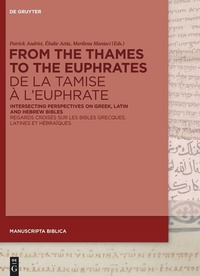
From the Thames to the Euphrates De la Tamise à l'Euphrate
Beschreibung

This volume is the result of a symposium organised in 2018 by Élodie Attia in Aix-en-Provence and offers a cross-sectional view of the production of typologically similar Latin, Greek and Hebrew Bibles during the course of the Middle Ages.
It first explores the different ways in which complete Bibles, in one or more volumes from the same production (pandects), were produced in different places and at different times, with an emphasis on their structural complexity. Complete Bibles are rare in all the traditions considered but especially interesting given the technical challenges that their production posed for craftsmen.
Partial Bibles represent a different way of transmitting the biblical text, whether they consist of a choice of parts of the Bible, assembled and reassembled in more or less original ways, or in the design of new types (such as the "Pentateuch-Megillot-Haftarot", produced in the Ashkenazi world before 1300).
Bibles with commentaries are a very varied category, illustrated here by two examples: first, the pandects produced by Theodulf (┼ 821), in which the marginal notes are akin to a critical apparatus; second, Hebrew manuscripts containing systematic exegetical commentaries in sophisticated layouts that also vary according to their areas of production.
Finally, the presentation of new fragments of a very ancient scroll of Genesis and Exodus from the Cairo Genizah sheds new light on its insertion into the Masoretic tradition, and to document the existence of partial Bibles in the form of scrolls.
This volume shows the value of a comparative approach to ancient Bibles and hopefully represents a further step towards a more comprehensive perception of a history of the Bible.
Weitere Details
Weitere Ausgaben
Andere Ausgaben
Personen
Inhalt
- Intro
- Table des matières / Table of contents
- Introduction
- Section 1: Bibles complètes (en un ou plusieurs volumes) / Complete Bibles (in one or several volumes)
- Contenu, ordre et structure des Bibles byzantines aux ixe et xe siècles (notes inédites revues par Patrick Andrist)
- L'architecture du Codex Basilianus (Vat. gr. 2106 + Marc. gr. 1) et l'étonnante hypothèse de Paul Canart
- Item Biblia in uno volumine : le « compactage » du texte biblique du XI⊃&e&/sup& au XIII⊃&e&/sup& siècle
- Section 2: Bibles partielles / Partial Bibles
- Bibles hébraïques partielles : le cas des « Pentateuque- Megillot-Haftarot » ashkénazes
- Partial Bibles in Southern Italy: the case of Montecassino
- Section 3: Bibles à commentaires / Bibles with commentaries
- The pandects of Theodulf of Orleans. Carolingian Bibles with critical apparatus: state and prospects of research
- The layout of the glossed Hebrew Bible from manuscript to print
- Section 4: Rouleaux bibliques médiévaux / Medieval biblical scrolls
- Fragments of the earliest complete Torah scroll in the Cairo Genizah?
- Liste des contributrices et contributeurs / List of contributors
- Tables des livres bibliques / Tables of biblical books
- Index des illustrations / Index of illustrations
- Index of sources / Index des sources
- Index des manuscrits cités / List of quoted manuscripts
