

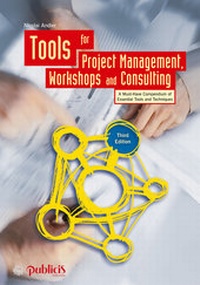
Tools for Project Management, Workshops and Consulting
A Must-Have Compendium of Essential Tools and Techniques
3. Auflage
Erschienen am 15. August 2016
488 Seiten
978-3-89578-918-2 (ISBN)
Beschreibung

"This book is of the kind you always wanted but didn't think would or could ever exist: the universal field theory of problem solving." Tom Sommerlatte
Typically today's tasks in management and consulting include project management, running workshops and strategic work - all complex activities, which require a multitude of skills and competencies. This standard work, which is also well accepted amongst consultants, gives you a reference or cookbook-style access to the most important tools, including a rating of each tool in terms of applicability, ease of use and effectiveness.
In this considerably enlarged third edition, Nicolai Andler presents 152 of such tools, grouped into task-specific categories: Definition of a Situation/Problem - Information Gathering - Creativity - Information Consolidation - Goal Setting - Strategic, Technical and Organisational Analysis - Evaluation and Decision Making - Project Management.
Checklists and Application Scenarios further enhance the use of this toolbox. Information provided by this book is:
- comprehensive and sufficiently wide in scope, combined with a practical level of detail without being too academic
- reliable and proven in numerous real implemented cases
- easy to apply due to many different search options, checklists, application scenarios and guiding instructions.
Written by a professional consultant, business analyst and business coach, this book is a unique reference work and guide for those wanting to learn about or who are active in the fields of consulting, project management and problem solving in general, both in business and engineering: business coaches and management trainers, workshop moderators, consultants and managers, project managers, lecturers and students.
Typically today's tasks in management and consulting include project management, running workshops and strategic work - all complex activities, which require a multitude of skills and competencies. This standard work, which is also well accepted amongst consultants, gives you a reference or cookbook-style access to the most important tools, including a rating of each tool in terms of applicability, ease of use and effectiveness.
In this considerably enlarged third edition, Nicolai Andler presents 152 of such tools, grouped into task-specific categories: Definition of a Situation/Problem - Information Gathering - Creativity - Information Consolidation - Goal Setting - Strategic, Technical and Organisational Analysis - Evaluation and Decision Making - Project Management.
Checklists and Application Scenarios further enhance the use of this toolbox. Information provided by this book is:
- comprehensive and sufficiently wide in scope, combined with a practical level of detail without being too academic
- reliable and proven in numerous real implemented cases
- easy to apply due to many different search options, checklists, application scenarios and guiding instructions.
Written by a professional consultant, business analyst and business coach, this book is a unique reference work and guide for those wanting to learn about or who are active in the fields of consulting, project management and problem solving in general, both in business and engineering: business coaches and management trainers, workshop moderators, consultants and managers, project managers, lecturers and students.
Rezensionen / Stimmen
Prof. Dr. Tom Sommerlatte: "This book is the kind you always wanted to have and didn´t think would and could ever exist: the universal field theory of problem solving."Weitere Details
Weitere Ausgaben
Andere Ausgaben
Nicolai Andler
Tools for Project Management, Workshops and Consulting
A Must-Have Compendium of Essential Tools and Techniques
Buch
07/2016
3. Auflage
PUBLICIS
49,90 €
Artikel ist vergriffen; siehe andere Ausgabe
Person
NICOLAI ANDLER
is a management/IT consultant, business analyst and business coach. He lives in Cape Town, South Africa, and works for enterprises in South Africa and Central Europe.
is a management/IT consultant, business analyst and business coach. He lives in Cape Town, South Africa, and works for enterprises in South Africa and Central Europe.
Inhalt
1 - Cover [Seite 1]
2 - The author [Seite 3]
3 - Tools for Project Management, Workshops and Consulting [Seite 4]
4 - Imprint [Seite 5]
5 - Brief contents / Overview of tools [Seite 6]
6 - Application areas of each tool [Seite 10]
7 - Foreword [Seite 15]
8 - Preface [Seite 16]
9 - Table of contents [Seite 18]
10 - 1 Introduction to the concept and application of this book [Seite 24]
10.1 - 1.1 Structure of this book [Seite 24]
10.2 - 1.2 How to use the book [Seite 24]
10.3 - 1.3 The target audience of this book [Seite 25]
10.4 - 1.4 The scope of this book [Seite 26]
10.5 - 1.5 Skills and competencies for your personal development [Seite 26]
10.6 - 1.6 Clarification on methodologies, models, tools and techniques [Seite 28]
11 - 2 Problem solving approach and application [Seite 30]
11.1 - 2.1 Problem solving [Seite 30]
11.1.1 - 2.1.1 Different problem solving processes and approaches [Seite 31]
11.1.2 - 2.1.2 The problem solving process used in this book [Seite 32]
11.1.3 - 2.1.3 Mental thinking levels during problem solving [Seite 36]
11.1.4 - 2.1.4 Problem solving process and consulting process [Seite 37]
11.1.5 - 2.1.5 The author's assumptions [Seite 39]
11.1.6 - 2.1.6 Macro logic project cycle - micro logic problem solving cycle [Seite 41]
11.2 - 2.2 Categories of tools [Seite 45]
11.3 - 2.3 How to select the right tool [Seite 49]
11.3.1 - 2.3.1 Overview of tools [Seite 49]
11.3.2 - (A) [Seite 49]
11.3.3 - 2.3.2 Where 'in' the problem solving process am I? [Seite 50]
11.3.4 - (B) [Seite 50]
11.3.5 - 2.3.3 Checklist for problem solving processes to identify required tool [Seite 50]
11.3.6 - (C) [Seite 50]
11.3.7 - 2.3.4 What is the right category? [Seite 51]
11.3.8 - (D) [Seite 51]
11.3.9 - 2.3.5 How to compile the shopping list [Seite 51]
11.3.10 - (scenario for workshop, E) [Seite 51]
11.3.11 - 2.3.6 Application sequence of tools [Seite 53]
12 - 3 Diagnosis [Seite 55]
12.1 - 3.1 Definition of a situation/problem [Seite 55]
12.1.1 - 3.1.1 5W Problem questions [Seite 59]
12.1.2 - 3.1.2 Problem definition [Seite 60]
12.1.3 - 3.1.3 Boundary examination [Seite 66]
12.1.4 - 3.1.4 Problem tree [Seite 69]
12.1.5 - 3.1.5 From As-Is to To-Be [Seite 73]
12.1.6 - 3.1.6 Problem goal twist [Seite 76]
12.1.7 - 3.1.7 SPIN [Seite 78]
12.1.8 - 3.1.8 Kepner/Tregoe problem diagnosis [Seite 80]
12.1.9 - 3.1.9 Reverse the problem [Seite 82]
12.1.10 - 3.1.10 Hypotheses [Seite 83]
12.1.11 - 3.1.11 Hypothesis tree [Seite 84]
12.1.12 - 3.1.12 Competing hypotheses [Seite 89]
12.1.13 - 3.1.13 Issue tree [Seite 90]
12.1.14 - 3.1.14 Influence matrix [Seite 93]
12.1.15 - 3.1.15 Fishbone or Cause-effect tool [Seite 95]
12.1.16 - 3.1.16 Black box [Seite 97]
12.1.17 - 3.1.17 IS - IS NOT [Seite 100]
12.1.18 - 3.1.18 Stakeholder expectation management [Seite 102]
12.1.19 - 3.1.19 Stakeholder analysis [Seite 104]
12.1.20 - 3.1.20 Stakeholder map [Seite 110]
12.1.21 - 3.1.21 Stakeholder influence matrix [Seite 113]
12.1.22 - 3.1.22 Stakeholder accordion [Seite 115]
12.1.23 - 3.1.23 Stakeholder swapping [Seite 117]
12.1.24 - 3.1.24 Context diagram [Seite 119]
12.1.25 - 3.1.25 Silo view [Seite 123]
12.1.26 - 3.1.26 Helicoptering [Seite 125]
12.1.27 - 3.1.27 Mind map [Seite 126]
12.1.28 - 3.1.28 Diagnosis plan [Seite 129]
12.2 - 3.2 Information gathering [Seite 131]
12.2.1 - 3.2.1 Desk research/database research [Seite 145]
12.2.2 - 3.2.2 Interview (unstructured) [Seite 146]
12.2.3 - 3.2.3 Socratic debate [Seite 147]
12.2.4 - 3.2.4 Focus interview [Seite 151]
12.2.5 - 3.2.5 Systemic questions [Seite 153]
12.2.6 - 3.2.6 Six Pillars [Seite 157]
12.2.7 - 3.2.7 Tripod (mixed) [Seite 161]
12.2.8 - 3.2.8 Octagon [Seite 162]
12.2.9 - 3.2.9 Focus groups (unstructured) [Seite 164]
12.2.10 - 3.2.10 Survey/field study - dipstick [Seite 166]
12.2.11 - 3.2.11 Direct observation (DILO = day in the life of) [Seite 168]
12.2.12 - 3.2.12 Delphi or expert panel [Seite 169]
12.2.13 - 3.2.13 Scenario analysis [Seite 170]
12.2.14 - 3.2.14 Questionnaire (structured) [Seite 172]
12.2.15 - 3.2.15 Climate assessment (structured) [Seite 174]
12.2.16 - 3.2.16 Information gathering plan [Seite 178]
12.2.17 - 3.2.17 5 Whys [Seite 179]
12.3 - 3.3 Creativity [Seite 180]
12.3.1 - 3.3.1 Brainstorming [Seite 183]
12.3.2 - 3.3.2 Cardstorming [Seite 185]
12.3.3 - 3.3.3 6-3-5 [Seite 187]
12.3.4 - 3.3.4 Questions circle [Seite 188]
12.3.5 - 3.3.5 Lotus blossom [Seite 189]
12.3.6 - 3.3.6 Irritating words [Seite 190]
12.3.7 - 3.3.7 Mental provocation [Seite 192]
12.3.8 - 3.3.8 Cross associations [Seite 193]
12.3.9 - 3.3.9 Funny Man [Seite 195]
12.3.10 - 3.3.10 Opponents advocate [Seite 196]
12.3.11 - 3.3.11 Fishpond [Seite 198]
12.3.12 - 3.3.12 Bionic [Seite 199]
12.3.13 - 3.3.13 Synectics [Seite 199]
12.3.14 - 3.3.14 Bisociations [Seite 203]
12.3.15 - 3.3.15 Distraction [Seite 204]
12.3.16 - 3.3.16 Provocative associations [Seite 205]
12.3.17 - 3.3.17 RARA [Seite 206]
12.3.18 - 3.3.18 Morphological matrix [Seite 208]
12.3.19 - 3.3.19 Attribute listing [Seite 209]
12.3.20 - 3.3.20 Nyaka (defect analysis) [Seite 210]
12.3.21 - 3.3.21 Merlin technique/Osborn checklist [Seite 212]
12.4 - 3.4 Information consolidation [Seite 215]
12.4.1 - 3.4.1 Cornell notes [Seite 220]
12.4.2 - 3.4.2 Pareto (80:20) [Seite 222]
12.4.3 - 3.4.3 ABC [Seite 224]
12.4.4 - 3.4.4 Information matrix [Seite 226]
12.4.5 - 3.4.5 Card sorting [Seite 228]
12.4.6 - 3.4.6 Affinity diagram [Seite 229]
12.4.7 - 3.4.7 Venn diagram [Seite 231]
12.4.8 - 3.4.8 Force field [Seite 233]
13 - 4 Goals and objectives setting [Seite 236]
13.1 - 4.1 Objectives tree [Seite 241]
13.2 - 4.2 Goal hierarchy [Seite 244]
13.3 - 4.3 Charter [Seite 247]
13.4 - 4.4 Goal catalogue [Seite 248]
13.5 - 4.5 X-matrix (Hoshin) [Seite 251]
13.6 - 4.6 SMART goals [Seite 254]
13.7 - 4.7 Goal grid [Seite 255]
13.8 - 4.8 Well-defined outcomes [Seite 256]
13.9 - 4.9 3 P statements [Seite 259]
13.10 - 4.10 SNAP [Seite 260]
14 - 5 Analysis [Seite 262]
14.1 - 5.1 Strategic analysis [Seite 265]
14.1.1 - 5.1.1 Value chain analysis [Seite 268]
14.1.2 - 5.1.2 Critical success factor (CSF) [Seite 272]
14.1.3 - 5.1.3 Hedgehog [Seite 275]
14.1.4 - 5.1.4 SWOT and TOWS [Seite 278]
14.1.5 - 5.1.5 Life cycle [Seite 285]
14.1.6 - 5.1.6 5 Forces [Seite 290]
14.1.7 - 5.1.7 Competitor analysis [Seite 294]
14.1.8 - 5.1.8 Customer segmentation [Seite 298]
14.1.9 - 5.1.9 Strategic market group [Seite 301]
14.1.10 - 5.1.10 Environmental analysis (PEST) [Seite 305]
14.1.11 - 5.1.11 Excursion: Introduction into strategic development [Seite 307]
14.1.12 - 5.1.12 Business matrix [Seite 308]
14.1.13 - 5.1.13 Product/market mix [Seite 313]
14.1.14 - 5.1.14 Blue ocean [Seite 316]
14.1.15 - 5.1.15 Strategic development options [Seite 320]
14.1.16 - 5.1.16 Strategy matrix [Seite 325]
14.2 - 5.2 Technical analysis (system, process, data, technology) [Seite 327]
14.2.1 - 5.2.1 Architectural decomposition view [Seite 327]
14.2.2 - 5.2.2 Functional decomposition [Seite 329]
14.2.3 - 5.2.3 Process analysis [Seite 332]
14.2.4 - 5.2.4 Interface analysis [Seite 335]
14.2.5 - 5.2.5 Logical data relationship [Seite 339]
14.2.6 - 5.2.6 Entity relationship diagram [Seite 341]
14.2.7 - 5.2.7 Technology and systems landscape [Seite 343]
14.2.8 - 5.2.8 Requirements catalogue [Seite 345]
14.2.9 - 5.2.9 Logical and functional system modelling [Seite 347]
14.3 - 5.3 Organisational analysis [Seite 349]
14.3.1 - 5.3.1 Organisational structure [Seite 351]
14.3.2 - 5.3.2 Diamond grading [Seite 356]
14.3.3 - 5.3.3 Org structure versus process [Seite 357]
14.3.4 - 5.3.4 Span of control [Seite 359]
14.3.5 - 5.3.5 Organisational assessment [Seite 361]
14.3.6 - 5.3.6 Powergram [Seite 362]
14.3.7 - 5.3.7 Communication net [Seite 365]
14.3.8 - 5.3.8 Communication matrix [Seite 367]
14.3.9 - 5.3.9 Communication structures [Seite 371]
15 - 6 Decision making (incl. evaluation, prioritisation) [Seite 373]
15.1 - 6.1 Decision tree [Seite 378]
15.2 - 6.2 Perspectives3 [Seite 380]
15.3 - 6.3 Argument balance [Seite 381]
15.4 - 6.4 Swap sorting [Seite 383]
15.5 - 6.5 Pair ranking [Seite 383]
15.6 - 6.6 Cross of beliefs [Seite 385]
15.7 - 6.7 Polarities [Seite 386]
15.8 - 6.8 Utility analysis [Seite 388]
15.9 - 6.9 Nominal group [Seite 390]
15.10 - 6.10 100 Points [Seite 392]
15.11 - 6.11 Cartesian coordinates [Seite 393]
15.12 - 6.12 Vroom Yetton [Seite 394]
15.13 - 6.13 Risk analysis [Seite 397]
15.14 - 6.14 Prioritisation matrices [Seite 402]
15.15 - 6.15 Think 360 [Seite 407]
15.16 - 6.16 Distance mapping [Seite 409]
15.17 - 6.17 Reflections [Seite 412]
16 - 7 Project management tools [Seite 414]
16.1 - 7.1 Project management activities, tools, terms and indicators of risk [Seite 415]
16.1.1 - 7.1.1 Key project management activities and tools [Seite 415]
16.1.2 - 7.1.2 Brief glossary of key project management terms [Seite 418]
16.1.3 - 7.1.3 Warning signs of project risks [Seite 420]
16.2 - 7.2 Project contract [Seite 422]
16.3 - 7.3 LogFrame [Seite 425]
16.4 - 7.4 Project roadmap/programme [Seite 431]
16.5 - 7.5 Work breakdown structure [Seite 433]
16.6 - 7.6 Gantt chart [Seite 437]
16.7 - 7.7 Project work plan [Seite 438]
16.8 - 7.8 Project environment analysis [Seite 439]
16.9 - 7.9 Project structure [Seite 441]
16.10 - 7.10 Project management roles and responsibilities [Seite 443]
16.11 - 7.11 Project communication plan [Seite 446]
16.12 - 7.12 Accountability matrix (CIDA) [Seite 450]
16.13 - 7.13 Stakeholder communication [Seite 452]
16.14 - 7.14 Workshop guideline [Seite 454]
16.15 - 7.15 Expectation review [Seite 456]
16.16 - 7.16 Booz ball evaluation [Seite 457]
16.17 - 7.17 Six thinking hats [Seite 458]
16.18 - 7.18 Action steps and reviews [Seite 459]
16.19 - 7.19 Project management skills radar [Seite 460]
17 - 8 Annex A - Check Questions [Seite 464]
17.1 - 8.1 Check questions for a project start [Seite 464]
17.2 - 8.2 Check questions to review ideas and qualitative information [Seite 465]
17.3 - 8.3 Check questions to define the current situation - diagnostic [Seite 465]
17.4 - 8.4 Check questions to define goals and objectives [Seite 466]
17.5 - 8.5 Check questions during an analysis [Seite 467]
17.6 - 8.6 Check questions during decision making [Seite 468]
17.7 - 8.7 Check questions for the project initiation phase [Seite 469]
18 - 9 Annex B - Scenarios and tool lists [Seite 470]
18.1 - 9.1 Author's top 10 tools [Seite 470]
18.2 - 9.2 Scenario: Good practice for project and problem definition [Seite 470]
18.3 - 9.3 Project planning and definition [Seite 472]
18.4 - 9.4 Strategic analysis [Seite 473]
18.5 - 9.5 Org analysis and org design [Seite 474]
18.6 - 9.6 Organisational restructuring [Seite 475]
18.7 - 9.7 Feasibility study [Seite 475]
18.8 - 9.8 System development [Seite 476]
18.9 - 9.9 Strategy workshop [Seite 477]
18.10 - 9.10 Business process improvements [Seite 478]
19 - Bibliography [Seite 479]
20 - Application areas of each tool (in alphabetic order) [Seite 485]
2 - The author [Seite 3]
3 - Tools for Project Management, Workshops and Consulting [Seite 4]
4 - Imprint [Seite 5]
5 - Brief contents / Overview of tools [Seite 6]
6 - Application areas of each tool [Seite 10]
7 - Foreword [Seite 15]
8 - Preface [Seite 16]
9 - Table of contents [Seite 18]
10 - 1 Introduction to the concept and application of this book [Seite 24]
10.1 - 1.1 Structure of this book [Seite 24]
10.2 - 1.2 How to use the book [Seite 24]
10.3 - 1.3 The target audience of this book [Seite 25]
10.4 - 1.4 The scope of this book [Seite 26]
10.5 - 1.5 Skills and competencies for your personal development [Seite 26]
10.6 - 1.6 Clarification on methodologies, models, tools and techniques [Seite 28]
11 - 2 Problem solving approach and application [Seite 30]
11.1 - 2.1 Problem solving [Seite 30]
11.1.1 - 2.1.1 Different problem solving processes and approaches [Seite 31]
11.1.2 - 2.1.2 The problem solving process used in this book [Seite 32]
11.1.3 - 2.1.3 Mental thinking levels during problem solving [Seite 36]
11.1.4 - 2.1.4 Problem solving process and consulting process [Seite 37]
11.1.5 - 2.1.5 The author's assumptions [Seite 39]
11.1.6 - 2.1.6 Macro logic project cycle - micro logic problem solving cycle [Seite 41]
11.2 - 2.2 Categories of tools [Seite 45]
11.3 - 2.3 How to select the right tool [Seite 49]
11.3.1 - 2.3.1 Overview of tools [Seite 49]
11.3.2 - (A) [Seite 49]
11.3.3 - 2.3.2 Where 'in' the problem solving process am I? [Seite 50]
11.3.4 - (B) [Seite 50]
11.3.5 - 2.3.3 Checklist for problem solving processes to identify required tool [Seite 50]
11.3.6 - (C) [Seite 50]
11.3.7 - 2.3.4 What is the right category? [Seite 51]
11.3.8 - (D) [Seite 51]
11.3.9 - 2.3.5 How to compile the shopping list [Seite 51]
11.3.10 - (scenario for workshop, E) [Seite 51]
11.3.11 - 2.3.6 Application sequence of tools [Seite 53]
12 - 3 Diagnosis [Seite 55]
12.1 - 3.1 Definition of a situation/problem [Seite 55]
12.1.1 - 3.1.1 5W Problem questions [Seite 59]
12.1.2 - 3.1.2 Problem definition [Seite 60]
12.1.3 - 3.1.3 Boundary examination [Seite 66]
12.1.4 - 3.1.4 Problem tree [Seite 69]
12.1.5 - 3.1.5 From As-Is to To-Be [Seite 73]
12.1.6 - 3.1.6 Problem goal twist [Seite 76]
12.1.7 - 3.1.7 SPIN [Seite 78]
12.1.8 - 3.1.8 Kepner/Tregoe problem diagnosis [Seite 80]
12.1.9 - 3.1.9 Reverse the problem [Seite 82]
12.1.10 - 3.1.10 Hypotheses [Seite 83]
12.1.11 - 3.1.11 Hypothesis tree [Seite 84]
12.1.12 - 3.1.12 Competing hypotheses [Seite 89]
12.1.13 - 3.1.13 Issue tree [Seite 90]
12.1.14 - 3.1.14 Influence matrix [Seite 93]
12.1.15 - 3.1.15 Fishbone or Cause-effect tool [Seite 95]
12.1.16 - 3.1.16 Black box [Seite 97]
12.1.17 - 3.1.17 IS - IS NOT [Seite 100]
12.1.18 - 3.1.18 Stakeholder expectation management [Seite 102]
12.1.19 - 3.1.19 Stakeholder analysis [Seite 104]
12.1.20 - 3.1.20 Stakeholder map [Seite 110]
12.1.21 - 3.1.21 Stakeholder influence matrix [Seite 113]
12.1.22 - 3.1.22 Stakeholder accordion [Seite 115]
12.1.23 - 3.1.23 Stakeholder swapping [Seite 117]
12.1.24 - 3.1.24 Context diagram [Seite 119]
12.1.25 - 3.1.25 Silo view [Seite 123]
12.1.26 - 3.1.26 Helicoptering [Seite 125]
12.1.27 - 3.1.27 Mind map [Seite 126]
12.1.28 - 3.1.28 Diagnosis plan [Seite 129]
12.2 - 3.2 Information gathering [Seite 131]
12.2.1 - 3.2.1 Desk research/database research [Seite 145]
12.2.2 - 3.2.2 Interview (unstructured) [Seite 146]
12.2.3 - 3.2.3 Socratic debate [Seite 147]
12.2.4 - 3.2.4 Focus interview [Seite 151]
12.2.5 - 3.2.5 Systemic questions [Seite 153]
12.2.6 - 3.2.6 Six Pillars [Seite 157]
12.2.7 - 3.2.7 Tripod (mixed) [Seite 161]
12.2.8 - 3.2.8 Octagon [Seite 162]
12.2.9 - 3.2.9 Focus groups (unstructured) [Seite 164]
12.2.10 - 3.2.10 Survey/field study - dipstick [Seite 166]
12.2.11 - 3.2.11 Direct observation (DILO = day in the life of) [Seite 168]
12.2.12 - 3.2.12 Delphi or expert panel [Seite 169]
12.2.13 - 3.2.13 Scenario analysis [Seite 170]
12.2.14 - 3.2.14 Questionnaire (structured) [Seite 172]
12.2.15 - 3.2.15 Climate assessment (structured) [Seite 174]
12.2.16 - 3.2.16 Information gathering plan [Seite 178]
12.2.17 - 3.2.17 5 Whys [Seite 179]
12.3 - 3.3 Creativity [Seite 180]
12.3.1 - 3.3.1 Brainstorming [Seite 183]
12.3.2 - 3.3.2 Cardstorming [Seite 185]
12.3.3 - 3.3.3 6-3-5 [Seite 187]
12.3.4 - 3.3.4 Questions circle [Seite 188]
12.3.5 - 3.3.5 Lotus blossom [Seite 189]
12.3.6 - 3.3.6 Irritating words [Seite 190]
12.3.7 - 3.3.7 Mental provocation [Seite 192]
12.3.8 - 3.3.8 Cross associations [Seite 193]
12.3.9 - 3.3.9 Funny Man [Seite 195]
12.3.10 - 3.3.10 Opponents advocate [Seite 196]
12.3.11 - 3.3.11 Fishpond [Seite 198]
12.3.12 - 3.3.12 Bionic [Seite 199]
12.3.13 - 3.3.13 Synectics [Seite 199]
12.3.14 - 3.3.14 Bisociations [Seite 203]
12.3.15 - 3.3.15 Distraction [Seite 204]
12.3.16 - 3.3.16 Provocative associations [Seite 205]
12.3.17 - 3.3.17 RARA [Seite 206]
12.3.18 - 3.3.18 Morphological matrix [Seite 208]
12.3.19 - 3.3.19 Attribute listing [Seite 209]
12.3.20 - 3.3.20 Nyaka (defect analysis) [Seite 210]
12.3.21 - 3.3.21 Merlin technique/Osborn checklist [Seite 212]
12.4 - 3.4 Information consolidation [Seite 215]
12.4.1 - 3.4.1 Cornell notes [Seite 220]
12.4.2 - 3.4.2 Pareto (80:20) [Seite 222]
12.4.3 - 3.4.3 ABC [Seite 224]
12.4.4 - 3.4.4 Information matrix [Seite 226]
12.4.5 - 3.4.5 Card sorting [Seite 228]
12.4.6 - 3.4.6 Affinity diagram [Seite 229]
12.4.7 - 3.4.7 Venn diagram [Seite 231]
12.4.8 - 3.4.8 Force field [Seite 233]
13 - 4 Goals and objectives setting [Seite 236]
13.1 - 4.1 Objectives tree [Seite 241]
13.2 - 4.2 Goal hierarchy [Seite 244]
13.3 - 4.3 Charter [Seite 247]
13.4 - 4.4 Goal catalogue [Seite 248]
13.5 - 4.5 X-matrix (Hoshin) [Seite 251]
13.6 - 4.6 SMART goals [Seite 254]
13.7 - 4.7 Goal grid [Seite 255]
13.8 - 4.8 Well-defined outcomes [Seite 256]
13.9 - 4.9 3 P statements [Seite 259]
13.10 - 4.10 SNAP [Seite 260]
14 - 5 Analysis [Seite 262]
14.1 - 5.1 Strategic analysis [Seite 265]
14.1.1 - 5.1.1 Value chain analysis [Seite 268]
14.1.2 - 5.1.2 Critical success factor (CSF) [Seite 272]
14.1.3 - 5.1.3 Hedgehog [Seite 275]
14.1.4 - 5.1.4 SWOT and TOWS [Seite 278]
14.1.5 - 5.1.5 Life cycle [Seite 285]
14.1.6 - 5.1.6 5 Forces [Seite 290]
14.1.7 - 5.1.7 Competitor analysis [Seite 294]
14.1.8 - 5.1.8 Customer segmentation [Seite 298]
14.1.9 - 5.1.9 Strategic market group [Seite 301]
14.1.10 - 5.1.10 Environmental analysis (PEST) [Seite 305]
14.1.11 - 5.1.11 Excursion: Introduction into strategic development [Seite 307]
14.1.12 - 5.1.12 Business matrix [Seite 308]
14.1.13 - 5.1.13 Product/market mix [Seite 313]
14.1.14 - 5.1.14 Blue ocean [Seite 316]
14.1.15 - 5.1.15 Strategic development options [Seite 320]
14.1.16 - 5.1.16 Strategy matrix [Seite 325]
14.2 - 5.2 Technical analysis (system, process, data, technology) [Seite 327]
14.2.1 - 5.2.1 Architectural decomposition view [Seite 327]
14.2.2 - 5.2.2 Functional decomposition [Seite 329]
14.2.3 - 5.2.3 Process analysis [Seite 332]
14.2.4 - 5.2.4 Interface analysis [Seite 335]
14.2.5 - 5.2.5 Logical data relationship [Seite 339]
14.2.6 - 5.2.6 Entity relationship diagram [Seite 341]
14.2.7 - 5.2.7 Technology and systems landscape [Seite 343]
14.2.8 - 5.2.8 Requirements catalogue [Seite 345]
14.2.9 - 5.2.9 Logical and functional system modelling [Seite 347]
14.3 - 5.3 Organisational analysis [Seite 349]
14.3.1 - 5.3.1 Organisational structure [Seite 351]
14.3.2 - 5.3.2 Diamond grading [Seite 356]
14.3.3 - 5.3.3 Org structure versus process [Seite 357]
14.3.4 - 5.3.4 Span of control [Seite 359]
14.3.5 - 5.3.5 Organisational assessment [Seite 361]
14.3.6 - 5.3.6 Powergram [Seite 362]
14.3.7 - 5.3.7 Communication net [Seite 365]
14.3.8 - 5.3.8 Communication matrix [Seite 367]
14.3.9 - 5.3.9 Communication structures [Seite 371]
15 - 6 Decision making (incl. evaluation, prioritisation) [Seite 373]
15.1 - 6.1 Decision tree [Seite 378]
15.2 - 6.2 Perspectives3 [Seite 380]
15.3 - 6.3 Argument balance [Seite 381]
15.4 - 6.4 Swap sorting [Seite 383]
15.5 - 6.5 Pair ranking [Seite 383]
15.6 - 6.6 Cross of beliefs [Seite 385]
15.7 - 6.7 Polarities [Seite 386]
15.8 - 6.8 Utility analysis [Seite 388]
15.9 - 6.9 Nominal group [Seite 390]
15.10 - 6.10 100 Points [Seite 392]
15.11 - 6.11 Cartesian coordinates [Seite 393]
15.12 - 6.12 Vroom Yetton [Seite 394]
15.13 - 6.13 Risk analysis [Seite 397]
15.14 - 6.14 Prioritisation matrices [Seite 402]
15.15 - 6.15 Think 360 [Seite 407]
15.16 - 6.16 Distance mapping [Seite 409]
15.17 - 6.17 Reflections [Seite 412]
16 - 7 Project management tools [Seite 414]
16.1 - 7.1 Project management activities, tools, terms and indicators of risk [Seite 415]
16.1.1 - 7.1.1 Key project management activities and tools [Seite 415]
16.1.2 - 7.1.2 Brief glossary of key project management terms [Seite 418]
16.1.3 - 7.1.3 Warning signs of project risks [Seite 420]
16.2 - 7.2 Project contract [Seite 422]
16.3 - 7.3 LogFrame [Seite 425]
16.4 - 7.4 Project roadmap/programme [Seite 431]
16.5 - 7.5 Work breakdown structure [Seite 433]
16.6 - 7.6 Gantt chart [Seite 437]
16.7 - 7.7 Project work plan [Seite 438]
16.8 - 7.8 Project environment analysis [Seite 439]
16.9 - 7.9 Project structure [Seite 441]
16.10 - 7.10 Project management roles and responsibilities [Seite 443]
16.11 - 7.11 Project communication plan [Seite 446]
16.12 - 7.12 Accountability matrix (CIDA) [Seite 450]
16.13 - 7.13 Stakeholder communication [Seite 452]
16.14 - 7.14 Workshop guideline [Seite 454]
16.15 - 7.15 Expectation review [Seite 456]
16.16 - 7.16 Booz ball evaluation [Seite 457]
16.17 - 7.17 Six thinking hats [Seite 458]
16.18 - 7.18 Action steps and reviews [Seite 459]
16.19 - 7.19 Project management skills radar [Seite 460]
17 - 8 Annex A - Check Questions [Seite 464]
17.1 - 8.1 Check questions for a project start [Seite 464]
17.2 - 8.2 Check questions to review ideas and qualitative information [Seite 465]
17.3 - 8.3 Check questions to define the current situation - diagnostic [Seite 465]
17.4 - 8.4 Check questions to define goals and objectives [Seite 466]
17.5 - 8.5 Check questions during an analysis [Seite 467]
17.6 - 8.6 Check questions during decision making [Seite 468]
17.7 - 8.7 Check questions for the project initiation phase [Seite 469]
18 - 9 Annex B - Scenarios and tool lists [Seite 470]
18.1 - 9.1 Author's top 10 tools [Seite 470]
18.2 - 9.2 Scenario: Good practice for project and problem definition [Seite 470]
18.3 - 9.3 Project planning and definition [Seite 472]
18.4 - 9.4 Strategic analysis [Seite 473]
18.5 - 9.5 Org analysis and org design [Seite 474]
18.6 - 9.6 Organisational restructuring [Seite 475]
18.7 - 9.7 Feasibility study [Seite 475]
18.8 - 9.8 System development [Seite 476]
18.9 - 9.9 Strategy workshop [Seite 477]
18.10 - 9.10 Business process improvements [Seite 478]
19 - Bibliography [Seite 479]
20 - Application areas of each tool (in alphabetic order) [Seite 485]
