

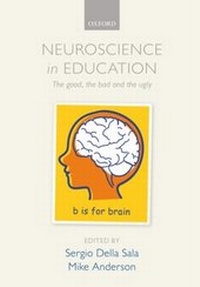
Neuroscience in Education
The Good, the Bad, and the Ugly
1. Auflage
Erschienen am 5. April 2012
402 Seiten
978-0-19-162899-3 (ISBN)
Beschreibung

In the past ten years, there has been growing interest in applying our knowledge of the functioning of the human brain to the field of education-including reading, learning, language and mathematics. This has resulted in the development of a number of new practices in education-some good, some bad and some just crazy. The 'good' is nearly always sound cognitive research that has clear implications for educational practice. The 'bad' is the use of neuroscience jargon to lure the unwary and to give an apparent scientific aura to flawed educational programs with no evidence base and which no reputable neuroscientist would endorse. The 'ugly' is simplistic interpretation and misapplication of cognitive theories leading to errors in their application. More and better could be done if neuroscientists and educationalists acknowledge the limits of their disciplines and start listening to each other. Neuroscience in Education brings together an international group of leading psychologists, neuroscientists, educationalists and geneticists to critically review some of these new developments, examining the science behind these practices, the validity of the theories on which they are based, and whether they work. It will be fascinating reading for anyone involved in education, including teachers, psychologists, neuroscientists, and policy makers as well as interested parents.
Weitere Details
Weitere Ausgaben
Andere Ausgaben
Buch
04/2012
Oxford University Press
97,76 €
Versand in 15-20 Tagen
Inhalt
- Cover
- Contents
- Editors' biographies
- List of contributors
- Section 1 Introductions
- 1 Neuroscience in education: an (opinionated) introduction
- 2 Understanding the neuroscience and education connection: themes emerging from a review of the literature
- Section 2 Theoretical approaches for developing the good, removing the bad and giving the ugly a makeover in neuroscience and education
- 3 Constructing connection: the evolving field of mind, brain and education
- 4 Principles of learning, implications for teaching? Cognitive neuroscience and the classroom
- Section 3 The contribution of cognitive neuroscience to understanding domains of learning
- 5 Reading in alphabetic writing systems: evidence from cognitive neuroscience
- 6 Can teachers count on mathematical neurosciences?
- 7 Working memory: the seat of learning and comprehension
- 8 Applications of cognitive science to education
- Section 4 The influence of neurogenetics on education
- 9 Genetics and genomics: good, bad and ugly
- 10 Genetic sciences for developmentalists: an example of reading ability and disability
- 11 Education 2.0: genetically-informed models for school and teaching
- Section 5 Misuse of neuroscience in the classroom
- 12 Neuroscience, education and educational efficacy research
- 13 Educational double-think
- 14 Rose-tinted? The use of coloured filters to treat reading difficulties
- 15 Don't try this at school: the attraction of 'alternative' educational techniques
- Section 6 Current conjectures from educational neuroscience
- 16 Bridging between brain science and educational practice with design patterns
- 17 Assuring successful lifelong learning: can neuroscience provide the key?
- 18 Educational cognitive neuroscience: designing autism-friendly methods to teach emotion recognition
- 19 Schools and the new ecology of the human mind
- 20 Brain-science and education in Japan
- Section 7 Final remarks
- 21 The good, the bad and the ugly in neuroscience and education: an educator's perspective
- 22 Of all the conferences in all the towns in all the world, what in heaven's name brought us to neuroeducation?
- Author Index
- A
- B
- C
- D
- E
- F
- G
- H
- I
- J
- K
- L
- M
- N
- O
- P
- Q
- R
- S
- T
- U
- V
- W
- X
- Y
- Z
- Subject Index
- A
- B
- C
- D
- E
- F
- G
- H
- I
- J
- K
- L
- M
- N
- O
- P
- Q
- R
- S
- T
- U
- V
- W
- Y
