

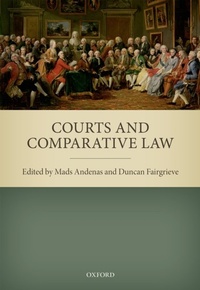
Courts and Comparative Law
1. Auflage
Erschienen am 30. Juli 2015
730 Seiten
978-0-19-105903-2 (ISBN)
Beschreibung

While the role of comparative law in the courts was previously only an exception, foreign sources are now increasingly becoming a source of law in regular use in supreme and constitutional courts. There is considerable variation between the practices of courts and the role of comparative law, and methods remain controversial. In the US, the issue has been one of intense public debate and it is still one of the major dividing issues in the discussion about the role of the courts.
Contributing to the existing discussion of the use of comparative law in the courts, this book provides an inclusive, coherent, and practical analysis of the relevant law and jurisprudence in comparative law in the courts. It examines the consequences for court procedures and the form of judgments, as well as how foreign sources are drawn upon in private international law, European law, administrative law, and constitutional law as well as before general courts. The book also includes case studies of comparative law used in particular spheres of the law, such as tort law and consumer law. Written by practising judges and lawyers as well as leading academics, this book serves as a central reference point concerning the role of comparative law before the courts.
Weitere Details
Weitere Ausgaben
Andere Ausgaben
Mads Andenas | Duncan Fairgrieve
Courts and Comparative Law
Buch
07/2015
Oxford University Press
234,00 €
Versand in 15-20 Tagen
Personen
Mads Andenas QC is Professor of the University of Oslo and the Institute of Advanced Legal Studies, University of London, and former Président-Rapporteur of the United Nations Working Group on Arbitrary Detention and Director of the British Institute of International and Comparative Law.
Duncan Fairgrieve is Senior Research Fellow in Comparative Law and Director of the Product Liability Forum, at the Institute at the British Institute of International and Comparative Law, and Professor of Comparative Law at Université Paris Dauphine PSL.
Inhalt
- 1: Mads Andenas and Duncan Fairgrieve: Introduction - Courts and Comparative Law: In Search of Common Language for Open Legal Systems
- Part I: Conflicts and Comparisons
- 2: Thomas Kadner Graziano: Is it Legitimate and Beneficial for Judges to Use Comparative Law?
- 3: Geoffrey Samuel: Comparative Law and the Courts: What is Comparative and What is Law?
- 4: Bénédicte Fauvarque-Cosson: Foreign Law before the French Courts: The Conflicts of Law Perspective
- 5: Richard Fentiman: Foreign Law in National Courts: A Common Law Perspective
- 6: Guido Alpa: Foreign Law in International Legal Practice
- Part II: Comparative Law Within a European and International Law Context
- 7: Paul Mahoney and Rachael Kondak: Common Ground: A Starting Point or Destination for Comparative Law Analysis by the European Court of Human Rights?
- 8: Koen Lenaerts and Kathleen Gutman: Comparative Law and the Court of Justice of the European Union: Interlocking Legal Orders Revisted
- 9: Ermanno Calzolaio: National Judges and Strasbourg Case Law: Comparative Reflections About the Italian Experience
- 10: Haris Tagaras: Comparative Law and the European Union Civil Service Tribunal
- 11: Martin Gelter and Mathias Siems: Networks, Dialogue, or One-Way Traffic? An Empirical Analysis of Cross-Citations Between Ten of Europe's Highest Courts
- 12: Eirik Bjorge: Comparative Law and the Method of Law: Ascertainment of the International Court of Justice
- Part III: Comparative Law Before Administrative Courts
- 13: Olivier Dutheillet de Lamothe: Comparative Law as an Essential Feature of French Public Law
- 14: Aurélie Bretonneau, Samuel Dahan, Duncan Fairgrieve: Comparative Legal Methodology of the Conseil d'Etat: Towards an Innovative Judicial Process?
- 15: Francois Lichère: The Use of Comparative Law Before the French Administrative Law Courts: Or the Triumph of Castles Over Pyramids
- 16: Aldo Sandulli: The Use of Comparative Law Before the Italian Public Law Courts
- 17: Peter M. Huber and Andreas L. Paulus: Cooperation of Constitutional Courts in Europe - The Openness of the German Constitution to International, European, and Comparative Constitutional Law
- 18: Ana Maria Guerra Martins and Miguel Prata Roque: Judicial Dialogue in a Multilevel Constitutional Network: The Role of the Portuguese Constitutional Court
- 19: Lucio Pegoraro: Judges and Professors: the Influence of Foreign Scholarship on Constitutional Courts' Decisions
- 20: Christa Rautenbach: South Africa: Teaching an 'Old Dog' New Tricks? An Empirical Study of the Use of Foreign Precedents by the South African Constitutional Court (1995-2010)
- 21: Gianluca Gentili: Enhancing Constitutional Self-Understanding through Comparative Law: An Empirical Study of the Use of Foreign Case Law by the Supreme Court of Canada (1982-2013)
- 22: Elaine Mak: Comparative Law Before the Supreme Courts of the UK and the Netherlands: An Empirical and Comparative Analysis
- 23: Judith Resnik: Constructing the 'Foreign': American Law's Relationship to Non-Domestic Sources
- 24: Guy Canivet: The Use of Comparative Law Before the French Private Law Courts
- 25: Alexis Albarian: The Use of Comparative Law Before the French Cour de Cassation : The View From Academia
- 26: Annalisa Aschieri: Italian Courts and Comparative Law
- 27: Martha Minow: The Controversial Status of International and Comparative Law in the United States
- 28: Jeremy Waldron: Foreign Law and the Modern Ius Gentium
- 29: Marta Requejo Isidro and Marta Otero Crespo: Comparative Law Before the Spanish Private Law Courts in the XXI Century
- 30: H. Patrick Glenn: Comparative Legal Reasoning and the Courts: A View from the Americas
- 31: Hannes Unberath and Astrid Stadler: Comparative Law in the German Courts
- 32: Kerstin Steiner: Comparative Law in the Syariah Courts: A Case Study of Singapore, Malaysia, and Brunei
- Part VI: Using Comparative Law: Case Studies
- 33: Bernard Rabatel and Olivier Deparis: Liaison Magistrates: Their Role in International Judicial Cooperation and Comparative Law
- 34: Geraint Howells and Jonathon Watson: Comparative Law in Consumer Litigation
- 35: Romain M. Lorentz: The Use of Comparative Law by Courts in Birth-Related Tort Cases
- 36: His Honour Judge Michael Brooke QC and Ian Forrester Q.C: The Use of Comparative Law in A and Others v National Blood Authority
- 37: Erdem Büyüksagis: What Europeans Can Learn from an Untold Story of Transjudicial Communication: The Swiss-Turkish Experience
- 38: Galateia Kalouta: DCFR in the Courts: The Remaking of Comparative Law
