

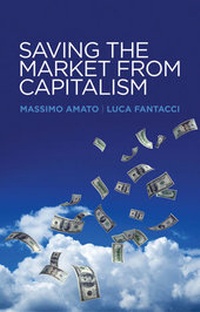
Saving the Market from Capitalism
Beschreibung

Despite the crisis, the power of the financial markets has continued to grow. Far from being subjected to major restructuring or regulation, they continue to rule largely unchecked - laying down economic policies, deposing governments, disrupting social contracts and reshaping international alliances. The time has come to think through more radical proposals for reform - to save other markets from the overwhelming power of the one market that has come to dominate them all, the financial market.
Through a detailed examination of specific measures - from policies aimed at reigning in financial markets to the idea of local currencies that could be used to foster economic development within localities and regions - the authors develop a set of proposals that would help to revitalize markets, free them from the domineering power of finance and re-establish the relationship between creditor and debtor that was severed by the rise of the modern financial system.
Building on their very successful work The End of Finance, this new and timely book will appeal to students of economics, politics and sociology as well as to general readers interested in one of the key issues of our time.
Weitere Details
Weitere Ausgaben
Andere Ausgaben
Personen
Luca Fantacci is Assistant Professor at UniversitàBocconi.
Inhalt
* Acknowledgements
* I Why can we find no exit from the crisis?
* II. The global crisis and the need to reform the international monetary and financial system
* III. The European crisis and the need for a new European Clearing Union
* IV. Local currencies and local finance
Introduction
Finance has a crucial role to play, imparting scope and vitality to the economy. Today, however, a form of finance prevails that does not serve this function well: that of financial markets. The dominion of financial markets is politically illegitimate, economically harmful and humanly aberrant. Exit is imperative. And there are already some signs pointing in that direction. This book is intended as a contribution to the conception and design of an alternative finance.*
Despite the crisis, which is above all their crisis, financial markets have achieved unprecedented power. They dictate the law, literally: they impose economic policies, depose governments they find non-compliant, abrogate rights which they see as constraints, sabotage social contracts and reshape the pattern of international equilibria and alliances. So much is a fact. Some also see it as an advantage, a form of discipline, the 'market discipline' that keeps irresponsible governments under the supervision of markets. And some actually see it as a 'virtual senate', the first step towards a global democracy - one dollar, one vote.1 However, at least until we've added to the list of human rights the right to be identified with one's bank account, there are no legitimate foundations for the rule of financial markets. Far from being a new form of democracy, it's a new form of oppression: the dominance of creditors over debtors. In other periods, which we flatter ourselves we have left far behind us, it lay with the political authority to re-balance relations between creditors and debtors. Today, it blithely sanctions the imbalance. We should have learnt the lesson by now, living as we do in countries with limited sovereignty, placed in the charge of their creditors. But perhaps we haven't fully grasped the situation if we are ready to ask China for loans, as if this could really be a way to save Europe.
In a world short of leadership, and even shorter of ideas to manage relations between debtors and creditors, it is the creditors who give the orders to debtors and 'leaders' alike. These, clearly, are the facts, but we cannot accept them as inexorable necessities - we must learn how they have arisen. And this could lead to the discovery that their apparent necessity is in fact open to alternatives. Another form of finance is indeed possible.
Until we've got our ideas straight, there is no point in blaming the creditor at the door, whether it is a German chancellor, a Chinese premier or an international banker. For every creditor is also a debtor. The really novel feature of the new regime that we have to size up is, rather, its impersonal, anonymous and reticular nature, diffuse yet concentrated. True, there are the big banks that make the market and earn a rent, but there are also our pretensions to see some income from our savings recognized as an acquired right - and this is also a form of rent. So here we are, faced with the new 'breed' exercising its authority through the global financial markets; the faceless breed of creditors with no responsibilities. They hold the world in their hands and manage it despotically, demanding sacrifices and handing out rewards.
For some people, this despotism isn't a problem. As they see it, financial markets need no legitimacy other than that deriving from effective performance: financial markets are the optimal instrument for the efficient allocation of resources. If they are a bit cruel, never mind, so long as they work.
The crisis has, however, also brought out a second fact: the financial markets that rule the world do it badly. The dominant finance holds sway over every field of associated life except for the field most directly concerned (just as the dominant economic science claims competence in any question you may raise, precisely, perhaps, to dissimulate its inability to settle purely economic issues). Today, financial markets are doing everything but financing. They play their game, you're told. But it isn't an innocent game, for it can, and today in practice does, prevent others from doing their work. If finance doesn't finance, businesses cannot do business and workers cannot work. Here lies the dissymmetry that the crisis has shown: while finance can grow even without a corresponding growth in the production of commodities and services, the opposite does not hold - the real economy cannot grow without the support of financial services. As the financial markets accomplished their irresistible rise to power, they moved ever further from the economic activities they were supposed to serve.
The crisis has revealed a division between economy and finance, but it did not produce it. If anything, it's just the opposite: it's the division - for years ignored and denied - between economy and finance that brought on first the financial crisis, and then the crisis in the real economy. This is why any efforts to tackle the economic crisis without rethinking the role of financial markets are misguided and doomed to failure.
Freed from its service to the economy, finance has used its power to force its dictates onto governments. However, one thing needs to be made perfectly clear: finance has been able to encroach on the field of politics and subjugate the real economy only because the market ideology has taken over the field of finance. As the fruit of an ideology that no one, in thirty years, has been able to oppose to any effect, the financial market is, as such, a problem. It's an economic, political and, ultimately, human problem. It's a problem because it has taken it upon itself to marketize a basic human and social relationship, that between debtor and creditor. Put like this, the absurdity of the pretension is strikingly obvious. The need, then, is to reform finance in such a way as to drive it back from the area it has encroached upon and restore it to its abandoned task. Depriving finance of its market form means putting it back in the service of the market economy. And this is a political task. Therefore the first, fundamental and overriding priority of political action is to regain its field of freedom and authority and shake off the yoke of ideology.
The 'end of history', proclaimed triumphantly by the neoliberal doxa on the collapse of the Iron Curtain, was the fruit of a miscalculation. The end of all ideologies was proclaimed, but actually one remained - the ideology of capitalism, in the form of an article of faith attributing the financial markets with all economic rationality. The crisis has shown how ill-founded it was. Even one of its most fervent advocates, Alan Greenspan, had to admit the debacle in a memorable hearing before the US Congress.
It is worth quoting at length the exchanges where Committee Chairman, Senator Waxman, subjected Greenspan to some particularly searching questioning:
Chairman Waxman: The question I have for you is, you had an ideology, you have the belief that free, competitive - and this is your statement - 'I do have an ideology. My judgement is that free, competitive markets are by far the unrivalled way to organise economies. We've tried regulation. None meaningfully worked.' That was your quote. You had the authority to prevent irresponsible lending practices that led to the sub-prime mortgage crisis. You were advised to do so by many others. And now our whole economy is paying its price. Do you feel that your ideology pushed you to make decisions that you wish you had not made? Greenspan: Well, remember that what an ideology is is a conceptual framework for the way people deal with reality. Everyone has one. You have to - to exist, you need an ideology. The question is whether it is accurate - or not. And what I'm saying to you is, yes, I found a flaw. I don't know how significant or permanent it is, but I've been very distressed by that fact. But if I may, may I just finish an answer to the question. Chairman Waxman: You found a flaw?. Greenspan: I found a flaw in the model that I perceived as the critical functioning structure that defines how the world works, so to speak. Chairman Waxman: In other words, you found that your view of the world, your ideology, was not right, it was not working? Greenspan: Precisely. That's precisely the reason I was shocked, because I had been going for forty years or more with very considerable evidence that it was working exceptionally well. But just let me, if I may. Chairman Waxman: Well, the problem is that the time has expired.2It sounds not so much like the 'End of History' so triumphantly announced by Francis Fukuyama as, rather, Samuel Beckett's Endgame: the end of a world. But over the last five years we have witnessed a revival of the financial markets, if not of faith in their infallibility. Here lies the paradox of recent times: although the damage they caused is increasingly evident and their usefulness increasingly questionable, financial markets still reign supreme. Indeed, they've actually gained in power. The ideology wobbles but the regime it has helped establish holds out, as is...
