

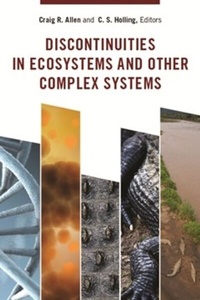
Discontinuities in Ecosystems and Other Complex Systems
1. Auflage
Erschienen am 25. September 2015
288 Seiten
978-0-231-51682-2 (ISBN)
Beschreibung

Following the publication of C. S. Holling's seminal work on the relationship between animal body mass patterns and scale-specific landscape structure, ecologists began to explore the theoretical and applied consequences of discontinuities in ecosystems and other complex systems. Are ecosystems and their components continuously distributed and do they adhere to scaling laws, or are they discontinuous and more complex than early models would have us believe? The resulting propositions over the structure of complex systems sparked an ongoing debate regarding the mechanisms generating discontinuities and the statistical methods used for their detection.
This volume takes the view that ecosystems and other complex systems are inherently discontinuous and that such fields as ecology, economics, and urban studies greatly benefit from this paradigm shift. Contributors present evidence of the ubiquity of discontinuous distributions in ecological and social systems and how their analysis provides insight into complex phenomena. The book is divided into three sections. The first focuses on background material and contrasting views concerning the discontinuous organization of complex systems. The second discusses discontinuous patterns detected in a number of different systems and methods for detecting them, and the third touches on the potential significance of discontinuities in complex systems. Science is still dominated by a focus on power laws, but the contributors to this volume are convinced power laws often mask the interesting dynamics of systems and that those dynamics are best revealed by investigating deviations from assumed power law distributions.
In 2008, a grand conference on resilience was held in Stockholm, hosting 600 participants from around the world. There are now three big centers established with resilience, the most recent one being the Stockholm Resilience Center, with others in Australia (an international coral reef center), Arizona State University's new sustainability center focusing on anthropology, and Canada's emerging social sciences and resilience center. Activity continues to flourish in Alaska, South Africa, and the Untied Kingdom, and a new center is forming in Uruguay.
This volume takes the view that ecosystems and other complex systems are inherently discontinuous and that such fields as ecology, economics, and urban studies greatly benefit from this paradigm shift. Contributors present evidence of the ubiquity of discontinuous distributions in ecological and social systems and how their analysis provides insight into complex phenomena. The book is divided into three sections. The first focuses on background material and contrasting views concerning the discontinuous organization of complex systems. The second discusses discontinuous patterns detected in a number of different systems and methods for detecting them, and the third touches on the potential significance of discontinuities in complex systems. Science is still dominated by a focus on power laws, but the contributors to this volume are convinced power laws often mask the interesting dynamics of systems and that those dynamics are best revealed by investigating deviations from assumed power law distributions.
In 2008, a grand conference on resilience was held in Stockholm, hosting 600 participants from around the world. There are now three big centers established with resilience, the most recent one being the Stockholm Resilience Center, with others in Australia (an international coral reef center), Arizona State University's new sustainability center focusing on anthropology, and Canada's emerging social sciences and resilience center. Activity continues to flourish in Alaska, South Africa, and the Untied Kingdom, and a new center is forming in Uruguay.
Alle Preise
Weitere Details
Weitere Ausgaben
Andere Ausgaben
Craig R. Allen | C. S. Holling
Discontinuities in Ecosystems and Other Complex Systems
Buch
07/2008
Columbia University Press
139,51 €
Versand in 10-20 Tagen
Craig R. Allen | C. S. Holling
Discontinuities in Ecosystems and Other Complex Systems
Buch
07/2008
Columbia University Press
51,85 €
Versand in 10-20 Tagen
Personen
Craig R. Allen is leader of the USGS Nebraska Cooperative Fish and Wildlife Research Unit and associate professor in the School of Natural Resources, University of Nebraska. He serves on the board of directors of the Resilience Alliance and the board of editors of the journal Ecology and Society.
C. S. Holling has worked at the Institute of Resource Ecology, University of British Columbia, and the International Institute for Applied Systems Analysis in Vienna. He has also held the Arthur R. Marshall Jr. Chair in Ecological Sciences at the University of Florida, where he launched a comparative study of the structure and dynamics of ecosystems in the Florida Everglades. He is a coeditor of Columbia University Press's Barriers and Bridges to the Renewal of Regional Ecosystems.
C. S. Holling has worked at the Institute of Resource Ecology, University of British Columbia, and the International Institute for Applied Systems Analysis in Vienna. He has also held the Arthur R. Marshall Jr. Chair in Ecological Sciences at the University of Florida, where he launched a comparative study of the structure and dynamics of ecosystems in the Florida Everglades. He is a coeditor of Columbia University Press's Barriers and Bridges to the Renewal of Regional Ecosystems.
Inhalt
Preface
Part I. Background
1. Panarchies and Discontinuities, by Crawford S. Holling and Garry D. Peterson
2. Self-organization and Discontinuities in Ecosystems, by Garry D. Peterson
3. Discontinuity, by Multimodality, by Graeme S. Cumming and Tanya D. Havlicek
4. Discontinuities in Body-Size Distributions: A View from the Top, by Pablo A. Marquet, by Sebastian Abades
Part II. Patterns
5. Patterns of Landscape Structure, by Discontinuity, by Jan P. Sendzimir
6. Biophysical Discontinuities in the Everglades Ecosystem, by Lance H. Gunderson
7. Discontinuities in the Geographical Range Size of North American Birds and Butterflies, by Carla Restrepo and Natalia Arango
8. Discontinuities in Urban Systems: Comparison of Regional City-Size Structure in the United States, by Ahjond S. Garmestani, by Craig R. Allen
9. Evaluating the Textural Discontinuity Hypothesis: A Case for Adaptive Inference, by Craig A. Stow, by Jan P. Sendzimir
Part III. Consequences
10. Dynamic Discontinuities in Ecologic-Economic Systems, by J. Barkley Rosser Jr.
11. The Ecological Significance of Discontinuities in Body-Mass Distributions, by Jennifer J. Skillen and Brian A. Maurer
12. Cross-Scale Structure and the Generation of Innovation and Novelty in Discontinuous Complex Systems, by Craig R. Allen and Crawford S. Holling
Synthesis
Donald Ludwig
References
Contributors
Index
Part I. Background
1. Panarchies and Discontinuities, by Crawford S. Holling and Garry D. Peterson
2. Self-organization and Discontinuities in Ecosystems, by Garry D. Peterson
3. Discontinuity, by Multimodality, by Graeme S. Cumming and Tanya D. Havlicek
4. Discontinuities in Body-Size Distributions: A View from the Top, by Pablo A. Marquet, by Sebastian Abades
Part II. Patterns
5. Patterns of Landscape Structure, by Discontinuity, by Jan P. Sendzimir
6. Biophysical Discontinuities in the Everglades Ecosystem, by Lance H. Gunderson
7. Discontinuities in the Geographical Range Size of North American Birds and Butterflies, by Carla Restrepo and Natalia Arango
8. Discontinuities in Urban Systems: Comparison of Regional City-Size Structure in the United States, by Ahjond S. Garmestani, by Craig R. Allen
9. Evaluating the Textural Discontinuity Hypothesis: A Case for Adaptive Inference, by Craig A. Stow, by Jan P. Sendzimir
Part III. Consequences
10. Dynamic Discontinuities in Ecologic-Economic Systems, by J. Barkley Rosser Jr.
11. The Ecological Significance of Discontinuities in Body-Mass Distributions, by Jennifer J. Skillen and Brian A. Maurer
12. Cross-Scale Structure and the Generation of Innovation and Novelty in Discontinuous Complex Systems, by Craig R. Allen and Crawford S. Holling
Synthesis
Donald Ludwig
References
Contributors
Index

