

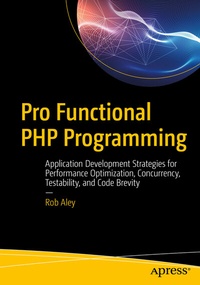
Pro Functional PHP Programming
Application Development Strategies for Performance Optimization, Concurrency, Testability, and Code Brevity
Erschienen am 27. September 2017
XIX, 292 Seiten
978-1-4842-2958-3 (ISBN)
Beschreibung
Bring the power of functional programming to your PHP applications. From performance optimizations to concurrency, improved testability to code brevity, functional programming has a host of benefits when compared to traditional imperative programming.
Part one of Pro Functional PHP Programming takes you through the basics of functional programming, outlining the key concepts and how they translate into standard PHP functions and code. Part two takes this theory and shows you the strategies for implementing it to solve real problems in your new or existing PHP applications.
Functional programming is popular in languages such as Lisp, Scheme and Clojure, but PHP also contains all you need to write functional code. This book will show you how to take advantage of functional programming in your own projects, utilizing the PHP programming language that you already know.
What You'll Learn
Programmers and web developers with experience of PHP who are looking to get more out of their PHP coding and be able to do more with PHP.
Part one of Pro Functional PHP Programming takes you through the basics of functional programming, outlining the key concepts and how they translate into standard PHP functions and code. Part two takes this theory and shows you the strategies for implementing it to solve real problems in your new or existing PHP applications.
Functional programming is popular in languages such as Lisp, Scheme and Clojure, but PHP also contains all you need to write functional code. This book will show you how to take advantage of functional programming in your own projects, utilizing the PHP programming language that you already know.
What You'll Learn
-
Discover functional programming in PHP
-
Work with functional programming functions
-
Design strategies for high-performance applications
-
Manage business logic with functions
-
Use functional programming in object-oriented and procedural applications
-
Employ helper libraries in your application
-
Process big data with functional PHP
Programmers and web developers with experience of PHP who are looking to get more out of their PHP coding and be able to do more with PHP.
Weitere Details
Reihe
Auflage
1st ed.
Sprache
Englisch
Verlagsort
Berkeley
USA
Verlagsgruppe
APRESS
Zielgruppe
Für Beruf und Forschung
Produkt-Hinweis
Reflowable
Illustrationen
XIX, 292 p. 5 illus., 3 illus. in color.
Dateigröße
2,97 MB
ISBN-13
978-1-4842-2958-3 (9781484229583)
DOI
10.1007/978-1-4842-2958-3
Schweitzer Klassifikation
Weitere Ausgaben
Person
Rob Aley has been programming commercially and academically in a variety of programming languages, with over 10 years of PHP experience since graduating in Computer Science from the University of Leeds in 1999.
Having had a varied career working in industries from coffee to condoms, as well as doing freelance software development, Rob is now a "Database Programmer" at the University of Oxford working in healthcare related data analysis. He uses PHP almost exclusively now, out of choice.
When he's not working or writing books, he spends time with his wife, three young children, and most importantly his cat.
Having had a varied career working in industries from coffee to condoms, as well as doing freelance software development, Rob is now a "Database Programmer" at the University of Oxford working in healthcare related data analysis. He uses PHP almost exclusively now, out of choice.
When he's not working or writing books, he spends time with his wife, three young children, and most importantly his cat.
Inhalt
Part One : Function Programming in PHP 7.- 1. Introduction.- 2. Functional Programming - the basics.- 3. Basic Functional Programming.- 4. Working with Functions.- Part Two : Application Development Strategies.- 5. Strategies for High Performance Applications.- 6. Managing Business Logic with Functions.- 7. Using FP in Object-Oriented & Procedural Applications.- 8. Using Helper Libraries in Your Application.- 9. Processing "Big Data" with Functional PHP.- 10. Afterword: Where to now?.- Appendices.- A. Installing PHP and Libraries.- B. Command Line PHP.- C. Functional Programming Resources.
