

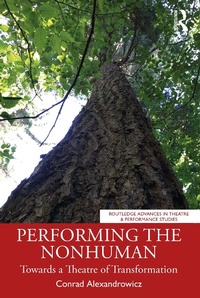
Performing the Nonhuman
Towards a Theatre of Transformation
1. Auflage
Erschienen am 2. September 2024
172 Seiten
978-1-040-12322-5 (ISBN)
Beschreibung

This book radically reimagines theatre/performance pedagogy and dramaturgy in response to the accelerating climate crisis.
This text is founded upon the principle that the theatre is the most anthropocentric of all the arts: the means of its representation, the human figure, is identical with its conventional object, the human narrative, broadly considered. In order to respond ethically to the climate crisis, it must expand its range to include performing as/in response to the nonhuman. Conrad Alexandrowicz concisely explores theoretical approaches to the other-than-human, found in the work of, among others, Jane Bennett, Timothy Morton, Rosi Braidotti, and Cary Wolfe. The implications of this move are far-reaching and commence with displacing realism from its traditional position of dominance. The practices of 20th century physical theatre visionaries such as Tadeusz Kantor, Jacques Lecoq, and Jerzy Grotowski are revisited and reconsidered for their applicability to forms of theatre that might serve the needs of establishing storytelling deriving from nonhuman phenomena. This logically leads to the matter of responding appropriately to Indigenous ways of knowing and being. The work finds guidance in Indigenous, pre-scientific ways of knowing and being, such as those articulated by Robin Wall Kimmerer (Braiding Sweetgrass, 2013). In contemplating our kinship with vegetative life, the work finds inspiration in the latest research into the ways tree communities communicate, collaborate, and share resources, including the work of Suzanne Simard (Finding the Mother Tree, 2021). It next imagines transformations in how theatre is situated, delivered, and received and considers the ways in which the performer/spectator binary may have to be reconfigured, with particular reference to Grotowski's experiments in participatory theatre. It poses an even more provocative question: is such theorized performance work pointing in the direction of some re-imagined version of ritual and ceremony that may find antecedents in pre-Christian European belief and practice? Finally, it locates such eco-theatre in the realm of healing: climate anxiety, depression, and grief on the part of instructors, students, and artists will require us to consider and activate the healing power of the art form; perhaps, the core purpose of all the arts will shift to support the need to generate solace in times of fear, anger, and uncertainty.
This book is intended for instructors, both scholars and performance pedagogues, in theatre and performance studies, as well as graduate and undergraduate students in these areas.
This text is founded upon the principle that the theatre is the most anthropocentric of all the arts: the means of its representation, the human figure, is identical with its conventional object, the human narrative, broadly considered. In order to respond ethically to the climate crisis, it must expand its range to include performing as/in response to the nonhuman. Conrad Alexandrowicz concisely explores theoretical approaches to the other-than-human, found in the work of, among others, Jane Bennett, Timothy Morton, Rosi Braidotti, and Cary Wolfe. The implications of this move are far-reaching and commence with displacing realism from its traditional position of dominance. The practices of 20th century physical theatre visionaries such as Tadeusz Kantor, Jacques Lecoq, and Jerzy Grotowski are revisited and reconsidered for their applicability to forms of theatre that might serve the needs of establishing storytelling deriving from nonhuman phenomena. This logically leads to the matter of responding appropriately to Indigenous ways of knowing and being. The work finds guidance in Indigenous, pre-scientific ways of knowing and being, such as those articulated by Robin Wall Kimmerer (Braiding Sweetgrass, 2013). In contemplating our kinship with vegetative life, the work finds inspiration in the latest research into the ways tree communities communicate, collaborate, and share resources, including the work of Suzanne Simard (Finding the Mother Tree, 2021). It next imagines transformations in how theatre is situated, delivered, and received and considers the ways in which the performer/spectator binary may have to be reconfigured, with particular reference to Grotowski's experiments in participatory theatre. It poses an even more provocative question: is such theorized performance work pointing in the direction of some re-imagined version of ritual and ceremony that may find antecedents in pre-Christian European belief and practice? Finally, it locates such eco-theatre in the realm of healing: climate anxiety, depression, and grief on the part of instructors, students, and artists will require us to consider and activate the healing power of the art form; perhaps, the core purpose of all the arts will shift to support the need to generate solace in times of fear, anger, and uncertainty.
This book is intended for instructors, both scholars and performance pedagogues, in theatre and performance studies, as well as graduate and undergraduate students in these areas.
Weitere Details
Reihe
Auflage
1. Auflage
Sprache
Englisch
Verlagsort
London
Großbritannien
Verlagsgruppe
Taylor & Francis Ltd
Zielgruppe
Für höhere Schule und Studium
Für Beruf und Forschung
ISBN-13
978-1-040-12322-5 (9781040123225)
Copyright in bibliographic data and cover images is held by Nielsen Book Services Limited or by the publishers or by their respective licensors: all rights reserved.
Schweitzer Klassifikation
Weitere Ausgaben
Andere Ausgaben
Buch
09/2024
1. Auflage
Routledge
62,80 €
Versand in 10-20 Tagen
Buch
09/2024
1. Auflage
Routledge
195,80 €
Versand in 10-20 Tagen

Buch
09/2024
Taylor & Francis
Preis leider unbekannt
Lieferbar (Termin auf Anfrage)
Person
Conrad Alexandrowicz is a Professor in the Department of Theatre at the University of Victoria, Victoria, Canada.
Inhalt
Acknowledgements
Introduction: Embracing Eco-theatre and Its Pedagogy
Chapter 1: Theorizing the Nonhuman/Posthuman
Chapter 2: The Master and His Emissary
Chapter 3: Indigenous Ways of Knowing and Being
Chapter 4: Performing in Response to the Nonhuman
Chapter 5: Grotowski Recalled and Reconsidered
Chapter 6: Theatre and/as Ritual
Chapter 7: Mineral, Vegetable, Animal
Coda: A Theatre of Healing and Resilience
Work cited
Index
Introduction: Embracing Eco-theatre and Its Pedagogy
Chapter 1: Theorizing the Nonhuman/Posthuman
Chapter 2: The Master and His Emissary
Chapter 3: Indigenous Ways of Knowing and Being
Chapter 4: Performing in Response to the Nonhuman
Chapter 5: Grotowski Recalled and Reconsidered
Chapter 6: Theatre and/as Ritual
Chapter 7: Mineral, Vegetable, Animal
Coda: A Theatre of Healing and Resilience
Work cited
Index
