

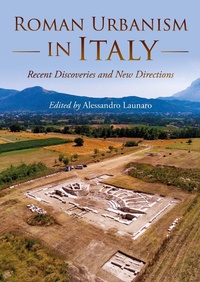
Roman Urbanism in Italy
Recent Discoveries and New Directions
Erschienen am 15. Februar 2024
272 Seiten
979-8-88857-037-1 (ISBN)
Beschreibung
This study presents new evidence for the development of commerce and inter-regional trade through survey and analysis of urban layout and architecture.
The study of Roman urbanism - especially its early (Republican) phases - is extensively rooted in the evidence provided by a series of key sites, several of them located in Italy. Some of these Italian towns (e.g. Fregellae, Alba Fucens, Cosa) have received a great deal of scholarly attention in the past and they are routinely referenced as textbook examples, framing much of our understanding of the broad phenomenon of Roman urbanism. However, discussions of these sites tend to fall back on well-established interpretations, with relatively little or no awareness of more recent developments. This is remarkable, since our understanding of these sites has since evolved thanks to new archaeological fieldwork, often characterised by the pursuit of new questions and the application of new approaches. Similarly, new evidence from other sites has since prompted a reconsideration of time-honoured views about the nature, role and long-term trajectory of Roman towns in Italy.
Tracing its origins in the Laurence Seminar on Roman Urbanism in Italy: recent discoveries and new directions, which took place at the Faculty of Classics of the University of Cambridge (27-28 May 2022), this volume brings together scholars whose recent work at key sites is contributing to expand, change or challenge our current knowledge and understanding of Roman urbanism in Italy. The individual chapters showcase some of the most recent methods and approaches applied to the study of Roman towns, discussing the broader implications of fresh archaeological discoveries from both well known and less widely known sites, from the Po Plain to Southern Italy, from the Republican to the Late Antique period (and beyond).
The study of Roman urbanism - especially its early (Republican) phases - is extensively rooted in the evidence provided by a series of key sites, several of them located in Italy. Some of these Italian towns (e.g. Fregellae, Alba Fucens, Cosa) have received a great deal of scholarly attention in the past and they are routinely referenced as textbook examples, framing much of our understanding of the broad phenomenon of Roman urbanism. However, discussions of these sites tend to fall back on well-established interpretations, with relatively little or no awareness of more recent developments. This is remarkable, since our understanding of these sites has since evolved thanks to new archaeological fieldwork, often characterised by the pursuit of new questions and the application of new approaches. Similarly, new evidence from other sites has since prompted a reconsideration of time-honoured views about the nature, role and long-term trajectory of Roman towns in Italy.
Tracing its origins in the Laurence Seminar on Roman Urbanism in Italy: recent discoveries and new directions, which took place at the Faculty of Classics of the University of Cambridge (27-28 May 2022), this volume brings together scholars whose recent work at key sites is contributing to expand, change or challenge our current knowledge and understanding of Roman urbanism in Italy. The individual chapters showcase some of the most recent methods and approaches applied to the study of Roman towns, discussing the broader implications of fresh archaeological discoveries from both well known and less widely known sites, from the Po Plain to Southern Italy, from the Republican to the Late Antique period (and beyond).
