

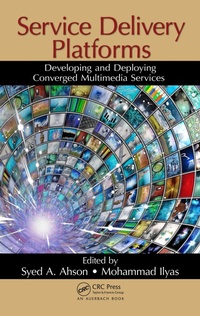
Service Delivery Platforms
Developing and Deploying Converged Multimedia Services
1. Auflage
Erschienen am 16. März 2011
406 Seiten
978-1-4398-0090-4 (ISBN)
Beschreibung

It is becoming increasingly important for telecom operators to be able to provide service delivery platforms (SDP) quickly and efficiently in order to improve the time-to-revenue of value-added services. Presenting a rapid architecture solution to meet this challenge, Service Delivery Platforms: Developing and Deploying Converged Multimedia Services supplies a comprehensive overview of the technical aspects of service and content delivery platforms.
Leading experts walk you through the entire user experience-including requirements for the user terminal, SDP, networks, and support systems. You'll start by examining content and media in modern networks. Evaluating basic functions and feasibility, you'll learn the fundamental requirements of service delivery platforms and various types of applications and formats. You'll also cover various delivery mechanisms including SRP, WAP, messaging, streaming, and broadcast. The book also:
Introduces the Unified Service Model (USM), a holistic approach to creating effective designs for a range of services
Proposes a self-adaptive service provisioning middleware framework (ASPF) that enables seamless omnipresent service provisioning to mobile users
Presents a general policy framework for web services, including policy generation, enforcement, publication, negotiation, and evolution
Unveils an SOA-based enterprise application integration platform composed of a basic integration platform, a supported platform, administration tool, and development tools
From basic concepts to research grade material, this complete reference considers enabling technologies, security issues, DRM, and the evolving role of SDPs. It includes a comparative study of mobile data service development in the United States, China, and South Korea.
Leading experts walk you through the entire user experience-including requirements for the user terminal, SDP, networks, and support systems. You'll start by examining content and media in modern networks. Evaluating basic functions and feasibility, you'll learn the fundamental requirements of service delivery platforms and various types of applications and formats. You'll also cover various delivery mechanisms including SRP, WAP, messaging, streaming, and broadcast. The book also:
Introduces the Unified Service Model (USM), a holistic approach to creating effective designs for a range of services
Proposes a self-adaptive service provisioning middleware framework (ASPF) that enables seamless omnipresent service provisioning to mobile users
Presents a general policy framework for web services, including policy generation, enforcement, publication, negotiation, and evolution
Unveils an SOA-based enterprise application integration platform composed of a basic integration platform, a supported platform, administration tool, and development tools
From basic concepts to research grade material, this complete reference considers enabling technologies, security issues, DRM, and the evolving role of SDPs. It includes a comparative study of mobile data service development in the United States, China, and South Korea.
Weitere Details
Auflage
1. Auflage
Sprache
Englisch
Verlagsort
London
Großbritannien
Verlagsgruppe
Taylor & Francis Ltd
Zielgruppe
Für Beruf und Forschung
Designers, planners, and researchers of emerging wireless communication networks.
Illustrationen
154 s/w Abbildungen, 14 s/w Tabellen
154 b/w images, 14 tables and 0-50 equations
ISBN-13
978-1-4398-0090-4 (9781439800904)
Copyright in bibliographic data and cover images is held by Nielsen Book Services Limited or by the publishers or by their respective licensors: all rights reserved.
Schweitzer Klassifikation
Weitere Ausgaben
Andere Ausgaben
Syed A. Ahson | Mohammad Ilyas
Service Delivery Platforms
Developing and Deploying Converged Multimedia Services
Buch
09/2019
1. Auflage
CRC Press
80,00 €
Versand in 15-20 Tagen
Syed A. Ahson | Mohammad Ilyas
Service Delivery Platforms
Developing and Deploying Converged Multimedia Services
Buch
03/2011
1. Auflage
Taylor & Francis
172,50 €
Versand in 15-20 Tagen
Personen
About the Editors:
Syed Ahson is a Senior Staff Software Engineer with Future Technologies and Solutions, Motorola Inc. As part of the Data Applications group, Syed focuses on Internet Browser, Messaging (MMS, SMS) and Over-the-Air programming (including data synchronization) for cellular phones. Syed has extensive experience of Wireless Data Protocols (WAP 2.0 MMS, Wireless Email, Wireless Profiled TCP, Wireless Profiled HTTP) and Voice over IP Protocols (H.323, RTSP, RTP). Prior to joining Motorola, Inc, Syed was a software developer with NetSpeak Corporation (now part of Net2Phone), a leading provider of Voice over IP solutions.
Syed is a co-author of Smartphones, an International Engineering Consortium (IEC) Research Report. Syed is a co-editor of the Handbook of Wireless Local Area Networks: Applications, Technology, Security, and Standards, (CRC Press). Syed has published several research articles and taught computer engineering courses as adjunct faculty at Florida Atlantic University, Boca Raton, USA. Syed received his MS degree in Computer Engineering in July 1998 at Florida Atlantic University. He received his B.Sc. degree in Electrical Engineering from Aligarh Muslim University, India, in 1995.
Dr. Mohammad Ilyas received his B.Sc. degree in Electrical Engineering from the University of Engineering and Technology, Lahore, Pakistan, in 1976. From March 1977 to September 1978, he worked for the Water and Power Development Authority, Pakistan. In 1978, he was awarded a scholarship for his graduate studies and he completed his MS degree in Electrical and Electronic Engineering in June 1980 at Shiraz University, Shiraz, Iran. In September 1980, he joined the doctoral program at Queen's University in Kingston, Ontario, Canada. He completed his Ph.D. degree in 1983. His doctoral research was about switching and flow control techniques in computer communication networks.
Syed Ahson is a Senior Staff Software Engineer with Future Technologies and Solutions, Motorola Inc. As part of the Data Applications group, Syed focuses on Internet Browser, Messaging (MMS, SMS) and Over-the-Air programming (including data synchronization) for cellular phones. Syed has extensive experience of Wireless Data Protocols (WAP 2.0 MMS, Wireless Email, Wireless Profiled TCP, Wireless Profiled HTTP) and Voice over IP Protocols (H.323, RTSP, RTP). Prior to joining Motorola, Inc, Syed was a software developer with NetSpeak Corporation (now part of Net2Phone), a leading provider of Voice over IP solutions.
Syed is a co-author of Smartphones, an International Engineering Consortium (IEC) Research Report. Syed is a co-editor of the Handbook of Wireless Local Area Networks: Applications, Technology, Security, and Standards, (CRC Press). Syed has published several research articles and taught computer engineering courses as adjunct faculty at Florida Atlantic University, Boca Raton, USA. Syed received his MS degree in Computer Engineering in July 1998 at Florida Atlantic University. He received his B.Sc. degree in Electrical Engineering from Aligarh Muslim University, India, in 1995.
Dr. Mohammad Ilyas received his B.Sc. degree in Electrical Engineering from the University of Engineering and Technology, Lahore, Pakistan, in 1976. From March 1977 to September 1978, he worked for the Water and Power Development Authority, Pakistan. In 1978, he was awarded a scholarship for his graduate studies and he completed his MS degree in Electrical and Electronic Engineering in June 1980 at Shiraz University, Shiraz, Iran. In September 1980, he joined the doctoral program at Queen's University in Kingston, Ontario, Canada. He completed his Ph.D. degree in 1983. His doctoral research was about switching and flow control techniques in computer communication networks.
Inhalt
Content and Media in Modern Telecommunication Networks. The User Experience (Services, Applications, and Terminals/Handsets). Service Delivery Platform Requirements. Network Requirements.
