

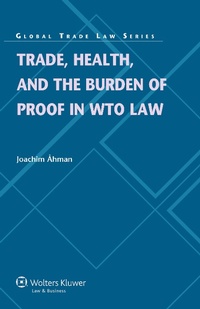
Trade, Health, and the Burden of Proof in WTO Law
Erschienen am 5. Dezember 2011
352 Seiten
978-90-411-4291-7 (ISBN)
Beschreibung

Most of us do not immediately think of health protection measures as trade barriers. Yet to the trade liberalization interest they are often exactly that--"hidden protectionism" some would say. When the conflict between trade and health hardens into a confrontation, allocation of the burden of proof becomes the critical factor in determining the outcome. And the outcome of such a WTO dispute may affect a very large number of people. This important book examines the WTO provisions applicable to health protection measures from a burden of proof perspective, with an up-to-date and thorough analysis of all relevant case law. It clearly demonstrates and explains the following and more: - how burden of proof decisions, following from the burden of proof concept as it has developed in national legal systems and in general international law, may favour or disfavor different interests;
- the problems that may occur when risk-related facts have to be proved;how the legal facts in the WTO provisions specifically regulating the adoption of health protection measures have been interpreted in case law; and
- how the burden of proof concept can be used to balance the conflicting interests in ways other than those used so far.
No other source offers such a comprehensive analysis of WTO provisions applicable to health protection measures. This book's burden of proof perspective makes it an especially valuable resource for trade law experts, WTO member representatives, and interested NGOs seeking to understand and discuss the balancing of health protection and trade liberalization.
- the problems that may occur when risk-related facts have to be proved;how the legal facts in the WTO provisions specifically regulating the adoption of health protection measures have been interpreted in case law; and
- how the burden of proof concept can be used to balance the conflicting interests in ways other than those used so far.
No other source offers such a comprehensive analysis of WTO provisions applicable to health protection measures. This book's burden of proof perspective makes it an especially valuable resource for trade law experts, WTO member representatives, and interested NGOs seeking to understand and discuss the balancing of health protection and trade liberalization.
Weitere Details
Weitere Ausgaben
Andere Ausgaben
Joachim Ahman
Trade, Health, and the Burden of Proof in WTO Law
Buch
12/2011
1. Auflage
Kluwer Law International
263,71 €
Versand in 10-20 Tagen
Inhalt
- Intro
- Title Page
- Contents
- Copyright Page
- List of Abbreviations
- Acknowledgements
- Chapter 1 Introduction
- Chapter 2 The Burden of Proof Concept
- 2.1 Introduction
- 2.2 The Law and the Facts
- 2.2.1 Legal Consequences Attached to Facts
- 2.2.2 Abstract and Concrete Legal Facts
- 2.2.3 Evidentiary Facts
- 2.2.4 Questions of Law and Questions of Fact
- 2.2.5 Who Should Provide Answers to Questions of Law?
- 2.2.5.1 The Principle Jura Novit Curia
- 2.2.5.2 The Prohibition of Non Liquet
- 2.2.6 Who Should Provide Answers to Questions of Fact?
- 2.3 The Establishment of the Factum Probandum
- 2.3.1 A Probabilistic Approach
- 2.3.2 The Persuasive Burden
- 2.3.3 The Standard of Proof
- 2.3.4 Arguments for Allocating the Persuasive Burden to a Certain Party and for Applying a Certain Standard of Proof
- 2.3.4.1 Reducing the Risk of Erroneous Outcomes
- 2.3.4.2 Type I and Type II Errors
- 2.3.4.3 Four Categories of Arguments
- 2.3.5 Evidence and the Burden to Prove Evidentiary Facts
- 2.3.6 The Evaluation of Evidence and the Tactical Burden
- 2.3.7 The Original Probability
- 2.3.8 Presumptions
- 2.3.9 Prima Facie Evidence
- 2.3.10 The Standard of Review
- 2.4 The Principle Actori Incumbit Probatio
- 2.4.1 General Burden of Proof Principles
- 2.4.2 How to Apply the Principle Actori Incumbit Probatio
- 2.4.3 General Rules and Exceptions
- 2.4.4 Arguments for Allocating the Burden to the Claimant under General Rules
- 2.4.5 Arguments for Allocating the Burden to the Defendant under Exceptions
- 2.4.6 Arguments for Allocating the Burden to the Claimant under Exceptions and to the Defendant under General Rules
- 2.5 The Health Risk as a Factum Probandum
- 2.5.1 Two Layers of Uncertainty
- 2.5.2 The Definition of Risk
- 2.5.3 Risk and Uncertainty
- 2.5.4 Analysing Uncertainty
- 2.5.5 Risk Assessment and Risk Management
- 2.5.6 Uncertainty Related to the Health Risk and Uncertainty Related to the Standard of Proof
- 2.6 Summary and Conclusions
- Chapter 3 The Burden of Proof in WTO Law
- 3.1 Introduction
- 3.2 The Proceedings
- 3.2.1 Initiating a Proceeding
- 3.2.2 Consultations
- 3.2.3 Panel Proceedings
- 3.2.4 Appellate Body Proceedings
- 3.2.5 Recommendations and Implementation
- 3.3 The Law and the Facts
- 3.3.1 Questions of Law
- 3.3.2 Questions of Fact
- 3.4 The Persuasive Burden
- 3.4.1 The Principle Actori Incumbit Probatio
- 3.4.2 General Rules and Exceptions
- 3.4.2.1 The Approach in Case Law
- 3.4.2.2 Exceptions in the First Sense
- 3.4.2.3 Exceptions in the Second Sense
- 3.5 The Standard of Proof
- 3.6 Establishing a Prima Facie Case
- 3.7 Summary and Conclusions
- Chapter 4 Health Protection Measures under the GATT 1994
- 4.1 Introduction
- 4.2 Relevant Provisions and Order of Analysis
- 4.3 Article XX(b)
- 4.3.1 The Provision
- 4.3.2 Is the Measure's Objective to Protect Human Life or Health?
- 4.3.2.1 Where to Look for the Measure's Objective?
- 4.3.2.2 Measures with Several Objectives
- 4.3.2.3 What Health Risks?
- 4.3.2.4 Does the Health Risk Exist?
- 4.3.2.5 The Life and Health of What Humans?
- 4.3.3 Is the Measure Necessary to Protect Human Life or Health?
- 4.3.3.1 The Necessity of What?
- 4.3.3.2 The Different Steps of the Necessity Analysis
- 4.3.3.3 The Measure's Contribution to the Achievement of the Objective
- 4.3.3.4 The Importance of the Measure's Objective
- 4.3.3.5 The Trade Restrictiveness of the Measure
- 4.3.3.6 Weighing and Balancing the Factors
- 4.3.3.7 The Comparison with Alternative Measures
- 4.4 The Chapeau of Article XX
- 4.4.1 The Provision
- 4.4.2 The Purpose of the Chapeau
- 4.4.3 The Measure Itself and the Application of the Measure
- 4.4.4 Has the Application of the Measure Resulted in Arbitrary or Unjustifiable Discrimination?
- 4.4.4.1 Three Elements
- 4.4.4.2 Between Countries Where the Same Conditions Prevail
- 4.4.4.3 Discrimination
- 4.4.4.4 Arbitrary or Unjustifiable
- 4.4.5 Has the Application of the Measure Resulted in a Disguised Restriction?
- 4.5 Summary of the Legal Facts Relating to the Health Risk
- 4.6 The Burden of Proof
- 4.6.1 Case Law
- 4.6.2 Effects and Arguments
- 4.7 Summary and Conclusions
- Chapter 5 Health Protection Measures under the SPS Agreement
- 5.1 Introduction
- 5.2 Relevant Provisions and Order of Analysis
- 5.3 Scientific Justification
- 5.3.1 Articles 5.1 and 5.2
- 5.3.1.1 The Provisions
- 5.3.1.2 Two Types of Risk Assessment
- 5.3.1.3 The Elements of the First Type of Risk Assessment
- 5.3.1.4 The Elements of the Second Type of Risk Assessment
- 5.3.1.5 The Risk Assessor
- 5.3.1.6 Risk Assessment and Risk Management
- 5.3.1.7 The Existence of a Risk
- 5.3.1.8 Specificity
- 5.3.1.9 The Scientific Basis
- 5.3.1.10 Appropriate to the Circumstances
- 5.3.1.11 Risk Assessment Techniques Developed by the Relevant International Organizations
- 5.3.1.12 Is the Measure Based on the Risk Assessment?
- 5.3.2 Article 2.2
- 5.3.2.1 The Provision
- 5.3.2.2 Is the Measure Necessary to Protect Human Life or Health?
- 5.3.2.3 Is the Measure Based on Scientific Principles and Not Maintained without Sufficient Scientific Evidence?
- 5.3.2.4 The Relationship between Articles 2.2 and 5.1
- 5.3.3 Article 5.7
- 5.3.3.1 The Provision
- 5.3.3.2 The Relationship between Article 5.7 and Articles 2.2 and 5.1
- 5.3.3.3 The Relationship between Article 5.7 and Articles 2.3, 5.5, and 5.6
- 5.3.3.4 Is There a Situation Where Relevant Scientific Evidence Is Insufficient?
- 5.3.3.5 Has the Measure Been Adopted on the Basis of Available Pertinent Information?
- 5.3.3.6 Has the Member Sought to Obtain the Additional Information Necessary for a More Objective Assessment of Risk?
- 5.3.3.7 Has the Member Reviewed the Measure within a Reasonable Period of Time?
- 5.3.4 Summary of the Legal Facts Relating to the Health Risk
- 5.3.5 The Burden of Proof
- 5.4 Consistency and Non-discrimination
- 5.4.1 Article 5.5
- 5.4.1.1 The Provision
- 5.4.1.2 Has the Member Adopted Levels of Protection in Several Different Situations?
- 5.4.1.3 Do the Levels of Protection Exhibit an Arbitrary or Unjustifiable Distinction?
- 5.4.1.4 Has the Distinction Resulted in Discrimination or a Disguised Restriction?
- 5.4.2 Article 2.3
- 5.4.2.1 The Provision
- 5.4.2.2 Does the Measure Arbitrarily or Unjustifiably Discriminate?
- 5.4.2.3 Has the Measure Been Applied in a Manner, Which Constitutes a Disguised Restriction?
- 5.4.3 Summary of the Legal Facts Relating to the Health Risk
- 5.4.4 The Burden of Proof
- 5.5 Trade Restrictiveness
- 5.5.1 Article 5.6
- 5.5.1.1 The Provision
- 5.5.1.2 Does a Reasonably Available Alternative Measure Exist?
- 5.5.1.3 Does the Alternative Measure Achieve the Level of Protection?
- 5.5.1.4 Is the Alternative Measure Significantly Less Trade Restrictive?
- 5.5.2 Summary of the Legal Facts Relating to the Health Risk
- 5.5.3 The Burden of Proof
- 5.6 Harmonization
- 5.6.1 Article 3.1
- 5.6.1.1 The Provision
- 5.6.1.2 Does a Relevant Standard Exist?
- 5.6.1.3 Is the Measure Based on the Standard?
- 5.6.2 Article 3.2
- 5.6.2.1 The Provision
- 5.6.2.2 Does the Measure Conform to the Standard?
- 5.6.2.3 The Presumption of Consistency
- 5.6.3 Article 3.3
- 5.6.3.1 The Provision
- 5.6.3.2 Measures Deviating from Standards
- 5.6.3.3 Scientific Justification of Deviating Measures
- 5.6.4 Summary of the Legal Facts Relating to the Health Risk
- 5.6.5 The Burden of Proof
- 5.7 The Burden of Proof
- 5.7.1 Case Law
- 5.7.2 Effects and Arguments
- 5.8 Summary and Conclusions
- Chapter 6 Summary and Conclusions
- Bibliography
- Table of Cases
- Index
