

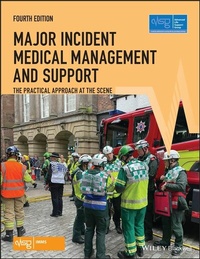
Major Incident Medical Management and Support
Beschreibung

This new edition has been fully revised to ensure doctors, nurses and paramedics are able to prepare for, and implement, a structured response to major incidents such as those involving hazardous materials, natural disasters, mass gatherings, multiple burn casualties and large numbers of children. The wide range of topics covered include communications, personal and medical equipment, command and control, planning, assessment and the psychological aspects of major incidents. This new edition also includes:
* Practical information and clear guidelines for medical professionals delivering care to multiple casualties at the scene both during and after an incident
* The organisations, structures and different roles involved in the medical management of major incidents
* Contributions from an international team of experts in fields including emergency medicine and nursing, fire and rescue services, disaster preparedness and response and emergency transport
* Appendices covering responsibility for the dead, radio use and voice procedures, the media, the hospital response and the steps to take beyond the immediate situation
Major Incident Medical Management and Support is required reading for all those undertaking the MIMMS education programme.
The Advanced Life Support Group (ALSG) improves outcomes for people in life-threatening situations, anywhere along the healthcare pathway, anywhere in the world. ALSG is a leading medical education charity and have delivered advanced life support training to over 225 000 clinicians in 44 countries, across 5 continents, for over 25 years.
For more information on the complete range of Wiley medical student and junior doctor publishing, please visit: www.wiley.com
For more information on the Advanced Life Support Group, please visit: www.alsg.org
To receive automatic updates on Wiley books and journals, join our email list. Sign up today at www.wiley.com/email
This new edition is also available as an e-book. For more details, please see www.wiley.com/buy/9781119348382
TITLES OF RELATED INTEREST
Major Incident Medical Management and Support: The Practical Approach in the Hospital,
2nd Edition
Advanced Life Support Group
9781119501015
December 2018
Pre-Obstetric Emergency Training:
A Practical Approach
2nd Edition
Advanced Life Support Group
9781119348382
August 2018
Pre-Hospital Paediatric Life Support:
A Practical Approach to Emergencies
3rd Edition
Advanced Life Support Group
9781118339763
October 2017
Weitere Details
Weitere Ausgaben
Andere Ausgaben
Personen
Inhalt
International reference group viii
Contributors to fourth edition ix
Contributors to previous editions x
Foreword to fourth edition xii
Preface to fourth edition xiii
Preface to first edition xiv
Acknowledgements xv
Contact details and further information xvi
How to use your textbook xvii
Part I: Introduction 1
1 Introduction 3
2 The structured approach to major incidents 13
Part II: Organisation 19
3 Health service structure and roles 21
4 Emergency service organisation and roles 35
5 Support service organisation and roles 39
Part III: Preparation 41
6 Planning 43
7 Personal equipment 47
8 Medical equipment 53
9 Training 61
Part IV: Management 63
10 Command and control 65
11 Health service scene layout 75
12 Safety at the scene 79
13 Communications 83
14 Assessment 89
Part V: Medical support 93
15 Triage 95
16 Treatment 109
17 Transport 115
18 Responsibility for the dead 121
Part VI: Special incidents 125
19 Hazardous materials and CBRNe incidents 127
20 Incidents involving large numbers of children 133
21 Incidents involving multiple casualties with burns 139
22 Mass gatherings 141
23 Natural disasters 145
24 Uncompensated major incidents 149
25 Marauding terrorist attacks 155
Part VII: Appendices 157
A Psychological aspects of major incidents 159
B The media 161
C Logs 165
D Radio use and voice procedures 169
E The hospital response 179
F Human factors 185
Template annexe of local highlights 193
Glossary 207
Index 209
CHAPTER 1
Introduction
Learning outcomes
After reading this chapter you will be able to:
- Describe what defines a major incident
- Discuss the classifications of a major incident
1.1 What is a major incident?
In health service terms a major incident can be defined as any incident where the location, number, severity or type of live casualties requires extraordinary resources. The number of casualties alone does not determine a major incident for the health services. Thirty minor injuries that self-evacuate from the scene may be managed effectively by one hospital without the requirement for additional pre-hospital or hospital resources. The same number of severely injured casualties will almost certainly require extraordinary resources. Certain medical resources may be very scarce (for example, intensive care beds) or regionalised (for example, burns surgery), and small incidents with relatively few casualties can therefore require early involvement of regional or national resources. Where there are large numbers of dead with few or no survivors, there is often no major incident for the health services. An incident in a remote or difficult to access location may also demand greater resources to effect the rescue of casualties.
Factors that influence the declaration of a major incident for the health service
- Number of casualties
- Severity of injury
- Numbers of medical responders
- Access to medical resources
- Location (urban vs rural)
In a similar vein, a major incident for one emergency service may not be a major incident for all other services. Where fire or chemical spillage is the predominant issue, without risk to life, a major incident response will be required from the fire and rescue service without the same level of response from other services. Where public disorder is the predominant problem, the principal response will be from the police. The following examples illustrate this point:
On 2 September 1666 a fire started in a baker's shop on Pudding Lane; it lasted 4 days and left 80% of London's buildings in ruins. A disaster on such a scale is hard to imagine and would certainly overwhelm the resources of the modern fire and rescue service. In fact, only a handful of people died in this, the Great Fire of London.
On 27 March 1977 a KLM (Royal Dutch Airlines) Boeing 747 collided with a PanAM Boeing 747 aircraft during take-off in fog. All passengers and members of the crew died (total 583). This is the worst aviation disaster in history but had very little impact on the health response as all the casualties were dead.
In January 1975 a large petrol tanker hit the Tasman Bridge, a major transport structure linking the suburbs of Hobart, Tasmania. Thirteen people died, no one was left injured.
In April 1990 the passenger ferry M/S Scandinavian Star caught fire on the Swedish west coast. Most passengers were asleep and smoke inhalation caused the death of 158 people. The surviving passengers were mostly uninjured.
A health service major incident is influenced by:
- Number of live casualties.
- Severity of injuries.
- Access to medical resources (ITU beds, burns beds).
- Incident location (remote vs urban).
Local highlights: Major incident definitions
A major incident requiring extraordinary resources occurred three or four times per year in the UK (with a range from 0 to 11 incidents per annum) in the 30 years from 1966 to 1996. Although there is a particular emphasis on terrorist-related incidents in the west over the last two decades, it must be remembered that non-terrorist-related incidents continue to occur and are frequently associated with greater morbidity and mortality.
1.2 Classification of major incidents
It is convenient to classify major incidents in three ways:
- Natural or man-made.
- Simple or compound.
- Compensated or uncompensated.
Natural incidents
A natural major incident is the result of a natural event such as an earthquake, flood, fire, volcano, tsunami, drought, famine or pestilence (Table 1.1). To some extent, the natural disaster will be self-propagating: following a flood or earthquake those left homeless and starving will be vulnerable to the diseases associated with squalor.
Table 1.1 Natural incidents (number of injured not accurately known)
Date Type Place Estimated casualties 28 July 1976 Earthquake T'angshan, China 655 000 dead February 1983 Bushfires Australia 76 dead, 1100 injured 19 September 1985 Earthquake Mexico City, Mexico 40 000 dead 7 December 1988 Earthquake Armenia 55 000 dead 17 January 1995 Earthquake Kobe, Japan 6398 dead 27 June 1998 Earthquake Adana-Ceyan, Turkey 145 dead, 1500 injured 26 December 2004 Tsunami Indian Ocean 225 000 dead 12 May 2008 Earthquake Great Sichuan, China 69 000 dead, 375 000 injured 12 January 2010 Earthquake Haiti 220 000 dead, 300 000 injured 22 February 2011 Earthquake Christchurch, New Zealand 185 dead, 2000 injured 11 March 2011 Earthquake and tsunami Japan 21 000 dead, 5888 injured 27 December 2011 Floods Philippines Over 1500 dead, 1.6 million affected 29 October 2012 Hurricane Sandy North America Over 209 dead 7 November 2013 Typhoon Haiyan Philippines and Vietnam 6150 dead June-November 2014 Ebola epidemic West Africa Over 11 000 dead 25 April 2015 Earthquakes Nepal 8857 dead, 21 952 injured 6 February 2016 Earthquake Southern Taiwan 117 dead, 550 injured September 2017 Hurricane Irma Caribbean and Florida 134 dead 7 and 19 September 2016 Earthquakes Mexico 350 dead 28 September 2018 Earthquake Sulawesi, Indonesia 4340 dead, 10 700 injured June 2019-October 2020 Floods India Over 4000 dead 4 April 2021 Tropical cyclone East Timor, Indonesia and Australia 229 deadMan-made incidents
The range of man-made incidents is huge, but certain patterns are clear. A major incident can occur whenever large numbers of people gather together to travel, to work or for leisure. In some circumstances, the incident will be the result of deliberate terrorist activity.
Transport incidents
These are the commonest type of man-made major incidents. All forms of bulk transport of people are associated with a serious list of incidents (Table 1.2). The worst ever road traffic accident occurred in the Salang tunnel in Afghanistan in 1982 when a petrol tanker exploded. Such was the degree of destruction that only an estimate could be made of the number of dead of between 1100 and 2700.
Table 1.2 Transport incidents
Date Type Place Casualties 28 February 1975 London Underground crash Moorgate, UK 43 dead, 74 injured 18 January 1977 Rail crash/bridge collapse Granville, NSW, Australia 83 dead, 213 injured 2 June 1980 Rail crash Storsund, Sweden 11 dead, 40 injured 22 August 1985 Aircraft fire Manchester, UK 55 dead, 80 injured 6 March 1987 Ferry capsized Zeebrugge, Belgium 137 dead, 402 injured 18 November 1987 Underground fire King's Cross St Pancras Tube Station, London, UK 31 dead, 100 injured 22 December 1988 Aircraft bomb Lockerbie, UK 270 dead 8 January 1989 Aircraft crash Kegworth (M1),...