

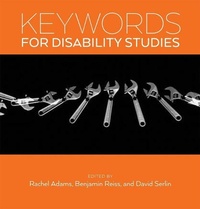
Keywords for Disability Studies
1. Auflage
Erschienen am 14. August 2015
277 Seiten
978-1-4798-1214-1 (ISBN)
Beschreibung

Introduces key terms, concepts, debates, and histories for Disability Studies
Keywords for Disability Studies aims to broaden and define the conceptual framework of disability studies for readers and practitioners in the field and beyond. The volume engages some of the most pressing debates of our time, such as prenatal testing, euthanasia, accessibility in public transportation and the workplace, post-traumatic stress, and questions about the beginning and end of life.
Each of the 60 essays in Keywords for Disability Studies focuses on a distinct critical concept, including "ethics," "medicalization," "performance," "reproduction," "identity," and "stigma," among others. Although the essays recognize that "disability" is often used as an umbrella term, the contributors to the volume avoid treating individual disabilities as keywords, and instead interrogate concepts that encompass different components of the social and bodily experience of disability. The essays approach disability as an embodied condition, a mutable historical phenomenon, and a social, political, and cultural identity.
An invaluable resource for students and scholars alike, Keywords for Disability Studies brings the debates that have often remained internal to disability studies into a wider field of critical discourse, providing opportunities for fresh theoretical considerations of the field's core presuppositions through a variety of disciplinary perspectives.
Visit keywords.nyupress.org for online essays, teaching resources, and more.
Keywords for Disability Studies aims to broaden and define the conceptual framework of disability studies for readers and practitioners in the field and beyond. The volume engages some of the most pressing debates of our time, such as prenatal testing, euthanasia, accessibility in public transportation and the workplace, post-traumatic stress, and questions about the beginning and end of life.
Each of the 60 essays in Keywords for Disability Studies focuses on a distinct critical concept, including "ethics," "medicalization," "performance," "reproduction," "identity," and "stigma," among others. Although the essays recognize that "disability" is often used as an umbrella term, the contributors to the volume avoid treating individual disabilities as keywords, and instead interrogate concepts that encompass different components of the social and bodily experience of disability. The essays approach disability as an embodied condition, a mutable historical phenomenon, and a social, political, and cultural identity.
An invaluable resource for students and scholars alike, Keywords for Disability Studies brings the debates that have often remained internal to disability studies into a wider field of critical discourse, providing opportunities for fresh theoretical considerations of the field's core presuppositions through a variety of disciplinary perspectives.
Visit keywords.nyupress.org for online essays, teaching resources, and more.
Rezensionen / Stimmen
"Accessible and versatile,Keywords for Disability Studiescapaciously welcomes both newcomers and veterans of the field." (Symploke) "No mere inventory,Keywords for Disability Studiesis an invaluable conceptual mapping of the field. With entries that combine succinctness with clarity, the volume as a whole effectively synthesizes ongoing debates and evolving ideas to make this a most welcome addition to the field of disability studies." - Ato Quayson,author of Aesthetic Nervousness: Disability and the Crisis of Representation "The entries are a brief but comprehensive take on some of the concepts found within disability studies. Coherent, direct, and informative,Keywords for Disability Studieswill undoubtedly generate questions and provide valuable resources for students and scholars alike in nearly any discipline for the foreseeable future." (Medical Humanities) "Keywords for Disability Studies is an important primer featuring over 60 short essays on key concepts within an interdisciplinary field, destined for syllabi and bookshelves both within and outside of academia." (Cultural Studies) "Keywords for Disability Studiesdeftly demonstrates how disability may act as a conjuncture (like race) that opens cultural studies to new and crucial means of making sense of economic and cultural contexts, and deploying that knowledge politically. Its interdisciplinarity, broad-ranging perspectives, and deeply enacted connection to material politics ought to make this an exciting and illuminating read for those interested in cultural studies, disability, or both. In this intersection, there is the potential for the best kind of acculturation, a mutually transformative and progressive growth." (Cultural Studies)Weitere Details
Reihe
Sprache
Englisch
Verlagsort
New York
USA
Zielgruppe
Für Beruf und Forschung
Dateigröße
1,44 MB
ISBN-13
978-1-4798-1214-1 (9781479812141)
Copyright in bibliographic data and cover images is held by Nielsen Book Services Limited or by the publishers or by their respective licensors: all rights reserved.
Schweitzer Klassifikation
Weitere Ausgaben
Andere Ausgaben

Rachel Adams | Benjamin Reiss | David Serlin
Keywords for Disability Studies
Buch
08/2015
New York University Press
35,50 €
Versand in 10-20 Tagen

Rachel Adams | Benjamin Reiss | David Serlin
Keywords for Disability Studies
Buch
08/2015
New York University Press
107,86 €
Versand in 10-20 Tagen
Personen
Rachel Adams (Editor)
Rachel Adams is Professor of English and Comparative Literature at Columbia University. She is the author of many books, including Raising Henry: A Memoir of Motherhood, Disability, and Discovery, and co-editor of Keywords for Disability Studies.
Benjamin Reiss (Editor)
Benjamin Reiss is Professor of English at Emory University and co-director of the Emory Disability Studies Initiative.
David Serlin (Editor)
David Serlin is Associate Professor of Communication and Science Studies at the University of California, San Diego.
Rachel Adams is Professor of English and Comparative Literature at Columbia University. She is the author of many books, including Raising Henry: A Memoir of Motherhood, Disability, and Discovery, and co-editor of Keywords for Disability Studies.
Benjamin Reiss (Editor)
Benjamin Reiss is Professor of English at Emory University and co-director of the Emory Disability Studies Initiative.
David Serlin (Editor)
David Serlin is Associate Professor of Communication and Science Studies at the University of California, San Diego.
Inhalt
- Cover
- Contents
- Introduction
- 1 Disability
- 2 Ability
- 3 Access
- 4 Accident
- 5 Accommodation
- 6 Activism
- 7 Aesthetics
- 8 Affect
- 9 Aging
- 10 Blindness
- 11 Citizenship
- 12 Cognition
- 13 Communication
- 14 Crip
- 15 Deafness
- 16 Deformity
- 17 Dependency
- 18 Design
- 19 Diversity
- 20 Education
- 21 Embodiment
- 22 Ethics
- 23 Eugenics
- 24 Euthanasia
- 25 Family
- 26 Fat
- 27 Freak
- 28 Gender
- 29 Genetics
- 30 History
- 31 Human
- 32 Identity
- 33 Illness
- 34 Impairment
- 35 Institutions
- 36 Invisibility
- 37 Madness
- 38 Medicalization
- 39 Minority
- 40 Modernity
- 41 Narrative
- 42 Normal
- 43 Pain
- 44 Passing
- 45 Performance
- 46 Prosthetics
- 47 Queer
- 48 Race
- 49 Rehabilitation
- 50 Representation
- 51 Reproduction
- 52 Rights
- 53 Senses
- 54 Sex
- 55 Sexuality
- 56 Space
- 57 Stigma
- 58 Technology
- 59 Trauma
- 60 Visuality
- 61 Vulnerability
- 62 Work
- Works Cited
- About the Contributors
