

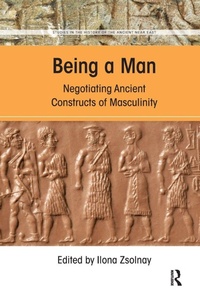
Being a Man
Negotiating Ancient Constructs of Masculinity
1. Auflage
Erschienen am 5. Juli 2019
Buch
Softcover
300 Seiten
978-0-367-35778-8 (ISBN)
Beschreibung
Being a Man is a formative work which reveals the myriad and complex negotiations for constructions of masculine identities in the greater ancient Near East and beyond. Through a juxtaposition of studies into Neo-Assyrian artistic representations and omens, biblical hymns and narrative, Hittite, Akkadian, and Indian epic, as well as detailed linguistic studies on gender and sex in the Sumerian and Hebrew languages, the book challenges traditional understandings and assumed homogeneity for what it meant "to be a man" in antiquity. Being a Man is an indispensable resource for students of the ancient Near East, and a fascinating study for anyone with an interest in gender and sexuality throughout history.
Rezensionen / Stimmen
"This important book, both fascinating and instructive, seems to be the first of its kind in probing masculinity and masculinities in a wide range of societies of the ancient world that lay outside the orbit of Graeco-Roman culture." - David J.A. Clines, University of Sheffield, UK"Ilona Zsolnay, the editor of the book, and all the authors who took part in it deserve our congratulations for producing this welcome addition to gender studies and to ancient Near Eastern studies in a broad sense... [W]ith its intrinsic diversity, Zsolnay's volume of the study of masculinities constitutes a welcome addition to a field that is still largely unexplored. I agree with her diagnosis of why this is so: "the negotiation and maintenance of certain constructions of masculinities, as they are today, form a, if not the, keystone of societal organization" (p. 5). In this scenario, then, there is no doubt that approaching ancient masculinities as a research topic may help us to assess (or re-assess) some of our current views on masculinities and femininities." - Bryn Mawr Classical Review
"[A] very significant contribution to understanding the complexity of the socio-cultural construction of masculinities in the ancient Near East and in the Bible. The presence of a comparative vision, with contributions on India and on the reception of the biblical tradition, is important and stimulating. The volume, therefore, demonstrates the importance of a look at the relational aspects of male gender performances, taking into account not only the opposition to the other gender(s) but also the systems of social classification concerning age, work, social roles, power, hegemony-subordination relationships, and at the body as the place of this ongoing negotiation. The volume shows the importance and potential of the study of the construction of masculinities in the ancient Near East." - Archiv fuer Orientforschung
Weitere Details
Reihe
Sprache
Englisch
Verlagsort
London
Großbritannien
Verlagsgruppe
Taylor & Francis Ltd
Zielgruppe
Für höhere Schule und Studium
Maße
Höhe: 234 mm
Breite: 156 mm
Dicke: 16 mm
Gewicht
459 gr
ISBN-13
978-0-367-35778-8 (9780367357788)
Copyright in bibliographic data and cover images is held by Nielsen Book Services Limited or by the publishers or by their respective licensors: all rights reserved.
Schweitzer Klassifikation
Weitere Ausgaben
Andere Ausgaben
Buch
08/2016
1. Auflage
Routledge
232,10 €
Versand in 10-20 Tagen
E-Book
08/2016
Routledge
65,99 €
Als Download verfügbar
E-Book
08/2016
Routledge
65,99 €
Als Download verfügbar
Person
Ilona Zsolnay (University of Pennsylvania, Lecturer and Consulting Scholar) specializes in ancient Near Eastern religion(s) and gender theory. She is the author of several articles which investigate the intersection between deities, clergy, and the body politic. She is also the ANE area editor of Oxford Encyclopedia of Bible and Gender (ed. Julia O'Brien, 2014).
Inhalt
Introduction
Ilona Zsolnay (University of Pennsylvania)
1. Categorizing Men and Masculinity in Sumer
Joan Goodnick-Westenholz? and Ilona Zsolnay
2. Men Looking At Men: The Homoerotics of Power in the State Arts of Assyria
Julia Assante (Muenster)
3. Wisdom of Former Days: The Manly Hittite King and Foolish Kumarbi, Father of the Gods
Mary R. Bachvarova (Willamette University)
4. Female trouble and troubled males: Roiled Seas, Decadent Royals, and Mesopotamian Masculinities in Myth and Practice
J. S. Cooper (Johns Hopkins)
5. Mapping Masculinities in the Sanskrit Mahabharata and Ramaya?a
Simon Brodbeck (Cardiff University)
6. Mesopotamia Before and After Sodom: Colleagues, Crack Troops, Comrades-in-Arms
Ann K. Guinan (University of Pennsylvania) and Peter Morris (Philadelphia)
7. Shaved Beards and Bared Buttocks: Shame and the Undermining of Masculine Performance in Biblical Texts
Hilary Lipka (University of New Mexico)
8. Happy is the Man who Fills His Quiver with Them (Ps. 127:5): Constructions of Masculinities in the Psalms
Marc Brettler (Duke University)
9. Relative Masculinities in the Hebrew Bible/Old Testament
Martti Nissinen (University of Helsinki)
10. The Masculinity of Male Angels on the Make: Genesis 6:1-4 in Early Nineteenth Century Gothic Imagination
Steven W. Holloway (James Madison University)
Ilona Zsolnay (University of Pennsylvania)
1. Categorizing Men and Masculinity in Sumer
Joan Goodnick-Westenholz? and Ilona Zsolnay
2. Men Looking At Men: The Homoerotics of Power in the State Arts of Assyria
Julia Assante (Muenster)
3. Wisdom of Former Days: The Manly Hittite King and Foolish Kumarbi, Father of the Gods
Mary R. Bachvarova (Willamette University)
4. Female trouble and troubled males: Roiled Seas, Decadent Royals, and Mesopotamian Masculinities in Myth and Practice
J. S. Cooper (Johns Hopkins)
5. Mapping Masculinities in the Sanskrit Mahabharata and Ramaya?a
Simon Brodbeck (Cardiff University)
6. Mesopotamia Before and After Sodom: Colleagues, Crack Troops, Comrades-in-Arms
Ann K. Guinan (University of Pennsylvania) and Peter Morris (Philadelphia)
7. Shaved Beards and Bared Buttocks: Shame and the Undermining of Masculine Performance in Biblical Texts
Hilary Lipka (University of New Mexico)
8. Happy is the Man who Fills His Quiver with Them (Ps. 127:5): Constructions of Masculinities in the Psalms
Marc Brettler (Duke University)
9. Relative Masculinities in the Hebrew Bible/Old Testament
Martti Nissinen (University of Helsinki)
10. The Masculinity of Male Angels on the Make: Genesis 6:1-4 in Early Nineteenth Century Gothic Imagination
Steven W. Holloway (James Madison University)