

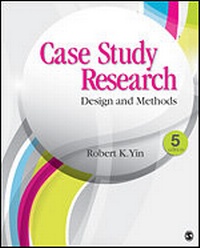
Case Study Research
Design and Methods
5. Auflage
Erschienen am 29. Juli 2013
Buch
Softcover
312 Seiten
978-1-4522-4256-9 (ISBN)
Beschreibung
Providing a complete portal to the world of case study research, the Fifth Edition of Robert K. Yin's bestselling text offers comprehensive coverage of the design and use of the case study method as a valid research tool. The book offers a clear definition of the case study method as well as discussion of design and analysis techniques. The Fifth Edition has been updated with nine new case studies, three new appendices, seven tutorials presented at the end of relevant chapters, increased coverage of values and ethics, expanded discussion on logic models, a brief glossary, and completely updated citations. This book includes exemplary case studies drawn from a wide variety of academic fields.
Weitere Details
Auflage
5th Revised edition
Sprache
Englisch
Verlagsort
Thousand Oaks
USA
Zielgruppe
Für höhere Schule und Studium
Editions-Typ
Überarbeitete Ausgabe
Maße
Höhe: 232 mm
Breite: 187 mm
Gewicht
525 gr
ISBN-13
978-1-4522-4256-9 (9781452242569)
Copyright in bibliographic data and cover images is held by Nielsen Book Services Limited or by the publishers or by their respective licensors: all rights reserved.
Schweitzer Klassifikation
Weitere Ausgaben
Nachauflagen
Buch
02/2018
6. Auflage
SAGE Publications Inc
115,50 €
Sofort lieferbar
Person
Robert K. Yin is President of COSMOS Corporation, an applied research and social science firm. Over the years, COSMOS has successfully completed hundreds of projects for federal agencies, state and local agencies, and private foundations.
Outside of COSMOS, Dr. Yin has assisted numerous other research groups, helping to train their field teams or to design research studies. The most recent such engagements have been with The World Bank, the Division of Special Education and disAbility Research at George Mason University, the Department of Nursing Research and Quality Outcomes at the Children's National Health System (Washington, DC), and the School of Education, Southern New Hampshire University.
Dr. Yin has authored over 100 publications, including authoring or editing 11 books (not counting the multiple editions of any given book). Earlier editions of the present book have been translated into eight languages (Chinese, Japanese, Korean, Swedish, Romanian, Italian, Polish, and Portuguese), and a second book on Qualitative Research from Start to Finish (2016) is in its 2nd edition and has been translated into four languages (Chinese, Korean, Swedish, and Portuguese). Dr. Yin received his B.A. in history from Harvard College (magna cum laude) and his Ph.D. in brain and cognitive sciences from MIT.
Outside of COSMOS, Dr. Yin has assisted numerous other research groups, helping to train their field teams or to design research studies. The most recent such engagements have been with The World Bank, the Division of Special Education and disAbility Research at George Mason University, the Department of Nursing Research and Quality Outcomes at the Children's National Health System (Washington, DC), and the School of Education, Southern New Hampshire University.
Dr. Yin has authored over 100 publications, including authoring or editing 11 books (not counting the multiple editions of any given book). Earlier editions of the present book have been translated into eight languages (Chinese, Japanese, Korean, Swedish, Romanian, Italian, Polish, and Portuguese), and a second book on Qualitative Research from Start to Finish (2016) is in its 2nd edition and has been translated into four languages (Chinese, Korean, Swedish, and Portuguese). Dr. Yin received his B.A. in history from Harvard College (magna cum laude) and his Ph.D. in brain and cognitive sciences from MIT.
Inhalt
Chapter 1. Getting Started: How to Know Whether and When to Use the Case Study as a Research Method
Chapter 2. Designing Case Studies: Identifying Your Case(s) and Establishing the Logic of Your Case Study
Chapter 3. Preparing to Collect Case Study Evidence: What You Need to Do before Starting to Collect Case Study Data
Chapter 4. Collecting Case Study Evidence: The Principles You Should Follow in Working with Six Sources of Evidence
Chapter 5. Analyzing Case Study Evidence: How to Start Your Analysis, Your Analytic Choices, and How They Work
Chapter 6. Reporting Case Studies: How and What to Compose
Appendix A: A Note on the Uses of Case Study Research in Psychology
Appendix B: A Note on the Uses of Case Study Research in Evaluations
Appendix C: Index of Individual Case Studies (cited in BOXES or from Expanded Case Study Materials)
Chapter 2. Designing Case Studies: Identifying Your Case(s) and Establishing the Logic of Your Case Study
Chapter 3. Preparing to Collect Case Study Evidence: What You Need to Do before Starting to Collect Case Study Data
Chapter 4. Collecting Case Study Evidence: The Principles You Should Follow in Working with Six Sources of Evidence
Chapter 5. Analyzing Case Study Evidence: How to Start Your Analysis, Your Analytic Choices, and How They Work
Chapter 6. Reporting Case Studies: How and What to Compose
Appendix A: A Note on the Uses of Case Study Research in Psychology
Appendix B: A Note on the Uses of Case Study Research in Evaluations
Appendix C: Index of Individual Case Studies (cited in BOXES or from Expanded Case Study Materials)