

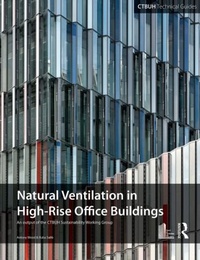
Guide To Natural Ventilation in High Rise Office Buildings
An output of the CTBUH Sustainability Working Group
1. Auflage
Erschienen am 5. September 2012
Buch
Softcover
184 Seiten
978-0-415-50958-9 (ISBN)
Beschreibung
Tall buildings are not the only solution for achieving sustainability through increased density in cities but, given the scale of current population shifts, the vertical city is increasingly being seen as the most viable solution for many urban centers. However, the full implications of concentrating more people on smaller plots of land by building vertically - whether for work, residential or leisure functions - needs to be better researched and understood.
It is generally accepted that we need to reduce the energy equation - in both operating and embodied terms - of every component and system in the building as an essential element in making it more sustainable. Mechanical HVAC systems (Heating, Ventilation and Air-Conditioning) in tall office buildings typically account for 30-40 percent of overall building energy consumption. The increased efficiency (or possibly even elimination) of these mechanical systems - through the provision of natural ventilation - could thus be argued to be the most important single step we could make in making tall buildings more sustainable.
This guide sets out recommendations for every phase of the planning, construction and operation of natural ventilation systems in these buildings, including local climatic factors that need to be taken into account, how to plan for seasonal variations in weather, and the risks in adopting different implementation strategies. All of the recommendations are based on analysis of the research findings from richly-illustrated international case studies.
Tried and tested solutions to real-life problems make this an essential guide for anyone working on the design and operation of tall buildings anywhere in the world. This is the first technical guide from the Council on Tall Buildings and Urban Habitat's Tall Buildings & Sustainability Working Group looking in depth at a key element in the creation of tall buildings with a much-reduced environmental impact, while taking the industry closer to an appreciation of what constitutes a sustainable tall building, and what factors affect the sustainability threshold for tall.
It is generally accepted that we need to reduce the energy equation - in both operating and embodied terms - of every component and system in the building as an essential element in making it more sustainable. Mechanical HVAC systems (Heating, Ventilation and Air-Conditioning) in tall office buildings typically account for 30-40 percent of overall building energy consumption. The increased efficiency (or possibly even elimination) of these mechanical systems - through the provision of natural ventilation - could thus be argued to be the most important single step we could make in making tall buildings more sustainable.
This guide sets out recommendations for every phase of the planning, construction and operation of natural ventilation systems in these buildings, including local climatic factors that need to be taken into account, how to plan for seasonal variations in weather, and the risks in adopting different implementation strategies. All of the recommendations are based on analysis of the research findings from richly-illustrated international case studies.
Tried and tested solutions to real-life problems make this an essential guide for anyone working on the design and operation of tall buildings anywhere in the world. This is the first technical guide from the Council on Tall Buildings and Urban Habitat's Tall Buildings & Sustainability Working Group looking in depth at a key element in the creation of tall buildings with a much-reduced environmental impact, while taking the industry closer to an appreciation of what constitutes a sustainable tall building, and what factors affect the sustainability threshold for tall.
Weitere Details
Sprache
Englisch
Verlagsort
London
Großbritannien
Verlagsgruppe
Taylor & Francis Ltd
Zielgruppe
Für Beruf und Forschung
Academic, Professional, and Professional Practice & Development
Illustrationen
150 Farbfotos bzw. farbige Rasterbilder, 150 farbige Zeichnungen
150 Line drawings, color; 150 Halftones, color
Maße
Höhe: 280 mm
Breite: 210 mm
Gewicht
320 gr
ISBN-13
978-0-415-50958-9 (9780415509589)
Copyright in bibliographic data and cover images is held by Nielsen Book Services Limited or by the publishers or by their respective licensors: all rights reserved.
Schweitzer Klassifikation
Weitere Ausgaben
Andere Ausgaben
Antony Wood | Ruba Salib
Guide To Natural Ventilation in High Rise Office Buildings
An output of the CTBUH Sustainability Working Group
Buch
07/2017
1. Auflage
Routledge
281,48 €
Versand in 10-20 Tagen
Antony Wood | Ruba Salib
Guide To Natural Ventilation in High Rise Office Buildings
E-Book
11/2012
1. Auflage
Routledge
94,99 €
Als Download verfügbar
Antony Wood | Ruba Salib
Guide To Natural Ventilation in High Rise Office Buildings
E-Book
11/2012
1. Auflage
Routledge
94,99 €
Als Download verfügbar
Personen
Antony Wood has been Executive Director of the Council on Tall Buildings and Urban Habitat since 2006. He is chair of the CTBUH Tall Buildings and Sustainability Working Group. Based at the Illinois Institute of Technology, Antony is also an Associate Professor in the College of Architecture, where he convenes various tall building design studios. A UK architect by training, his field of specialism is the design, and in particular the sustainable design, of tall buildings. Prior to becoming an academic, Antony worked as an architect in practice in Hong Kong, Bangkok, Kuala Lumpur, Jakarta and London. He is the author and editor of numerous books and papers in the field, including the 2008 title "Tall & Green: Typology for a Sustainable Urban Future." His PhD explored the multi-disciplinary aspects of skybridge connections between tall buildings.
Ruba Salib was raised in Amman/Jordan and immigrated to Canada in 2002, where she earned her Bachelor degree from the University of Toronto, majoring in both architecture and fine art history and developing an interest in sustainable design and energy efficient buildings. After practicing for a year at an architecture firm in Jordan, Ruba pursued her Master of Architecture in Environmental Design at the University of Nottingham in the UK, with a dissertation topic on Natural Ventilation in High-Rise Office Buildings. A passion for sustainable design has led her to be actively involved in drafting green building guidelines for Jordan and the United Arab Emirates. Currently based in London, she is working on various small-scale and large-scale international projects at RSP Planet Design Studios; an architecture, planning and engineering practice headquartered in Singapore.
Ruba Salib was raised in Amman/Jordan and immigrated to Canada in 2002, where she earned her Bachelor degree from the University of Toronto, majoring in both architecture and fine art history and developing an interest in sustainable design and energy efficient buildings. After practicing for a year at an architecture firm in Jordan, Ruba pursued her Master of Architecture in Environmental Design at the University of Nottingham in the UK, with a dissertation topic on Natural Ventilation in High-Rise Office Buildings. A passion for sustainable design has led her to be actively involved in drafting green building guidelines for Jordan and the United Arab Emirates. Currently based in London, she is working on various small-scale and large-scale international projects at RSP Planet Design Studios; an architecture, planning and engineering practice headquartered in Singapore.
Inhalt
1.0 Introduction and Background 1.1 Historical Overview of Natural Ventilation in High-Rise Office Buildings 1.2 The Principles of Natural Ventilation in a High-Rise Building 1.3 Natural Ventilation Strategies 1.4 The Purpose and Benefits of Natural Ventilation 2.0 Case Studies 2.1 RWE Headquarters Tower, Essen, 1996 2.2 Commerzbank, Frankfurt, 1997 2.3 Liberty Tower of Meiji University, Tokyo, 1998 2.4 Menara UMNO, Penang, 1998 2.5 Deutsche Messe AG Administration Building, Hannover, 1999 2.6 GSW Headquarters Tower, Berlin, 1999 2.7 Post Tower, Bonn, 2002 2.8 30 St. Mary Axe, London, 2004 2.9 Highlight Towers, Munich, 2004 2.10 Torre Cube, Guadalajara, 2005 2.11 San Francisco Federal Building, San Francisco, 2007 2.12 Manitoba Hydro Place, Winnipeg, 2008 2.13 KfW Westarkade, Frankfurt, 2010 2.14 1 Bligh Street, Sydney, 2011 3.0 Design Considerations, Risks and Limitations 3.1 Thermal Comfort Standards 3.2 Local Climate 3.3 Site Context, Building Orientation and the Relative Driving Forces for Natural Ventilation 3.4 Planning and Spatial Configuration 3.5 Sky Gardens and Vertical Segmentation of Atria 3.6 Aerodynamic Elements and Forms 3.7 Facade Treatment and Double-Skin 3.8 Related Sustainable Strategies 3.9 Predictive Performance and Modeling 3.10 Fire Engineering/Smoke Control 3.11 Other Risks, Limitations and Challenges 3.12 Looking to the Future: Naturally Ventilating the Supertall 3.13 Conclusion: Challenging Industry and Occupant Preconceptions 4.0 Recommendations and Future Research 4.1 Recommendations 4.2 Future Research 5.0 References