

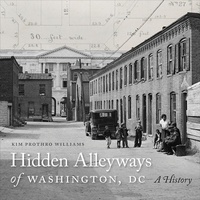
Hidden Alleyways of Washington, DC
A History
Erschienen am 1. November 2023
Buch
Hardcover
172 Seiten
978-1-64712-392-5 (ISBN)
Beschreibung
The remarkable architectural and social history of DC's multifaceted alleyways
Alleyways in Washington, DC, have always been a fundamental part of the city's life and economy. Deliberately hidden from public view by the capital's early planners, DC's alleys were created to provide access to stables, carriage houses, and other utility buildings. But as the city grew and property values rose, the nature of some alleys and their buildings changed, resulting in a parallel world of residential , manufacturing, and artistic spaces. Kim Prothro Williams reveals this world in a fascinating and richly illustrated history.
In the nineteenth and early twentieth centuries, the city's inhabited alleys were often unsanitary spaces that were home to its poorest residents. These conditions spurred Progressive Era campaigns to demolish alley dwellings, which in turn led to the displacement of minority and disadvantaged communities. Today, many remaining alleyways, with their intimately scaled buildings, have been transformed into vibrant commercial and residential spaces. Yet this new wave of development raises questions about how spaces that were once reserved for the city's poorest residents now cater to the wealthy.
This book is a must-have for anyone with an interest in Washington, social history, architecture, or historical preservation.
Alleyways in Washington, DC, have always been a fundamental part of the city's life and economy. Deliberately hidden from public view by the capital's early planners, DC's alleys were created to provide access to stables, carriage houses, and other utility buildings. But as the city grew and property values rose, the nature of some alleys and their buildings changed, resulting in a parallel world of residential , manufacturing, and artistic spaces. Kim Prothro Williams reveals this world in a fascinating and richly illustrated history.
In the nineteenth and early twentieth centuries, the city's inhabited alleys were often unsanitary spaces that were home to its poorest residents. These conditions spurred Progressive Era campaigns to demolish alley dwellings, which in turn led to the displacement of minority and disadvantaged communities. Today, many remaining alleyways, with their intimately scaled buildings, have been transformed into vibrant commercial and residential spaces. Yet this new wave of development raises questions about how spaces that were once reserved for the city's poorest residents now cater to the wealthy.
This book is a must-have for anyone with an interest in Washington, social history, architecture, or historical preservation.
Rezensionen / Stimmen
A unique blending of architectural and social history of Washington DC's multifaceted alleyways, Hidden Alleyways of Washington, DC: A History is essential reading and an informative history for students, academicians, historians, and non-specialist general readers with an interest in Washington's social history, architecture, or historical preservation. * Midwest Book Review * This is a book for historians of DC [and] those who live in alleys. * Washington History *Weitere Details
Sprache
Englisch
Verlagsort
Washington, DC
USA
Zielgruppe
US School Grade: College Graduate Student and over
Produkt-Hinweis
Fadenheftung
Gewebe-Einband
Illustrationen
Not illustrated
Maße
Höhe: 211 mm
Breite: 206 mm
Dicke: 9 mm
Gewicht
549 gr
ISBN-13
978-1-64712-392-5 (9781647123925)
Copyright in bibliographic data and cover images is held by Nielsen Book Services Limited or by the publishers or by their respective licensors: all rights reserved.
Schweitzer Klassifikation
Weitere Ausgaben
Andere Ausgaben

E-Book
11/2023
Georgetown University Press
28,99 €
Als Download verfügbar
Person
Kim Prothro Williams is an architectural historian and National Register coordinator at the DC Historic Preservation Office. She is the author of several books about historic places and communities, including, most recently, Lost Farms and Estates of Washington, DC (2018).
Inhalt
Acknowledgments
Introduction
1. The Origins of DC's Alleys
2. Alley Life
3. Humanitarian Reform Efforts
4. Twentieth-Century Alley Renovation
5. Commerce and Industry in the Alleys
6. Washington's Bohemia
7. Reimagining Alleys
Notes
Bibliography
Index
About the Author
Introduction
1. The Origins of DC's Alleys
2. Alley Life
3. Humanitarian Reform Efforts
4. Twentieth-Century Alley Renovation
5. Commerce and Industry in the Alleys
6. Washington's Bohemia
7. Reimagining Alleys
Notes
Bibliography
Index
About the Author