

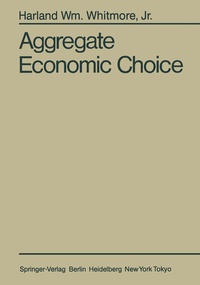
Aggregate Economic Choice
Erschienen am 1. Februar 1986
Buch
Softcover
X, 428 Seiten
978-3-540-16162-2 (ISBN)
Beschreibung
1. Conventional Macro Models and Aggregate Economic Choice.- An Overview of the Book.- 2. The Basic Structure.- Government Sector.- Household Sector.- Nonfinancial Business Sector.- Private Financial Sector.- Central Bank.- The Open-Economy Model.- 3. The Household Sector in the Simple Model.- Formal Model of the Household Sector.- 4. The Nonfinancial Business Sector in the Simple Model.- The Anticipated Current Revenue Function.- Next Period's Anticipated Revenue Function.- The Business Sector's Optimizing Problem at Time t.- First-order Necessary Conditions.- Conditions for Liquidation.- Response Functions of the Business Sector as a Going Concern.- 5. National Product and the Dynamic Properties of the Simple Model.- Derivation of Walras' Law in a Setting without Market-Clearing.- The Discrepancy between the Business Sector's Desired and Actual Cash Balances.- National Income and Product.- Specification of the Complete Model.- Some Implications of the Model.- The Conventional Approach to Introducing Government Activity.- 6. Government Activity and Aggregate Economic Choice.- The Government Sector.- Modifications of Household Sector Behavior.- Modifications of Business Sector Behavior.- National Product and Economic Fluctuations.- Some Implications of the Model.- 7. The Government Sector in the Expanded Model.- Formal Model of Government Activity.- 8. Household Sector Behavior in the Expanded Model.- Formal Model of Household Behavior.- First-Order Conditions.- Household Sector's Decision Variables.- 9. The Nonfinancial Business Sector in the Expanded Model.- Formal Model of the Nonfinancial Business Sector.- 10. The Private Financial Sector.- Formal Model of the Private Financial Sector.- Implications for Private Financial Sector Behavior.- 11. The CentralBank.- Formal Model of Central Bank Behavior.- Answers to Criticisms of Profit-Maximization and a Reliance Upon Discounting.- Conclusion.- 12. The Complete Model of a Closed Economy.- Formal Specification of the Complete Model.- 13. Model of a Large Open Economy.- The Government Sector.- The Household Sector.- The Nonfinancial Business Sector.- The Private Depository Institutions.- The Complete Model of a Large Open Economy.- Impacts of Changes in Selected Foreign Parameters upon the Domestic Economy.- 14. Conclusion.
Weitere Details
Auflage
Softcover reprint of the original 1st ed. 1986
Sprache
Englisch
Verlagsort
Berlin
Deutschland
Verlagsgruppe
Springer Berlin
Zielgruppe
Für Beruf und Forschung
Research
Illustrationen
X, 428 p.
Maße
Höhe: 244 mm
Breite: 170 mm
Dicke: 24 mm
Gewicht
754 gr
ISBN-13
978-3-540-16162-2 (9783540161622)
DOI
10.1007/978-3-642-70945-6
Schweitzer Klassifikation
Weitere Ausgaben
Andere Ausgaben
Harland W. Jr. Whitmore
Aggregate Economic Choice
E-Book
12/2012
Springer
53,49 €
Als Download verfügbar
Inhalt
1. Conventional Macro Models and Aggregate Economic Choice.- An Overview of the Book.- 2. The Basic Structure.- Government Sector.- Household Sector.- Nonfinancial Business Sector.- Private Financial Sector.- Central Bank.- The Open-Economy Model.- 3. The Household Sector in the Simple Model.- Formal Model of the Household Sector.- 4. The Nonfinancial Business Sector in the Simple Model.- The Anticipated Current Revenue Function.- Next Period's Anticipated Revenue Function.- The Business Sector's Optimizing Problem at Time t.- First-order Necessary Conditions.- Conditions for Liquidation.- Response Functions of the Business Sector as a Going Concern.- 5. National Product and the Dynamic Properties of the Simple Model.- Derivation of Walras' Law in a Setting without Market-Clearing.- The Discrepancy between the Business Sector's Desired and Actual Cash Balances.- National Income and Product.- Specification of the Complete Model.- Some Implications of the Model.- The Conventional Approach to Introducing Government Activity.- 6. Government Activity and Aggregate Economic Choice.- The Government Sector.- Modifications of Household Sector Behavior.- Modifications of Business Sector Behavior.- National Product and Economic Fluctuations.- Some Implications of the Model.- 7. The Government Sector in the Expanded Model.- Formal Model of Government Activity.- 8. Household Sector Behavior in the Expanded Model.- Formal Model of Household Behavior.- First-Order Conditions.- Household Sector's Decision Variables.- 9. The Nonfinancial Business Sector in the Expanded Model.- Formal Model of the Nonfinancial Business Sector.- 10. The Private Financial Sector.- Formal Model of the Private Financial Sector.- Implications for Private Financial Sector Behavior.- 11. The CentralBank.- Formal Model of Central Bank Behavior.- Answers to Criticisms of Profit-Maximization and a Reliance Upon Discounting.- Conclusion.- 12. The Complete Model of a Closed Economy.- Formal Specification of the Complete Model.- 13. Model of a Large Open Economy.- The Government Sector.- The Household Sector.- The Nonfinancial Business Sector.- The Private Depository Institutions.- The Complete Model of a Large Open Economy.- Impacts of Changes in Selected Foreign Parameters upon the Domestic Economy.- 14. Conclusion.