

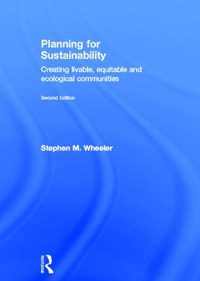
Planning for Sustainability
Creating Livable, Equitable and Ecological Communities
2. Auflage
Erschienen am 7. Juni 2013
Buch
Hardcover
424 Seiten
978-0-415-80988-7 (ISBN)
Beschreibung
How can human communities sustain a long-term existence on a small planet? This challenge grows ever more urgent as the threat of global warming increases.
Planning for Sustainability presents a wide-ranging, intellectually well-grounded and accessible introduction to the concept of planning for more sustainable and livable communities. The text explores topics such as how more compact and walkable cities and towns might be created, how local ecosystems can be restored, how social inequalities might be reduced, how greenhouse gas emissions might be lowered, and how more sustainable forms of economic development can be brought about.
The second edition has been extensively revised and updated throughout, including an improved structure with chapters now organized under three sections: the nature of sustainable planning, issues central to sustainable planning, and scales of sustainable planning. New material includes greater discussion of climate change, urban food systems, the relationships between public health and the urban environment, and international development.
Building on past schools of planning theory, Planning for Sustainability lays out a sustainability planning framework that pays special attention to the rapidly evolving institutions and power structures of a globalizing world. By considering in turn each scale of planning-international, national, regional, municipal, neighborhood, and site and building-the book illustrates how sustainability initiatives at different levels can interrelate. Only by weaving together planning initiatives and institutions at different scales, and by integrating efforts across disciplines, can we move towards long-term human and ecological well-being.
Planning for Sustainability presents a wide-ranging, intellectually well-grounded and accessible introduction to the concept of planning for more sustainable and livable communities. The text explores topics such as how more compact and walkable cities and towns might be created, how local ecosystems can be restored, how social inequalities might be reduced, how greenhouse gas emissions might be lowered, and how more sustainable forms of economic development can be brought about.
The second edition has been extensively revised and updated throughout, including an improved structure with chapters now organized under three sections: the nature of sustainable planning, issues central to sustainable planning, and scales of sustainable planning. New material includes greater discussion of climate change, urban food systems, the relationships between public health and the urban environment, and international development.
Building on past schools of planning theory, Planning for Sustainability lays out a sustainability planning framework that pays special attention to the rapidly evolving institutions and power structures of a globalizing world. By considering in turn each scale of planning-international, national, regional, municipal, neighborhood, and site and building-the book illustrates how sustainability initiatives at different levels can interrelate. Only by weaving together planning initiatives and institutions at different scales, and by integrating efforts across disciplines, can we move towards long-term human and ecological well-being.
Rezensionen / Stimmen
"In a clear, immediate and compelling style, this text offers a stimulating and cutting-edge guide to the challenges that emerged in the past decade, and to new understandings about how planning can be instrumental in shaping a more "liveable, equitable, and ecological" future." Dr Paola Gazzola, Newcastle University, UK."Wheeler's fully revised, restructured, and updated 2nd edition provides an excellent base of knowledge on how to plan for more sustainable communities for students, professional planners, and the public. His engaging writing provides a clear understanding of the history, theory, and practice of sustainability planning." Dr Hilary Nixon, San Jose State University, USA.
Weitere Details
Auflage
2nd edition
Sprache
Englisch
Verlagsort
London
Großbritannien
Verlagsgruppe
Taylor & Francis Ltd
Zielgruppe
Für höhere Schule und Studium
Illustrationen
75 s/w Abbildungen, 43 s/w Photographien bzw. Rasterbilder, 32 s/w Zeichnungen
32 Line drawings, black and white; 43 Halftones, black and white; 75 Illustrations, black and white
Maße
Höhe: 246 mm
Breite: 174 mm
Gewicht
940 gr
ISBN-13
978-0-415-80988-7 (9780415809887)
Copyright in bibliographic data and cover images is held by Nielsen Book Services Limited or by the publishers or by their respective licensors: all rights reserved.
Schweitzer Klassifikation
Weitere Ausgaben
Nachauflagen

Buch
09/2025
3. Auflage
Routledge
214,82 €
Versand in 10-20 Tagen
Andere Ausgaben
E-Book
07/2013
2. Auflage
Routledge
116,99 €
Als Download verfügbar
E-Book
07/2013
2. Auflage
Routledge
116,99 €
Als Download verfügbar
Buch
06/2013
2. Auflage
Routledge
122,95 €
Versand in 15-20 Tagen
Vorauflage
Stephen M. Wheeler
Planning for Sustainability
Creating Livable, Equitable and Ecological Communities
Buch
08/2004
Routledge
168,89 €
Artikel ist vergriffen; siehe Neuauflage
Person
Professor Stephen M. Wheeler, Ph.D., AICP is Associate Professor in the Landscape Architecture Program, Department of Human Ecology, at University of California, Davis. His areas of interest include sustainable development, planning for climate change, urban design, and built landscapes of metropolitan regions.
Inhalt
1. Introduction Part 1: The Nature of Sustainability Planning 2. Sustainable Development 3. Theory of Sustainability Planning 4. Sustainability Planning and the Three E's 5. Sustainability Planning in Practice 6. Tools for Sustainability Planning Part Two: Issues Central to Sustainability Planning 7. Climate Change Planning 8. Energy and Materials Use 9. Environmental Planning 10. Land Use and Urban Growth 11. Urban Design 12. Transportation 13. Housing, Food, and Health 14. Green Architecture and Building 15. Social Equity and Environmental Justice 16. Economic Development 17. Population 18. Governance and Social Ecology Part Three: Scales of Planning 19. International Planning 20. National Planning 21. State and Provincial Planning 22. Regional Planning 23. Local Planning 24. Neighborhood Planning 25. Site Planning and Architecture Conclusion 26. How Do We Get There From Here?