


Children's Testimony
A Handbook of Psychological Research and Forensic Practice
Erschienen am 13. September 2002
Buch
Softcover
426 Seiten
978-0-471-49173-6 (ISBN)
Beschreibung
Children's Testimony offers a comprehensive and up-to-date assessment of issues relating to children's evidence. Starting with psychological underpinnings and child protection considerations, the reader is taken through a clearly structured and timely collection of chapters from internationally renowned contributors. Pointers for practitioners are clearly highlighted throughout and a unique, jargon-free glossary of psychological terms encountered in child witness research is included making this a highly practical text. An accessible review of existing knowledge and preview of new and recent developments in psychological research and forensic practice An outstanding group of international contributors Offers a broad scope that considers all the key areas of research and practice
Rezensionen / Stimmen
" a 'must read' for students and everyone else interested in this area " (Legal & Criminological Psychology, No.7 2002) " overall content of the book makes worthwhile reading for less experienced and experienced practitioners, researchers and academics." (Journal of Child Psychiatry, Vol.44, No.6, 2003)Weitere Details
Sprache
Englisch
Verlagsort
Chichester
Großbritannien
Verlagsgruppe
John Wiley and Sons Ltd
Zielgruppe
Für Beruf und Forschung
Für höhere Schule und Studium
Maße
Höhe: 230 mm
Breite: 154 mm
Gewicht
638 gr
ISBN-13
978-0-471-49173-6 (9780471491736)
Copyright in bibliographic data is held by Nielsen Book Services Limited or its licensors: all rights reserved.
Schweitzer Klassifikation
Weitere Ausgaben
Nachauflagen
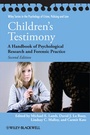
Michael E. Lamb | David J. La Rooy | Lindsay C. Malloy
Children's Testimony
A Handbook of Psychological Research and Forensic Practice
Buch
07/2011
2. Auflage
Wiley
65,00 €
Versand in 10-20 Tagen
Personen
Helen Westcott is a Lecturer in Psychology at The Open University, Milton Keynes, England, UK and is a Chartered Forensic Psychologist. She was formerly Research Officer with the National Society for the Prevention of Cruelty to Children (NSPCC) in London, and has researched children s eyewitness testimony, and the investigative interviewing of children, for many years. Her other research interests include the abuse of disabled children, the abuse of children and young people in institutional care, and children s perceptions of social work intervention. Helen trains and present regularly on those topics, and to date has published over 30 articles and two books, Perspectives on the Memorandum: Policy, Practice and Research in Investigative Interviewing (1997, edited with Jocelyn Jones) and This Far and No Further: Towards Ending the Abuse of Disabled Children (1996, authored with Merry Cross). She is part of the consortium working with the British Government s Home Office to revise the Memorandum of Good Practice on Video Recorded Interviews with Child Witnesses for Criminal Proceedings (1992). Graham Davies is a Professor of Psychology at Leicester University, England, UK. He is a Fellow of the British Psychological Society and a Chartered Forensic Psychologist. His major research interests lie in the eyewitness testimony of children and adults, on which he has published some 100 papers and five books. Graham is regularly asked to provide training and advice to professionals working with child witnesses. He is currently chairing the consortium working with the British Government s Home Office to revise the Memorandum of Good Practice on Video Recorded Interviews with Child Witnesses for Criminal Proceedings (1992). His recent research has included evaluations for the Home Office of the Live Link (1991), videotape facilities for child witnesses (1195), and training procedures for police officers involved in investigative interviewing of children (1997). Graham is the immediate past Chair of the Society of Applied Research in Memory and Cognition (SARMAC), and President elect of the European Association of Psychology of Law. Ray Bull is Professor of Psychology at the University of Portsmouth, England, UK. He has conducted research on witnessing since the late 1970s and on child witnesses since 1987. He regularly acts as an expert in legal cases involving child witness evidence. He has authored/co authored over 100 papers in refereed research journals and chapters in 1991, Ray was asked by the British Government s Home Office (together with Professor Di Birch) to write the first draft of the Memorandum of Good Practice on Video Recorded Interviews with Child Witnesses for Criminal Proceedings (published in 1992). He is now part of the consortium working with the Home Office to revise the document, Ray is regularly asked by police forces and other organizations around the world to present on the investigative interviewing of children. In 1995, he was awarded a Higher Doctorate (Doctor of Science) in recognition of the quality and extent of his research.
Inhalt
About the Editors. About the Contributors. Foreword. Preface. PART I: UNDERPINNINGS. Developmental Underpinnings of Children s Testimony (K. Saywitz). Cognitive Underpinnings of Children s Testimony (L. Baker Ward and P. Ornstein). Child Protection Concerns When Questioning Children (M. Page and G. Precey). Review of Part I. PART II: MEMORY AND INTERVIEWING. The Development of Autobiographical Memory (R. Fivush). Childrens Memories for Repeated Events (M. Powell and D. Thomson). Children s Source Monitoring (D. Lindsay). The Construction of False Events in Memory (K. Pezdek and T. Hinz). Children s Suggestibility Research: Implications for the Courtroom and the Forensic Interview (S. Ceci, et al.). The Effects of Forensic Interview Practices on the Quality of Information Provided by Alleged Victims of Child Abuse (M. Lamb, et al.). How and Why Do Children Respond to Nonsensical Questions? (A. Waterman, et al.). Enhancing Children s Accounts: How Useful Are Non verbal Techniques? (M. E. Pipe, et al.). Deception in Children: A Literature Review and Implications for Children s Testimony (A. Vrij). Review of Part II: PART III: COURT ISSUES. Innovative Procedures for Child Witnesses (J. Cashmore). New Measures and New Challenges: Children s Experiences of the Court Process (A. Wade). A German Perspective on Children s Testimony (G. Kohnken). Child Witnesses and the Oath (T. Lyon). Child Witnesses Experiences Post Court: Effects of Legal Involvement (R. Edelstein, et al.). Persuading and Controlling: The Theory of Cross Examination in Relation to Children (E. Henderson). What Do Judges Know about Young Witnesses? (J. Plotnikoff and R. Woolfson). Young Witnesses: Still No Justice (B. Esam). Review of Part III. PART IV: ALTERNATIVE PERSPECTIVES ON CHILDREN S TESTIMONY. Methodological Issues in the Study of Children s Testimony (B. Clifford). A Sociological Approach to Child Witness Research (C. Wattam). Remembering the Point: A Feminist Perspective on Children s Evidence (L. Kelly). Review of Part IV. Epilogue. Glossary. Index.