

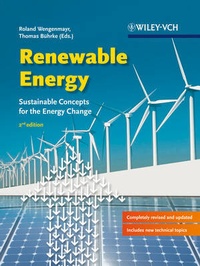
Renewable Energy
Sustainable Concepts for the Energy Change
2. Auflage
Erschienen am 14. November 2012
Buch
Hardcover
VI, 164 Seiten
978-3-527-41187-0 (ISBN)
Beschreibung
This comprehensive overview of the topic perfectly balances expertise and intelligibility, allowing the reader to contribute to discussions about alternative energies.
The new edition has six more chapters than its predecessor, taking into account such radical developments as tidal power stations, the Desertec project, and thermography of buildings. Furthermore, the critical debate about today's first-generation "biofuels" is carefully presented, discussing promising solutions that do not trade food for fuel. In addition, this edition includes exciting new articles on thin film solar cells, seaweed, osmosis, hydrogen, and electric vehicles.
Edited by experienced journalists and backed by striking full-color diagrams and simplified graphics, this book presupposes no relevant scientific background and is thus ideally suited to interested lay readers.
Im Zentrum vieler Debatten zum Klimawandel steht die Diskrepanz zwischen dem weltweit wachsenden Energieverbrauch auf der einen und der Begrenztheit fossiler Ressourcen auf der anderen Seite. Erneuerbare Energien werden immer wieder als Schlüssel zur Lösung dieses Problems benannt. Doch beurteilen, ob und in welchem Umfang sie dies wirklich sind, kann man nur auf der Grundlage fundierter Informationen. Genau diese bietet der vorliegende Band. Die Autoren, führende Experten ihres Fachs, erklären verständlich, wie sich aus Wind und Sonne Energie gewinnen lässt, wie geothermische Energie nutzbar gemacht werden kann oder wie Wellenkraftwerke funktionieren. Die Herausgeber, beide Autoren der Zeitschrift "Physik in unserer Zeit", möchten mit diesem Buch das Fundament für einen kompetenten und ideologiefreien Austausch zu diesem so wichtigen Thema legen. Für die englischsprachige Ausgabe wurden dem Original einige Beiträge hinzugefügt, die solche mit einem Fokus auf Deutschland und Europa ersetzen.
The new edition has six more chapters than its predecessor, taking into account such radical developments as tidal power stations, the Desertec project, and thermography of buildings. Furthermore, the critical debate about today's first-generation "biofuels" is carefully presented, discussing promising solutions that do not trade food for fuel. In addition, this edition includes exciting new articles on thin film solar cells, seaweed, osmosis, hydrogen, and electric vehicles.
Edited by experienced journalists and backed by striking full-color diagrams and simplified graphics, this book presupposes no relevant scientific background and is thus ideally suited to interested lay readers.
Im Zentrum vieler Debatten zum Klimawandel steht die Diskrepanz zwischen dem weltweit wachsenden Energieverbrauch auf der einen und der Begrenztheit fossiler Ressourcen auf der anderen Seite. Erneuerbare Energien werden immer wieder als Schlüssel zur Lösung dieses Problems benannt. Doch beurteilen, ob und in welchem Umfang sie dies wirklich sind, kann man nur auf der Grundlage fundierter Informationen. Genau diese bietet der vorliegende Band. Die Autoren, führende Experten ihres Fachs, erklären verständlich, wie sich aus Wind und Sonne Energie gewinnen lässt, wie geothermische Energie nutzbar gemacht werden kann oder wie Wellenkraftwerke funktionieren. Die Herausgeber, beide Autoren der Zeitschrift "Physik in unserer Zeit", möchten mit diesem Buch das Fundament für einen kompetenten und ideologiefreien Austausch zu diesem so wichtigen Thema legen. Für die englischsprachige Ausgabe wurden dem Original einige Beiträge hinzugefügt, die solche mit einem Fokus auf Deutschland und Europa ersetzen.
Rezensionen / Stimmen
"Summing Up: Highly recommended. Students of all levels, researchers/faculty, and general readers." (Choice, 1 September 2013)Weitere Details
Auflage
2. Auflage
Sprache
Englisch
Verlagsort
Berlin
Deutschland
Zielgruppe
Für höhere Schule und Studium
Für Beruf und Forschung
Illustrationen
9
128 farbige Abbildungen, 2 s/w Abbildungen, 9 s/w Tabellen
130 Abb. (128 Farbabb.), 9 Tab.
Maße
Höhe: 28 cm
Breite: 21 cm
Dicke: 1.7 cm
Gewicht
948 gr
ISBN-13
978-3-527-41187-0 (9783527411870)
Schweitzer Klassifikation
Weitere Ausgaben
Andere Ausgaben
E-Book
02/2013
2. Auflage
Wiley-VCH
26,99 €
Als Download verfügbar
E-Book
02/2013
2. Auflage
Wiley-VCH
26,99 €
Als Download verfügbar
Vorauflage
Buch
02/2008
1. Auflage
Wiley-VCH
29,90 €
Vom Verlag/Hersteller zurückgezogen
Personen
Roland Wengenmayr is science journalist and editor of the journal "Physik in unserer Zeit". He studied physics in Darmstadt, with a temporary stay at the European research laboratory CERN in Geneva. After the diploma he worked as an engineer in the chemical plant construction then he moved on to the publishing house Wiley-VCH, where he worked as commissioning editor for physics and physical chemistry. Today he writes for prominent newspapers on topics like e.g. renewable energy.
Thomas Bührke is science journalist, editor of the journal "Physik in unserer Zeit", and author of several popular science books within the ranges of physics and astrophysics. He studied Physics at the universities of Göttingen and Heidelberg and attained there a doctorate at the Max-Planck Institute for Astronomy. Subsequently, he changed to the publishing house Wiley VCH, where he started as an editor of the journal "Physikalischen Blätter" (now: "Physik Journal") and later changed to "Physik in unserer Zeit".
Thomas Bührke is science journalist, editor of the journal "Physik in unserer Zeit", and author of several popular science books within the ranges of physics and astrophysics. He studied Physics at the universities of Göttingen and Heidelberg and attained there a doctorate at the Max-Planck Institute for Astronomy. Subsequently, he changed to the publishing house Wiley VCH, where he started as an editor of the journal "Physikalischen Blätter" (now: "Physik Journal") and later changed to "Physik in unserer Zeit".
Inhalt
Preface - Eicke Weber
Foreword - Roland Wengenmayr, Thomas Bührke
Renewable Energy Sources on the Rise - Harald Kohl
A Tailwind for Sustainable Technology - Martin Kühn
Flowing Energy - Roland Wengenmayr
How the Sun gets into the Power Plant - Robert Pitz- Paal
Solar Cells - an Overview - Roland Wengenmayr
Solar Cells from Ribbon Silicon - Giso Hahn
Photovoltaic Cells on Glass - Nikolaus Meyer
CdTe-thin film solar cells - Michael Harr
Energy from the Depths of the Earth - Ernst Huenges
Does the Future belong to Biogas - Roland Wengenmayr
Confusion about "bio" fuels - Kreysa
Fuel from seaweed - Griehl
Synthetic Fuels from the Biomass - Nicolaus Dahmen
Eletric Power from Hot Air - Jörg Schlaich, Gerhard Weinrebe
Tidal current power stations - Ruprecht
Energy Reserves from the Oceans - Kai-Uwe Graw
Osmosis power station - Peinemann
Is the Hydrogen Economy Around the Corner? - Gerd Eisenbeiß
DESERTEC- Trieb
Hydrogen, an alternative to fossil energy carriers? - Stolten
Heat on Call - Silke Köhler, Frank Kabus, Ernst Huenges
Taming the Flame - Joachim Hoffmann
Electric vehicles - Andrea Vezzini
Cooling with the Heat of the Sun - Roland Wengenmayr
A Super Climate in the Greenhouse - Roland Wengenmayr
An Exceptional Sustainabliliy Concept - Christian Matt, Matthias Schuler
Building thermography - Michael Vollmer
How Political Will Changes a Country - Thomas Bührke
Foreword - Roland Wengenmayr, Thomas Bührke
Renewable Energy Sources on the Rise - Harald Kohl
A Tailwind for Sustainable Technology - Martin Kühn
Flowing Energy - Roland Wengenmayr
How the Sun gets into the Power Plant - Robert Pitz- Paal
Solar Cells - an Overview - Roland Wengenmayr
Solar Cells from Ribbon Silicon - Giso Hahn
Photovoltaic Cells on Glass - Nikolaus Meyer
CdTe-thin film solar cells - Michael Harr
Energy from the Depths of the Earth - Ernst Huenges
Does the Future belong to Biogas - Roland Wengenmayr
Confusion about "bio" fuels - Kreysa
Fuel from seaweed - Griehl
Synthetic Fuels from the Biomass - Nicolaus Dahmen
Eletric Power from Hot Air - Jörg Schlaich, Gerhard Weinrebe
Tidal current power stations - Ruprecht
Energy Reserves from the Oceans - Kai-Uwe Graw
Osmosis power station - Peinemann
Is the Hydrogen Economy Around the Corner? - Gerd Eisenbeiß
DESERTEC- Trieb
Hydrogen, an alternative to fossil energy carriers? - Stolten
Heat on Call - Silke Köhler, Frank Kabus, Ernst Huenges
Taming the Flame - Joachim Hoffmann
Electric vehicles - Andrea Vezzini
Cooling with the Heat of the Sun - Roland Wengenmayr
A Super Climate in the Greenhouse - Roland Wengenmayr
An Exceptional Sustainabliliy Concept - Christian Matt, Matthias Schuler
Building thermography - Michael Vollmer
How Political Will Changes a Country - Thomas Bührke