

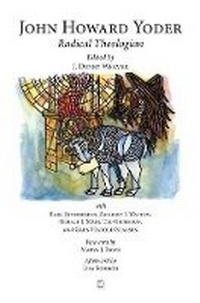
John Howard Yoder
Radical Theologian
Erschienen am 26. März 2015
Buch
Softcover
436 Seiten
978-0-7188-9394-1 (ISBN)
Beschreibung
'John Howard Yoder: Radical Theologian' shows that for John Howard Yoder both theology (in particular Christology) and ethics are expressions of the meaning of the narrative of Jesus. All such statements are relative to a particular context, so that theology and ethics are subject to reaching back to the narrative in order to restate the meaning in new and ever-changing contexts. This methodology is visible in Yoder's 'Preface to Theology', which has been little used in most treatments of Yoder's thought.
Yoder has been characterised as standing on Nicene orthodoxy, criticised for rejecting Nicene orthodoxy, called heterodox, and designated a postmodern thinker to be interpreted in terms of other such thinkers. None of these characterisations adequately locates the basis of his methodology in the narrative of Jesus. Thus 'John Howard Yoder: Radical Theologian' aims to go beyond or to supersede existing treatments with its demonstration that Yoder is a radical theologian in the historical meaning of radical - that is, as one who returns to the root - but also relates his theology to the personal accusations that clouded his later years. For Christian faith, this root is Christ. Parts II and III of the book explore the sources of Yoder's approach, and its application in several contemporary contexts.
Yoder has been characterised as standing on Nicene orthodoxy, criticised for rejecting Nicene orthodoxy, called heterodox, and designated a postmodern thinker to be interpreted in terms of other such thinkers. None of these characterisations adequately locates the basis of his methodology in the narrative of Jesus. Thus 'John Howard Yoder: Radical Theologian' aims to go beyond or to supersede existing treatments with its demonstration that Yoder is a radical theologian in the historical meaning of radical - that is, as one who returns to the root - but also relates his theology to the personal accusations that clouded his later years. For Christian faith, this root is Christ. Parts II and III of the book explore the sources of Yoder's approach, and its application in several contemporary contexts.
Rezensionen / Stimmen
One thing is clear: The contributors to this volume succeeded in presenting a compelling case for an honest, open-minded and fresh reading of one of the most influential theologians and social ethicists of the twentieth century in the lineage of the Radical Reformation. Uniquely within Yoderian scholarship, the contributors address forthrightly, wrestle with and draw lessons from Yoder's hurtful conduct and human failures. Undoubtedly this volume of considerate reflections will provide food-for-thought for the students of Christian theology and ethics in the time to come.Dr Parush R Parushev, Journal of European Baptist Studies, Volume 15, Issue 3
Weitere Details
Sprache
Englisch
Verlagsort
Cambridge
Großbritannien
Verlagsgruppe
James Clarke & Co Ltd
Maße
Höhe: 229 mm
Breite: 153 mm
Gewicht
634 gr
ISBN-13
978-0-7188-9394-1 (9780718893941)
Copyright in bibliographic data and cover images is held by Nielsen Book Services Limited or by the publishers or by their respective licensors: all rights reserved.
Schweitzer Klassifikation
Weitere Ausgaben
Andere Ausgaben
E-Book
03/2015
Lutterworth Press
27,49 €
Als Download verfügbar
E-Book
03/2015
Lutterworth Press
36,49 €
Als Download verfügbar
Person
J. Denny Weaver is Professor Emeritus of Religion at Bluffton (Ohio) University. His other books include 'Becoming Anabaptist' (2nd ed., 2005); 'Defenseless Christianity' (co-written with Gerald J. Mast, 2009); 'The Nonviolent Atonement' (2nd ed., 2011); and 'The Nonviolent God' (2013). He has lectured on atonement theology in the United Kingdom, the Congo, and Germany. He lives in Wisconsin.
Inhalt
List of Contributors
Foreword -Marva J. Dawn
Preface -J. Denny Weaver
Introduction -J. Denny Weaver
Part One: The Orientation of John Howard Yoder's Theology
1 Christology: From the Root -J. Denny Weaver
Part Two: Sources of John Howard Yoder's Theology
2 Sixteenth-Century Anabaptist Roots -Earl Zimmerman
3 Harold S. Bender, Anabaptist Vision, and the Goshen School -Zachary J. Walton
4 Oscar Cullmann and Radical Discipleship -Earl Zimmerman
5 Deconstructing Karl Barth -Gerald J. Mast
Part Three: Extending John Howard Yoder's Theology
6 Jesus to Paul -Ted Grimsrud
7 The Free Church as Body Politics -Earl Zimmerman
8 Pacifism as a Way of Knowing -Gerald J. Mast
9 A Nonviolent Public Ethic -Glen Harold Stassen
10 Interfaith Conversations: Judaism to Islam to Hinduism -J. Denny Weaver and Earl Zimmerman
11 A Model in Conversation with Black and Evangelical Theology -J. Denny Weaver and Gerald J. Mast
12 Reflections from a Chagrined "Yoderian" in Face of His Sexual Violence -Ted Grimsrud
13 Sin and Failure in Anabaptist Theology -Gerald J. Mast
Conclusion -J. Denny Weaver
Afterword: To the Next Generation of Pacifist Theologians -Lisa Schirch
Bibliography
Index
Foreword -Marva J. Dawn
Preface -J. Denny Weaver
Introduction -J. Denny Weaver
Part One: The Orientation of John Howard Yoder's Theology
1 Christology: From the Root -J. Denny Weaver
Part Two: Sources of John Howard Yoder's Theology
2 Sixteenth-Century Anabaptist Roots -Earl Zimmerman
3 Harold S. Bender, Anabaptist Vision, and the Goshen School -Zachary J. Walton
4 Oscar Cullmann and Radical Discipleship -Earl Zimmerman
5 Deconstructing Karl Barth -Gerald J. Mast
Part Three: Extending John Howard Yoder's Theology
6 Jesus to Paul -Ted Grimsrud
7 The Free Church as Body Politics -Earl Zimmerman
8 Pacifism as a Way of Knowing -Gerald J. Mast
9 A Nonviolent Public Ethic -Glen Harold Stassen
10 Interfaith Conversations: Judaism to Islam to Hinduism -J. Denny Weaver and Earl Zimmerman
11 A Model in Conversation with Black and Evangelical Theology -J. Denny Weaver and Gerald J. Mast
12 Reflections from a Chagrined "Yoderian" in Face of His Sexual Violence -Ted Grimsrud
13 Sin and Failure in Anabaptist Theology -Gerald J. Mast
Conclusion -J. Denny Weaver
Afterword: To the Next Generation of Pacifist Theologians -Lisa Schirch
Bibliography
Index