

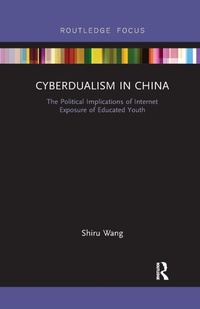
Cyberdualism in China
The Political Implications of Internet Exposure of Educated Youth
1. Auflage
Erschienen am 23. Januar 2019
Buch
Softcover
100 Seiten
978-0-367-14185-1 (ISBN)
Beschreibung
Internet usage in China has recently grown exponentially, rising from 59 million users in 2002 to 710 million by mid-2016. One in every two Chinese has currently been exposed to the Internet. This upsurge has made political communication among citizens and between the government and citizens less costly and almost instantaneous in China. Despite these advances, scholars are only beginning to understand and systematically explain the ways in which increased Internet exposure may affect behavior and values of Chinese netizens. Can the Internet help liberalize Chinese society due to its innate pluralism? Has the Internet become an efficient tool assisting the ruling elite to remain in power given the tendency of Internet service providers and users to be easily manipulated by the Chinese state?
This book addresses these questions by focusing on the most digitally embedded segment of Chinese population - university students. Using survey evidence from more than 1200 observations, data confirm that Internet exposure to information generated by fellow netizens promotes democratic orientation, enhances political resistance to indoctrination, and boosts popular nationalism. However, exposure to government-managed websites encourages regime support and, at a less significance level, decreases democratic orientation, and elevates official patriotism. People who perceive the Internet as a tool enhancing the vertical communication between the Chinese government and netizens tend to become patriotic and supportive of the regime. Building upon quantitative evidence, this book draws a nuanced picture of Internet exposure and its political implications.
This book addresses these questions by focusing on the most digitally embedded segment of Chinese population - university students. Using survey evidence from more than 1200 observations, data confirm that Internet exposure to information generated by fellow netizens promotes democratic orientation, enhances political resistance to indoctrination, and boosts popular nationalism. However, exposure to government-managed websites encourages regime support and, at a less significance level, decreases democratic orientation, and elevates official patriotism. People who perceive the Internet as a tool enhancing the vertical communication between the Chinese government and netizens tend to become patriotic and supportive of the regime. Building upon quantitative evidence, this book draws a nuanced picture of Internet exposure and its political implications.
Weitere Details
Reihe
Sprache
Englisch
Verlagsort
London
Großbritannien
Verlagsgruppe
Taylor & Francis Ltd
Zielgruppe
Für höhere Schule und Studium
Illustrationen
4 s/w Zeichnungen, 11 s/w Tabellen
11 Tables, black and white; 4 Line drawings, black and white
Maße
Höhe: 216 mm
Breite: 140 mm
Dicke: 6 mm
Gewicht
155 gr
ISBN-13
978-0-367-14185-1 (9780367141851)
Copyright in bibliographic data and cover images is held by Nielsen Book Services Limited or by the publishers or by their respective licensors: all rights reserved.
Schweitzer Klassifikation
Weitere Ausgaben
Andere Ausgaben
Buch
05/2017
1. Auflage
Routledge
83,80 €
Versand in 10-20 Tagen
E-Book
04/2017
Routledge
32,99 €
Als Download verfügbar
E-Book
04/2017
Routledge
32,99 €
Als Download verfügbar
Person
Shiru Wang is Research Associate at Hong Kong Institute of Asia-Pacific Studies, The Chinese University of Hong Kong
Inhalt
List of Figures
List of Tables
Understanding the Internet
Internet Exposure of Chinese University Students
Internet Exposure and Political Beliefs
Internet Exposure and Political Resistance
Internet Exposure and Nationalism
Conclusions and New Challenges
Appendix
List of Tables
Understanding the Internet
Internet Exposure of Chinese University Students
Internet Exposure and Political Beliefs
Internet Exposure and Political Resistance
Internet Exposure and Nationalism
Conclusions and New Challenges
Appendix