

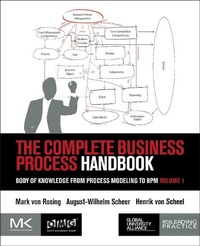
The Complete Business Process Handbook
Body of Knowledge from Process Modeling to BPM, Volume 1
Erschienen am 15. Dezember 2014
Buch
Softcover
776 Seiten
978-0-12-799959-3 (ISBN)
Beschreibung
The Complete Business Process Handbook is the most comprehensive body of knowledge on business processes with revealing new research. Written as a practical guide for Executives, Practitioners, Managers and Students by the authorities that have shaped the way we think and work with process today. It stands out as a masterpiece, being part of the BPM bachelor and master degree curriculum at universities around the world, with revealing academic research and insight from the leaders in the market.
This book provides everything you need to know about the processes and frameworks, methods, and approaches to implement BPM. Through real-world examples, best practices, LEADing practices and advice from experts, readers will understand how BPM works and how to best use it to their advantage. Cases from industry leaders and innovators show how early adopters of LEADing Practices improved their businesses by using BPM technology and methodology. As the first of three volumes, this book represents the most comprehensive body of knowledge published on business process. Following closely behind, the second volume uniquely bridges theory with how BPM is applied today with the most extensive information on extended BPM. The third volume will explore award winning real-life examples of leading business process practices and how it can be replaced to your advantage.
This book provides everything you need to know about the processes and frameworks, methods, and approaches to implement BPM. Through real-world examples, best practices, LEADing practices and advice from experts, readers will understand how BPM works and how to best use it to their advantage. Cases from industry leaders and innovators show how early adopters of LEADing Practices improved their businesses by using BPM technology and methodology. As the first of three volumes, this book represents the most comprehensive body of knowledge published on business process. Following closely behind, the second volume uniquely bridges theory with how BPM is applied today with the most extensive information on extended BPM. The third volume will explore award winning real-life examples of leading business process practices and how it can be replaced to your advantage.
Weitere Details
Sprache
Englisch
Verlagsort
San Francisco
USA
Verlagsgruppe
Elsevier Science & Technology
Zielgruppe
Für Beruf und Forschung
Executives, Managers, Business Process Professionals, Students, Academics and Researcher
Illustrationen
Illustrated
Maße
Höhe: 231 mm
Breite: 186 mm
Dicke: 38 mm
Gewicht
1633 gr
ISBN-13
978-0-12-799959-3 (9780127999593)
Copyright in bibliographic data and cover images is held by Nielsen Book Services Limited or by the publishers or by their respective licensors: all rights reserved.
Schweitzer Klassifikation
Weitere Ausgaben
Andere Ausgaben
Mark Von Rosing | Henrik Von Scheel | August-Wilhelm Scheer
The Complete Business Process Handbook
Body of Knowledge from Process Modeling to BPM, Volume 1
E-Book
12/2014
Morgan Kaufmann
49,95 €
Als Download verfügbar
Personen
Mark von Rosing is a best-selling author, a sought-after speaker, researcher and board-room advisor. He is a pioneer in the field of climate control and Sustainability. Through his research, publications and effort with standard bodies (ISO, IEEE, OMG, CEN, NIST, LEADing Practice, NATO, UN, W3C) he has been involved of developing 200+ Enterprise Standards and 52 different Industry Standards. Beyond, he left his mark in the field of process modelling having published the best-selling book series The Complete Business Process Handbook, published by Elsevier. Companies such as SAP AG have involved him in developing and leading their Sustainability approaches as well as the Sustainability architecture approaches. Henrik von Scheel is regarded as one of the most influential thinkers on strategy with focus on growth + innovation and is a sought-after speaker. Listed by Financial Times as one of the most influential business thinkers on strategy and management concepts and corporate practices. He was awarded the "NEXT 100 Top Influencers of the European Digital Industry in 2012" among the most important Europeans shaping our digital future. Best known as one of the founding fathers of Europe's digital agenda 2020 and Industry 4.0. He has played a significant role to define Germany's digital agenda in 09, which was adopted by the European Commission in 2010 as part of the Europe 2020. He digital agenda evolved into the fourth industrial revolution. Through his academic research, publications and efforts with standard bodies (ISO, IEEE, OMG, CEN, NIST, LEADing Practice, NATO, UN, W3C) he has defined concepts and practices in business management and strategy execution that have evolved the mainstream thinking of what is being taught by academia and applied by organizations today. He is accredited for his contribution of having identified the repeatable patterns of the outperformers, early adopters, & industry adopters and hyper-growth organization over the past 30 years i.e. best practices, industry practices, leading practices, emerging & disruptive trends adoptions patterns. Most notable are the emerging & disruptive trends, competitive advantage lifecycle, six business models, operating model notations and complexity simplification. Henrik is the CEO of LEADing Practice and serves as board member at Google EMEA, Gazprom, Global University Alliance and Capital Investment Partners. Professor Dr. Dr. h.c. mult. Scheer is founder of the Institute for Information Systems (IWi) at Saarland University and was its director for 30 years. His publications in the field of business information systems are today considered standard references and are very well known across the global market. The Y-CIM production model, created by Prof. Scheer, serves as an overall framework for integrating operative information systems in the manufacturing industries. Prof Scheer was honored with the Lifetime Achievement Award in 2013 by the Global University Alliance on behave of +300 universities, in recognition of his long-term impact and contribution to evolve the academic world and organization's structural thinking of how to apply enterprise modelling today. Leaving his mark on this generation and generations to come. Pushing the bar with his research and focus on information and business process management, Prof Scheer has, among others, brought to us:* Link between processes and information.* His contribution to the academic world: in 1975 Scheer took over one of the first chairs for information systems and founded the Institute for information Systems (IWI) at the Saarland University, which he led until 2005.* His contribution to the Software world: In 1984 he founded IDS Scheer, a Business Process Management (BPM) software company, which is still today the market leader.* His contribution to Enterprise Modelling: The ARIS House which is one of the first Enterprise Modelling concepts that combines and organizes information of an organization in five interrelated views: data, function, organization, output, and control.His contribution to the Process Modelling community: He developed among others 2 main concepts for Business Process Modelling:* Business content in Value-added Chain Diagrams (VCD).* Process content in Event-driven Process Chains (EPC).He is widely regarded as the founder of the BPM industry.In 1984, he founded the international software and consulting company IDS Scheer AG. Until 2009 he expanded the business to become one of the leading IT companies in Germany. In 1997 he founded the imc AG located in Saarbruecken and in 2000 the Scheer Group GmbH which participates in innovative high tech companies, such as the Scheer Management Consulting & Solutions GmbH. He is forerunner and companion of the future project "Industry 4.0" initiated by the German federal government. The network of IT companies within the Scheer Group are actively participating in the implementation of projects along with well-known industry and research partners.
Inhalt
Preface
Introduction to the Book
Phase I: Process Concept Evolution
Mark von Rosing, August-Wilhelm Scheer, Henrik von Scheel, John A. Zachman, James P. Womack, Daniel T. Jones, Marianne Fonseca, Keith Swenson
Sun Tzu
Adam Smith
Taylorism
Henry Ford
Gantt Chart
Frank B. Gilbreth
Allan B. Mogensen
Boeing B17
Ben S. Graham
ASME
Functional Flow Block Diagram og PERT (1950'erne)
Data Flow Diagrams og IDEF (1970'erne)
Zero Defects (1960'erne)
Toyota Production System (1948-75)
IDS Scheer
John A. Zachman
LEAN & Lean Consumption
Business Process Reengineering
TQM (+TQM Tools)
Six Sigma
What is BPM
Phase II: BPM Way of Thinking
Mark von Rosing, Wim Laurier, Maria Hove, Simon Polovina, Neil Kemp, Henrik von Scheel
The value of an Ontology
The BPM Ontology
Process Tagging - Classification and categorization
Process Templates
Phase III -The BPM Way of Working
Mark von Rosing, August W. Scheer, Henrik von Scheel, Adam D.M. Svendsen, Anette Bogebjerg, Anni Olsen, Antony Dicks, Asif Gill, Bob J Storms, Cay Clemmensen, Christopher K. Swierczynski, Dan Moorcroft, Dan T. Jones, David Coloma, Dickson Hunja Muhita, Duarte Goncalves, Hendrik Bohn, Fabrizio Maria Maggi, Fan Zhao, Fatma Dandashi, Fred Cummins, Gabriel von Scheel, Gary Doucet, Gabriella von Rosing, Gert O Jansson. Hans Scheruhn. Harald Van der Weel, Henk de Man, Henrik Naundrup Vester, Jacob Gammelgaard, James P. Womack, Jeanne Ross, John A. Zachman, John Bertram, John Golden, John M. Rogers, Jonnro Erasmus, Joshua Michael von Scheel, Joshua Waters, Justin Tomlinson, Keith Swenson, Karin Graeslund, Kenneth Dean Teske, Klaus Vitt, Krzysztof Skurzak, LeAnne Spurrell, Lloyd Dugan, Lotte Tange, Mads Clausager, Maria Hove, Mark Stanford, Marianne Fonseca, Marlon Dumas, Mathias Kirchmer, Maxim Arzumanyan, Michael Tisdel, Mikael Munck, Mike A. Marin, Mona von Rosing, Nathaniel Palmer, Neil Kemp, Nils Faltin, Patricia Kemp, Peter Franz, Rich Hilliard, Richard N. Conzo, Richard L. Fallon, Rogan Morrision, Ronald N. Batdorf, Sarel J. Snyman, Scott Davis, Simon Polovina, Steve Willoughby, Thomas Boosz, Thomas Christian Olsen, Ulrik Foldager, Victor Abele, Volker Rebhan, Wim Laurier, Yury Orlov, Zakaria Maamar
Business Process Trends
Building BPM Competencies - the BPM Center of Excellence
The various BPM Roles
Working with the BPM LifeCycle
Process Analysis
Process Build
Process Deployment
Process Monitoring & Process Maintenance
Continuous Process Improvement
Chief Process Officer - executing the strategy
iBPM - Intelligent Business Process Management
Evidence Based BPM
Social Media & BPM
BPM Maturity
Phase IV -The BPM Way of Modelling
Mark von Rosing, Conrad Bock, Henk deMan, Fred Cummins, Henrik von Scheel, Stephen White, Jonnro Erasmus, Mathias Kirchmer, David Coloma, Gabriella von Rosing, Henrik von Scheel, Karin Graeslund, Hans Scheruhn, Richard L. Fallon
BPMN
How to work with and model Business Processes Variations
Focusing business processes on superior value creation: value oriented process modelling
Sustainability Oriented Process Modeling
Process Automation- Link between process models and information models
Phase V - The Way of Implementation and Governance
Mark von Rosing, Joshua von Scheel, Asif Gill, Maria Hove, Mona von Rosing, Joshua von Scheel, Dickson Muhita, Maria Hove, Gabriella von Rosing, Bob Storms, Dr. Hendrik Bohn, Joshua von Scheel, Richard Conzo, August W. Scheer, Nils Faltin, Kenneth Dean Teske, Michael D. Tisdel, Victor Abele, Justin Tomlinson, Henrik von Scheel, Gary Doucet, Gert O Jansson
Agile BPM
BPM Change Management
BPM Governance
BPM Portfolio Management
Real Time Learning BPM
BPM Alignment
Business Process Outsourcing
Phase VI - The Way of Training and Coaching
Mark von Rosing, Henrik von Scheel, Marianne Fonseca, Maria Hove, Ulrik Foldager
The need for a standardized and common Process Training
Process eXpert Training
Process Architect Training
Process Engineer Training
Introduction to the Book
Phase I: Process Concept Evolution
Mark von Rosing, August-Wilhelm Scheer, Henrik von Scheel, John A. Zachman, James P. Womack, Daniel T. Jones, Marianne Fonseca, Keith Swenson
Sun Tzu
Adam Smith
Taylorism
Henry Ford
Gantt Chart
Frank B. Gilbreth
Allan B. Mogensen
Boeing B17
Ben S. Graham
ASME
Functional Flow Block Diagram og PERT (1950'erne)
Data Flow Diagrams og IDEF (1970'erne)
Zero Defects (1960'erne)
Toyota Production System (1948-75)
IDS Scheer
John A. Zachman
LEAN & Lean Consumption
Business Process Reengineering
TQM (+TQM Tools)
Six Sigma
What is BPM
Phase II: BPM Way of Thinking
Mark von Rosing, Wim Laurier, Maria Hove, Simon Polovina, Neil Kemp, Henrik von Scheel
The value of an Ontology
The BPM Ontology
Process Tagging - Classification and categorization
Process Templates
Phase III -The BPM Way of Working
Mark von Rosing, August W. Scheer, Henrik von Scheel, Adam D.M. Svendsen, Anette Bogebjerg, Anni Olsen, Antony Dicks, Asif Gill, Bob J Storms, Cay Clemmensen, Christopher K. Swierczynski, Dan Moorcroft, Dan T. Jones, David Coloma, Dickson Hunja Muhita, Duarte Goncalves, Hendrik Bohn, Fabrizio Maria Maggi, Fan Zhao, Fatma Dandashi, Fred Cummins, Gabriel von Scheel, Gary Doucet, Gabriella von Rosing, Gert O Jansson. Hans Scheruhn. Harald Van der Weel, Henk de Man, Henrik Naundrup Vester, Jacob Gammelgaard, James P. Womack, Jeanne Ross, John A. Zachman, John Bertram, John Golden, John M. Rogers, Jonnro Erasmus, Joshua Michael von Scheel, Joshua Waters, Justin Tomlinson, Keith Swenson, Karin Graeslund, Kenneth Dean Teske, Klaus Vitt, Krzysztof Skurzak, LeAnne Spurrell, Lloyd Dugan, Lotte Tange, Mads Clausager, Maria Hove, Mark Stanford, Marianne Fonseca, Marlon Dumas, Mathias Kirchmer, Maxim Arzumanyan, Michael Tisdel, Mikael Munck, Mike A. Marin, Mona von Rosing, Nathaniel Palmer, Neil Kemp, Nils Faltin, Patricia Kemp, Peter Franz, Rich Hilliard, Richard N. Conzo, Richard L. Fallon, Rogan Morrision, Ronald N. Batdorf, Sarel J. Snyman, Scott Davis, Simon Polovina, Steve Willoughby, Thomas Boosz, Thomas Christian Olsen, Ulrik Foldager, Victor Abele, Volker Rebhan, Wim Laurier, Yury Orlov, Zakaria Maamar
Business Process Trends
Building BPM Competencies - the BPM Center of Excellence
The various BPM Roles
Working with the BPM LifeCycle
Process Analysis
Process Build
Process Deployment
Process Monitoring & Process Maintenance
Continuous Process Improvement
Chief Process Officer - executing the strategy
iBPM - Intelligent Business Process Management
Evidence Based BPM
Social Media & BPM
BPM Maturity
Phase IV -The BPM Way of Modelling
Mark von Rosing, Conrad Bock, Henk deMan, Fred Cummins, Henrik von Scheel, Stephen White, Jonnro Erasmus, Mathias Kirchmer, David Coloma, Gabriella von Rosing, Henrik von Scheel, Karin Graeslund, Hans Scheruhn, Richard L. Fallon
BPMN
How to work with and model Business Processes Variations
Focusing business processes on superior value creation: value oriented process modelling
Sustainability Oriented Process Modeling
Process Automation- Link between process models and information models
Phase V - The Way of Implementation and Governance
Mark von Rosing, Joshua von Scheel, Asif Gill, Maria Hove, Mona von Rosing, Joshua von Scheel, Dickson Muhita, Maria Hove, Gabriella von Rosing, Bob Storms, Dr. Hendrik Bohn, Joshua von Scheel, Richard Conzo, August W. Scheer, Nils Faltin, Kenneth Dean Teske, Michael D. Tisdel, Victor Abele, Justin Tomlinson, Henrik von Scheel, Gary Doucet, Gert O Jansson
Agile BPM
BPM Change Management
BPM Governance
BPM Portfolio Management
Real Time Learning BPM
BPM Alignment
Business Process Outsourcing
Phase VI - The Way of Training and Coaching
Mark von Rosing, Henrik von Scheel, Marianne Fonseca, Maria Hove, Ulrik Foldager
The need for a standardized and common Process Training
Process eXpert Training
Process Architect Training
Process Engineer Training