

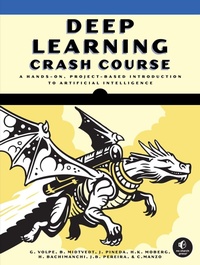
Deep Learning Crash Course
Erschienen am 6. Januar 2026
Buch
Softcover
672 Seiten
978-1-7185-0392-2 (ISBN)
Beschreibung
Deep Learning Crash Course goes beyond the basics of machine learning to delve into modern techniques and applications of great interest right now, and whose popularity will only grow in the future. The book covers topics such as generative models (the technology behind deep fakes), self-supervised learning, attention mechanisms (the tech behind ChatGPT), graph neural networks (the tech behind AlphaFold), and deep reinforcement learning (the tech behind AlphaGo). This book bridges the gap between theory and practice, helping readers gain the confidence to apply deep learning in their work.
Weitere Details
Sprache
Englisch
Verlagsort
San Francisco
USA
Produkt-Hinweis
Broschur/Paperback
Maße
Höhe: 235 mm
Breite: 181 mm
Dicke: 35 mm
Gewicht
1062 gr
ISBN-13
978-1-7185-0392-2 (9781718503922)
Copyright in bibliographic data and cover images is held by Nielsen Book Services Limited or by the publishers or by their respective licensors: all rights reserved.
Schweitzer Klassifikation
Weitere Ausgaben
Personen
Giovanni Volpe, head of the Soft Matter Lab at the University of Gothenburg and recipient of the Goeran Gustafsson Prize in Physics, has published extensively on deep learning and physics and developed key software packages including DeepTrack, Deeplay, and BRAPH. Benjamin Midtvedt and Jesus Pineda are core developers of DeepTrack and Deeplay. Henrik Klein Moberg and Harshith Bachimanchi apply AI to nanoscience and holographic microscopy. Joana B. Pereira, head of the Brain Connectomics Lab at the Karolinska Institute, organizes the annual conference Emerging Topics in Artificial Intelligence. Carlo Manzo, head of the Quantitative Bioimaging Lab at the University of Vic, is the founder of the Anomalous Diffusion Challenge.
Inhalt
Introduction
Chapter 1: Building and Training Your First Neural Network
Chapter 2: Capturing Trends and Recognizing Patterns with Dense Neural Networks
Chapter 3: Processing Images with Convolutional Neural Networks
Chapter 4: Enhancing, Generating, and Analyzing Data with Autoencoders
Chapter 5: Segmenting and Analyzing Images with U-Nets
Chapter 6: Training Neural Networks with Self-Supervised Learning
Chapter 7: Processing Time Series and Language with Recurrent Neural Networks
Chapter 8: Processing Language and Classifying Images with Attention and Transformers
Chapter 9: Creating and Transforming Images with Generative Adversarial Networks
Chapter 10: Implementing Generative AI with Diffusion Models
Chapter 11: Modeling Molecules and Complex Systems with Graph Neural Networks
Chapter 12: Continuously Improving Performance with Active Learning
Chapter 13: Mastering Decision-Making with Deep Reinforcement Learning
Chapter 14: Predicting Chaos with Reservoir Computing
Conclusion
Index
Chapter 1: Building and Training Your First Neural Network
Chapter 2: Capturing Trends and Recognizing Patterns with Dense Neural Networks
Chapter 3: Processing Images with Convolutional Neural Networks
Chapter 4: Enhancing, Generating, and Analyzing Data with Autoencoders
Chapter 5: Segmenting and Analyzing Images with U-Nets
Chapter 6: Training Neural Networks with Self-Supervised Learning
Chapter 7: Processing Time Series and Language with Recurrent Neural Networks
Chapter 8: Processing Language and Classifying Images with Attention and Transformers
Chapter 9: Creating and Transforming Images with Generative Adversarial Networks
Chapter 10: Implementing Generative AI with Diffusion Models
Chapter 11: Modeling Molecules and Complex Systems with Graph Neural Networks
Chapter 12: Continuously Improving Performance with Active Learning
Chapter 13: Mastering Decision-Making with Deep Reinforcement Learning
Chapter 14: Predicting Chaos with Reservoir Computing
Conclusion
Index