

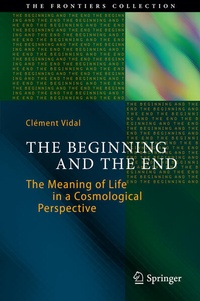
The Beginning and the End
Beschreibung
In this fascinating journey to the edge of science, Vidal takes on big philosophical questions: Does our universe have a beginning and an end or is it cyclic? Are we alone in the universe? What is the role of intelligent life, if any, in cosmic evolution? Grounded in science and committed to philosophical rigor, this book presents an evolutionary worldview where the rise of intelligent life is not an accident, but may well be the key to unlocking the universe's deepest mysteries. Vidal shows how the fine-tuning controversy can be advanced with computer simulations. He also explores whether natural or artificial selection could hold on a cosmic scale. In perhaps his boldest hypothesis, he argues that signs of advanced extraterrestrial civilizations are already present in our astrophysical data. His conclusions invite us to see the meaning of life, evolution and intelligence from a novel cosmological framework that should stir debate for years to come.
Rezensionen / Stimmen
From the book reviews:
"Vidal (Free Univ. of Brussels) offers a large-scale interdisciplinary work packed with interesting and challenging ideas. . Vidal's book is an impressive work of up-to-date, scientifically informed philosophy. Summing Up: Highly recommended. Upper-division undergraduates and above." (L. B. McHenry, Choice, Vol. 52 (6), February, 2015)
"In a very beautiful book, The Beginning and the End , published by Springer, Clément Vidal, a young French philosopher, succeeds in synthesizing what is at stake in the programmed disappearance. ... What is the ultimate goal of humanity, of science? For Clément Vidal, the answer to this latter question is clear: the ultimate goal of science is to fight the death of the universe, with the artificial creation of new universes." (quote translated into English, original book review in French language: Laurent Alexandre, Le monde, June 28, 2014)
Weitere Details
Weitere Ausgaben
Andere Ausgaben
Person
Dr. Clément Vidal is a philosopher with a background in logic and cognitive sciences. He is co-director of the 'Evo Devo Universe' community and founder of the 'High Energy Astrobiology' prize. To satisfy his intellectual curiosity when facing the big questions, he brings together many areas of knowledge such as cosmology, physics, astrobiology, complexity science, evolutionary theory and philosophy of science.