

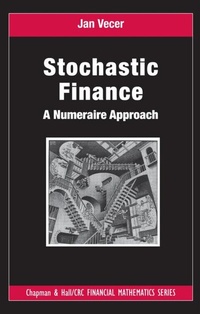
Stochastic Finance
A Numeraire Approach
1. Auflage
Erscheint ca. am 6. Januar 2011
Buch
Hardcover
342 Seiten
978-1-4398-1250-1 (ISBN)
Beschreibung
Unlike much of the existing literature, Stochastic Finance: A Numeraire Approach treats price as a number of units of one asset needed for an acquisition of a unit of another asset instead of expressing prices in dollar terms exclusively. This numeraire approach leads to simpler pricing options for complex products, such as barrier, lookback, quanto, and Asian options. Most of the ideas presented rely on intuition and basic principles, rather than technical computations.
The first chapter of the book introduces basic concepts of finance, including price, no arbitrage, portfolio, financial contracts, the First Fundamental Theorem of Asset Pricing, and the change of numeraire formula. Subsequent chapters apply these general principles to three kinds of models: binomial, diffusion, and jump models. The author uses the binomial model to illustrate the relativity of the reference asset. In continuous time, he covers both diffusion and jump models in the evolution of price processes. The book also describes term structure models and numerous options, including European, barrier, lookback, quanto, American, and Asian.
Classroom-tested at Columbia University to graduate students, Wall Street professionals, and aspiring quants, this text provides a deep understanding of derivative contracts. It will help a variety of readers from the dynamic world of finance, from practitioners who want to expand their knowledge of stochastic finance, to students who want to succeed as professionals in the field, to academics who want to explore relatively advanced techniques of the numeraire change.
The first chapter of the book introduces basic concepts of finance, including price, no arbitrage, portfolio, financial contracts, the First Fundamental Theorem of Asset Pricing, and the change of numeraire formula. Subsequent chapters apply these general principles to three kinds of models: binomial, diffusion, and jump models. The author uses the binomial model to illustrate the relativity of the reference asset. In continuous time, he covers both diffusion and jump models in the evolution of price processes. The book also describes term structure models and numerous options, including European, barrier, lookback, quanto, American, and Asian.
Classroom-tested at Columbia University to graduate students, Wall Street professionals, and aspiring quants, this text provides a deep understanding of derivative contracts. It will help a variety of readers from the dynamic world of finance, from practitioners who want to expand their knowledge of stochastic finance, to students who want to succeed as professionals in the field, to academics who want to explore relatively advanced techniques of the numeraire change.
Rezensionen / Stimmen
... a nice book for researchers and practitioners. ... this book can be regarded as a wonderful application of stochastic analysis, as it includes not only detailed theoretical proofs but also practical illustrative examples. With the systematic and feasible numeraire techniques, the book can serve as an everyday reference book for practitioners, but also as a powerful tool to deal with pricing and hedging for complicated financial assets. Most importantly, the representation of prices as a pairwise relationship of two assets is the most novel characteristic of this book, which could lead to deeper understanding of derivative contracts.-Jian Ping Wan, Mathematical Reviews, 2012f
Although the importance of the choice of numeraire has been recognized for quite some time, this is the first book to stress the fundamental role that numeraires play in modern asset pricing theory. The author is the leading expert on the subject so it is a pleasure to highly recommend this book.
-Peter Carr, Ph.D., Managing Director of Morgan Stanley and Executive Director of NYU's Master of Science Program in Mathematics in Finance
Finally, we have a full volume with a systematic treatment of the change of numeraire techniques. Jan Vecer has taken years of teaching experience and practitioners' feedback to unify a previously complicated topic into the most elegant and easily accessible numeraire textbook to come down the pike. Now it has become fun to learn about parity and duality relationships among exotic options in a whole variety of models. The practitioners will be happy about the dimension reduction methods. There should be more such books.
-Uwe Wystup, Ph.D., Managing Director of MathFinance AG
Weitere Details
Reihe
Sprache
Englisch
Verlagsort
Bosa Roca
USA
Verlagsgruppe
Taylor & Francis Inc
Zielgruppe
Für höhere Schule und Studium
Advanced undergraduate and graduate students, practitioners, and researchers in mathematics, statistics, and mathematical finance.
Illustrationen
41 s/w Abbildungen, 7 s/w Tabellen
7 Tables, black and white; 41 Illustrations, black and white
Maße
Höhe: 234 mm
Breite: 156 mm
Gewicht
612 gr
ISBN-13
978-1-4398-1250-1 (9781439812501)
Copyright in bibliographic data and cover images is held by Nielsen Book Services Limited or by the publishers or by their respective licensors: all rights reserved.
Schweitzer Klassifikation
Weitere Ausgaben
Andere Ausgaben
Buch
06/2017
1. Auflage
CRC Press
138,00 €
Versand in 10-20 Tagen
E-Book
01/2011
1. Auflage
CRC Press
106,99 €
Als Download verfügbar
E-Book
01/2011
1. Auflage
CRC Press
106,99 €
Als Download verfügbar
Person
Jan Vecer is a professor of finance and has taught courses on stochastic finance at Columbia University, the University of Michigan, Kyoto University, and the Frankfurt School of Finance and Management. His research interests encompass areas within financial statistics, financial engineering, and applied probability, including option pricing, optimal trading strategies, stochastic optimal control, and stochastic processes. He earned a Ph.D. in mathematical finance from Carnegie Mellon University.
Inhalt
Introduction. Elements of Finance. Binomial Model. Diffusion Models. Interest Rate Contracts. Barrier Options. Lookback Options. American Options. Contracts on Three or More Assets: Quantos, Rainbows and "Friends". Asian Options. Jump Models. Appendix. Solutions to Selected Exercises. References. Index.