

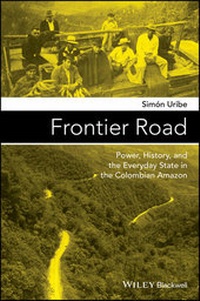
Frontier Road
Power, History, and the Everyday State in the Colombian Amazon
Erschienen am 14. Juli 2017
Buch
Hardcover
280 Seiten
978-1-119-10017-1 (ISBN)
Beschreibung
Frontier Road uses the history of one road in southern Colombia--known locally as "the trampoline of death"--to demonstrate how state-building processes and practices have depended on the production and maintenance of frontiers as inclusive-exclusive zones, often through violent means.
* Considers the topic from multiple perspectives, including ethnography of the state, the dynamics of frontiers, and the nature of postcolonial power, space, and violence
* Draws attention to the political, environmental, and racial dynamics involved in the history and development of transport infrastructure in the Amazon region
* Examines the violence that has sustained the state through time and space, as well as the ways in which ordinary people have made sense of and contested that violence in everyday life
* Incorporates a broad range of engaging sources, such as missionary and government archives, travel writing, and oral histories
Rezensionen / Stimmen
'What an exciting and devastating book! Philosophically as well as aesthetically it blends the material world of road-building into the Amazon with the myth of stately prowess, especially the state's heroic tropes of "opening up" the "frontier." Showing how such a road creates the state, rather than the other way around, the author also demolishes the myth of geographical determinism and does so in a calm, elegant, and lucid prose that upturns our basic concepts. By building his own road, Simón Uribe brings nature and the state into a dazzling new constellation.' Michael Taussig, Class of 1933 Professor of Anthropology, Columbia University, New York 'A wonderful historical treat in the emerging field of infrastructure studies, Frontier Road is a rich and fascinating account of the relation between state and frontier in the Putumayo region of Colombia. The protagonist is the road - a site of hope, frustration, violence and fear, and a space where histories of the future are tracked from the mid-nineteenth century to the present day.' Penny Harvey, Professor of Social Anthropology, University of Manchester, Manchester 'Simón Uribe takes us on an exhilarating journey to reveal how nearly two centuries of frustrated efforts to build a road through the Putumayo exposes the fantasies of state-building and uncertainty of development. With this beautifully written ethnography, Uribe introduces us to a cast of actors, from enigmatic missionaries, wizened truck drivers, and 'never present' guerrilla for whom the road is material infrastructure and symbol of state power. Frontier Road is a remarkable achievement that itself exists at the intellectual frontier of anthropology, geography and history.' Gareth Jones, Professor of Urban Geography, London School of Economics, LondonWeitere Details
Weitere Ausgaben
Andere Ausgaben
Buch
07/2017
Wiley
34,50 €
Versand in 15-20 Tagen
E-Book
05/2017
Wiley
20,99 €
Als Download verfügbar
E-Book
05/2017
Wiley
20,99 €
Als Download verfügbar
Person
Simón Uribe is Assistant Professor in the Institute of Regional Studies, University of Antioquia. He earned his PhD from the Department of Geography and Environment at the London School of Economics, UK. His research focuses on the anthropology of the state, the politics of infrastructure, and the history of frontiers, and has been published in a number of scholarly journals and books in both Spanish and English.
Inhalt
Series Editors' Preface viii
Acknowledgements ix
Introduction 1
Part I 19
1 Reyes' dream 21
2 A Titans' work 62
3 Fray Fidel de Montclar's deed 92
Part II 141
4 The trampoline of death 143
5 On the illegibility effects of state practices 182
6 The politics of the displaced 211
Conclusion: The condition of frontier 240
References 248
Index 264