

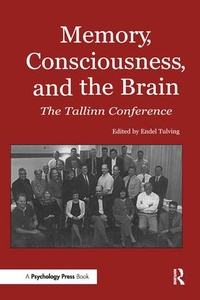
Memory, Consciousness and the Brain
The Tallinn Conference
Erschienen am 1. Dezember 1999
Buch
Hardcover
416 Seiten
978-1-84169-015-5 (ISBN)
Beschreibung
Memory and consciousness have been objects of fascination to psychologists and other brain scientists for over one hundred years. Because of the complexity of the two topics, however, and despite great efforts spent on their study, the progress in their understanding over most of this time has been rather slow. Recently, thanks to new techniques and to changing pre-theoretical orientations, the study of the role of the brain in memory and consciousness has received an immense boost, and has become a central focus of research activity by thousands of researchers worldwide.
The volume reviews recent progress on our understanding of memory, consciousness and the brain and identifies a number of acute outstanding problems. The purpose of the volume, based on a conference in Tallinn, is to look to the future, and not simply to share knowledge from ongoing research. In this sense, the volume does not contain a comprehensive overview of the field, but rather showcases a selection of exciting ideas in cognitive neuroscience. Contributors include some of the world's best-known cognitive brain scientists who have greatly contributed to our understanding of memory as a relation between the brain and the mind, as well as a number of highly promising younger researchers in the field. Memory, Consciousness and the Brain will be essential reading for anyone interested in the latest cutting-edge thinking at the interface of these topics, and in the future directions in which it may take us.
The volume reviews recent progress on our understanding of memory, consciousness and the brain and identifies a number of acute outstanding problems. The purpose of the volume, based on a conference in Tallinn, is to look to the future, and not simply to share knowledge from ongoing research. In this sense, the volume does not contain a comprehensive overview of the field, but rather showcases a selection of exciting ideas in cognitive neuroscience. Contributors include some of the world's best-known cognitive brain scientists who have greatly contributed to our understanding of memory as a relation between the brain and the mind, as well as a number of highly promising younger researchers in the field. Memory, Consciousness and the Brain will be essential reading for anyone interested in the latest cutting-edge thinking at the interface of these topics, and in the future directions in which it may take us.
Weitere Details
Sprache
Englisch
Verlagsort
Hove
Großbritannien
Verlagsgruppe
Taylor & Francis Ltd
Zielgruppe
Für höhere Schule und Studium
Maße
Höhe: 234 mm
Breite: 156 mm
Gewicht
725 gr
ISBN-13
978-1-84169-015-5 (9781841690155)
Copyright in bibliographic data and cover images is held by Nielsen Book Services Limited or by the publishers or by their respective licensors: all rights reserved.
Schweitzer Klassifikation
Weitere Ausgaben
Andere Ausgaben
Buch
12/2014
1. Auflage
Psychology Press Ltd
89,31 €
Versand in 15-20 Tagen
E-Book
05/2013
1. Auflage
Psychology Press Ltd
77,49 €
Als Download verfügbar
E-Book
05/2013
1. Auflage
Psychology Press Ltd
77,99 €
Als Download verfügbar
Person
Endel Tulving
Inhalt
List of Contributors. Prologue. Memory and Consciousness in Tallinn, Endel Tulving. Memory, shmemory: Lest we forget Mnemosyne, Jaan Puhvel. Part I: Memory. Available and accessible information in memory and vision, Jueri Allik. Item-specific weighted memory measurement, Herman Buschke and Martin J. Slivinski. Genetics and memory, Lars-Goeran Nilsson. Divided attention and memory: Impairment of processing or consolidation? Fergus I.M. Craik and Jill D. Kester. Why retrieval is the key process in understanding memory, Henry L. Roediger, III. Functional neuroimaging of episodic memory retrieval, Roberto Cabeza. Mood dependence and implicit memory, Lee Ryan and Eric Eich. Remembering what never happened, Elizabeth F. Loftus. The seven sins of memory: Perspectives from functional neuroimaging, Daniel L. Schacter. Memory, consciousness and temporality: What is retrieved and who exactly is controlling the retrieval? Gianfranco Dalla Barba. Part II: Consciousness. On the objectivity of subjective experiences of autonoetic and noetic consciousness, John M. Gardiner. What brain activity tells us about conscious awareness of memory retrieval, Emrah Duezel. Varieties of consciousness and memory in the developing child, Mark A. Wheeler. Self-regulation and autonoetic consciousness, Brian Levine. Affectively burnt in: One role of the right frontal lobe? Donald T. Stuss and Michael P. Alexander. 'Hot' emotions in human recollection: Towards a model of traumatic memory. Janet Metcalfe and W.J. Jacobs. Is schizophrenia a disorder of memory or consciousness? Nancy C. Andreasen. Part III: The Brain . Novelty assessment in the brain, Reza Habib and Martin Lepage. Dual effect theory of encoding, Randy Buckner. Successful remembering in the brain, Lars Nyberg. Testing Tulving: The split brain approach, Michael S. Gazzaniga and Michael B. Miller. Repressed memories, Hans J. Markowitsch. Remote memory and retrograde amnesia: Was Endel Tulving right all along? Morris Moscovitch, Tanya Yaschyshyn, Marilyne Ziegler, and Lynn Nadel. From location to integration: How neural interactions form the basis for human cognition, Anthony Randal McIntosh. Epilogue. Human intelligence: A case study of how more and more research can lead us to know less and less about a psychological phenomenon, until finally we know less than we did before we started doing research, Robert J. Sternberg. Author Index. Subject Index.