

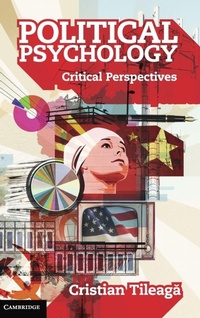
Political Psychology
Critical Perspectives
Erschienen am 3. Oktober 2013
Buch
Hardcover
234 Seiten
978-1-107-01768-9 (ISBN)
Beschreibung
This book provides an introduction to political psychology through a focus on European politics and topics. It describes a style of doing political psychology in Europe that has developed out of dialogue with as well as critique of North American approaches. By emphasising the theoretical and methodological diversity of political psychology, the book is intended to contribute to a greater understanding of the strength and utility of the field. * Opens up and extends the study of political psychology to a variety of socio-political contexts and manifestations of political behaviour * Clearly outlines the usefulness and promises of distinctive critical approaches in social and political psychology * Explicitly considers the role of language, communication, identity and social representations in the construction of political meanings. Political Psychology will appeal to upper-level students and scholars who seek to extend their knowledge of the complex relationship between psychology, politics and society.
Rezensionen / Stimmen
'Cristian Tileaga's impressive new book offers an exciting new vision for political psychology. Moving beyond individualistic paradigms that dominate the work on public opinion, political values, and behaviour, Tileaga argues for a critical and interpretive political psychology that draws on the best that European social psychology has to offer including: discursive and rhetorical psychology, social representations theory, social identity and collective action, narrative and collective memory.' Martha Augoustinos, University of Adelaide 'Is it possible to have a political psychology founded upon the qualitative particulars of individual and collective life? This book articulates a provocative new approach in the field, rooted in European experiences and scholarship, motivated by an unwavering commitment to democratic participation, and grounded in the idea that human action is based on fragmentary, unfinished and relative understandings.' Kevin Durrheim, University of KwaZulu-Natal, South Africa 'The most striking thing about this book is the way in which complex topics are clearly and succinctly presented whilst still managing to emphasise the theoretical and methodological diversity of the field. Throughout all the chapters runs the author's vision of a political psychology that moves beyond the individualistic paradigms that are the norm in much of the current work on political values and behaviour. He effortlessly incorporates significant research in many areas of social psychology in a way that makes this book a pleasure to read.' The PsychologistWeitere Details
Sprache
Englisch
Verlagsort
Cambridge
Großbritannien
Zielgruppe
Für höhere Schule und Studium
Für Beruf und Forschung
Illustrationen
4 Halftones, unspecified; 1 Line drawings, unspecified
Maße
Höhe: 235 mm
Breite: 157 mm
Dicke: 18 mm
Gewicht
510 gr
ISBN-13
978-1-107-01768-9 (9781107017689)
Copyright in bibliographic data and cover images is held by Nielsen Book Services Limited or by the publishers or by their respective licensors: all rights reserved.
Schweitzer Klassifikation
Weitere Ausgaben
Andere Ausgaben
Buch
08/2015
Cambridge University Press
41,50 €
Versand in 15-20 Tagen
E-Book
10/2013
Cambridge University Press
21,99 €
Als Download verfügbar
E-Book
09/2013
1. Auflage
Cambridge University Press
26,49 €
Als Download verfügbar
Person
Cristian Tileaga is Senior Lecturer in Social Psychology and member of the Discourse and Rhetoric Group at Loughborough University. His research centres on developing critical frameworks for researching social and political behaviour and his research interests include the discursive analysis of political discourse, collective memory, the critical psychology of racism, and social representations of history.
Inhalt
Introduction: political psychology as an interpretative field; 1. Public opinion and the rhetorical complexity of attitudes; 2. Mass subjectivity, values and democracy promotion; 3. The political psychology of intolerance: authoritarianism, extremism and moral exclusion; 4. Social representations of political affairs and beliefs; 5. From social to political identity: understanding self, intergroup relations and collective action; 6. Collective memory and political narratives; 7. Discourse and politics; 8. Political rhetoric; 9. Mediated politics: political discourse and political communication; Epilogue.