

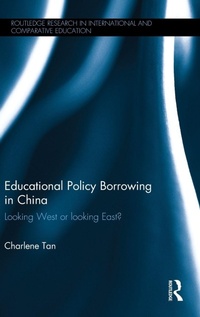
Educational Policy Borrowing in China
Looking West or looking East?
1. Auflage
Erschienen am 25. Februar 2016
Buch
Hardcover
202 Seiten
978-0-415-74324-2 (ISBN)
Beschreibung
For over a decade, Mainland China has been embarking on an ambitious nation-wide education reform ('New Curriculum Reform') for its basic education. The reform reflects China's propensity to borrow selected educational policies from elsewhere, particularly North America and Europe. Chinese scholars have used a local proverb "the West wind has overpowered the East wind" to describe this phenomenon of 'looking West'.
But what do we mean by educational policy borrowing from the West?
What are the educational policies in China's new curriculum reform that are perceived to be borrowed from the West?
To what extent have the borrowed educational policies in China's new curriculum reform been accepted, modified, and rejected by the various educational stakeholders?
How does culture influence the various educational stakeholders in China in interpreting and mediating educational policy borrowing from the West?
How do the findings of this study on China's education reform inform and add to the existing theories on and approaches to on cross-cultural educational policy borrowing?
This book answers the above questions by critically discussing China's policy borrowing from the West through its current reform for primary and secondary education. It presents the latest in-depth research findings from a three-year empirical study (2013-2015) with school principals, teachers, students and other educational stakeholders across China. This study offers new insights into China's educational policy borrowing from the West and international implications on cross-cultural educational transfer for academics, policymakers and educators.
But what do we mean by educational policy borrowing from the West?
What are the educational policies in China's new curriculum reform that are perceived to be borrowed from the West?
To what extent have the borrowed educational policies in China's new curriculum reform been accepted, modified, and rejected by the various educational stakeholders?
How does culture influence the various educational stakeholders in China in interpreting and mediating educational policy borrowing from the West?
How do the findings of this study on China's education reform inform and add to the existing theories on and approaches to on cross-cultural educational policy borrowing?
This book answers the above questions by critically discussing China's policy borrowing from the West through its current reform for primary and secondary education. It presents the latest in-depth research findings from a three-year empirical study (2013-2015) with school principals, teachers, students and other educational stakeholders across China. This study offers new insights into China's educational policy borrowing from the West and international implications on cross-cultural educational transfer for academics, policymakers and educators.
Rezensionen / Stimmen
'This remarkable book contributes in multiple ways both to our understanding of current schooling and educational issues in China, and of processes of educational and cultural borrowing, a core theme in the field of Comparative Education. It is broad in scope as well as rich in empirical depth. ... I see this book as bringing an unusual depth and richness to insights into the process of educational borrowing, a core theme in the field of comparative education, also to the understanding of China's current educational reform process.' - Professor Ruth Hayhoe, Ontario Institute for Studies in Education, University of Toronto (in Frontiers of Education, Volume 11, Issue 3)'Overall, this is a remarkable and impressive piece of work, which has not only gone through the mechanics and politics of China's borrowing policy from the West and its uptake in practice, but also dig deep into its cultural and historical roots for an explanation of the surprising and paradoxical development from both the borrower's and the borrowee's perspectives. There is no denying that it is a great contribution to the exploration of policy borrowing in the rarely touched Chinese context and a valuable addition to the reservoir of comparative education research as well.' - Qiuxian Chen & Ru Zhang, Foreign Language School, Shanxi University, Taiyuan, China (in Asia Pacific Journal of Education, Vol 39, issue 1)
Weitere Details
Reihe
Sprache
Englisch
Verlagsort
London
Großbritannien
Verlagsgruppe
Taylor & Francis Ltd
Zielgruppe
Für höhere Schule und Studium
Illustrationen
18 s/w Abbildungen, 11 s/w Tabellen
11 Tables, black and white; 18 Illustrations, black and white
Maße
Höhe: 240 mm
Breite: 161 mm
Dicke: 17 mm
Gewicht
511 gr
ISBN-13
978-0-415-74324-2 (9780415743242)
Copyright in bibliographic data and cover images is held by Nielsen Book Services Limited or by the publishers or by their respective licensors: all rights reserved.
Schweitzer Klassifikation
Weitere Ausgaben
Andere Ausgaben
Buch
10/2017
1. Auflage
Routledge
80,62 €
Versand in 10-20 Tagen
E-Book
02/2016
Routledge
68,49 €
Als Download verfügbar
E-Book
02/2016
Routledge
68,49 €
Als Download verfügbar
Person
Charlene Tan is an associate professor at the Policy and Leadership Studies Academic Group, National Institute of Education, Nanyang Technological University. A visiting scholar at the Institute of International and Comparative Education, Beijing Normal University in 2013, she has been teaching school leaders, teachers and administrators from various parts of China since 2008.
Inhalt
Preface
1. Concepts, Theories, and Models of Educational Policy Borrowing
2. Educational Policy Borrowing in China: Historical Perspectives
3. Introduction to the New Curriculum Reform in China
4. Looking West: Chinese Perceptions of the New Curriculum Reform
5. The New Curriculum Reform in the Classroom
6. Constructivism and Postmodernism for Education in China: A Critique
7. Looking East: Confucian Influences on Chinese Education
8. When East Meets West: Cultural Scripts, Indigenisation and the 'Teacher-Directed, Student-Engaged' Approach
9. Surprises and Paradoxes in China's Education Reform: The Example of Dulangkou Secondary School
10. Conclusions and Implications
1. Concepts, Theories, and Models of Educational Policy Borrowing
2. Educational Policy Borrowing in China: Historical Perspectives
3. Introduction to the New Curriculum Reform in China
4. Looking West: Chinese Perceptions of the New Curriculum Reform
5. The New Curriculum Reform in the Classroom
6. Constructivism and Postmodernism for Education in China: A Critique
7. Looking East: Confucian Influences on Chinese Education
8. When East Meets West: Cultural Scripts, Indigenisation and the 'Teacher-Directed, Student-Engaged' Approach
9. Surprises and Paradoxes in China's Education Reform: The Example of Dulangkou Secondary School
10. Conclusions and Implications