

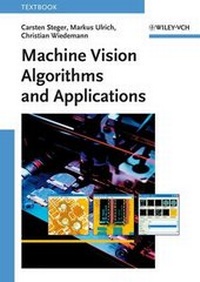
Machine Vision Algorithms and Applications
Erschienen am 14. November 2007
Buch
Softcover
X, 360 Seiten
978-3-527-40734-7 (ISBN)
Beschreibung
This first up-to-date textbook for machine vision software provides all the details on the theory and practical use of the relevant algorithms.
The first part covers image acquisition, including illumination, lenses, cameras, frame grabbers, and bus systems, while the second deals with the algorithms themselves. This includes data structures, image enhancement and transformations, segmentation, feature extraction, morphology, template matching, stereo reconstruction, and camera calibration. The final part concentrates on applications, and features real-world examples, example code with HALCON, and further exercises.
Uniting the latest research results with an industrial approach, this textbook is ideal for students of electrical engineering, physics and informatics, electrical and mechanical engineers, as well as those working in the sensor, automation and optical industries.
Free software available with registration code
Dieses erste aktuelle Handbuch der Software für maschinelles Sehen behandelt die relevanten Algorithmen theoretisch und stellt dann viele praktische Einsatzmöglichkeiten vor. Im ersten Teil geht es um die Bilderstellung (Linsen, Kameras, Framegrabber, Bussysteme), im zweiten Teil kommen die Algorithmen selbst zur Sprache (unter anderem Datenstrukturen, Bildbearbeitung, Segmentierung, Morphologie, Stereo-Rekonstruktion), und der dritte Teil befasst sich mit realitätsnahen Anwendungen. Umfangreiche Codebeispiele (in HALCON) und Übungsaufgaben runden den Text ab. Der Zugang zur MVTec-Software wird gewährleistet.
The first part covers image acquisition, including illumination, lenses, cameras, frame grabbers, and bus systems, while the second deals with the algorithms themselves. This includes data structures, image enhancement and transformations, segmentation, feature extraction, morphology, template matching, stereo reconstruction, and camera calibration. The final part concentrates on applications, and features real-world examples, example code with HALCON, and further exercises.
Uniting the latest research results with an industrial approach, this textbook is ideal for students of electrical engineering, physics and informatics, electrical and mechanical engineers, as well as those working in the sensor, automation and optical industries.
Free software available with registration code
Dieses erste aktuelle Handbuch der Software für maschinelles Sehen behandelt die relevanten Algorithmen theoretisch und stellt dann viele praktische Einsatzmöglichkeiten vor. Im ersten Teil geht es um die Bilderstellung (Linsen, Kameras, Framegrabber, Bussysteme), im zweiten Teil kommen die Algorithmen selbst zur Sprache (unter anderem Datenstrukturen, Bildbearbeitung, Segmentierung, Morphologie, Stereo-Rekonstruktion), und der dritte Teil befasst sich mit realitätsnahen Anwendungen. Umfangreiche Codebeispiele (in HALCON) und Übungsaufgaben runden den Text ab. Der Zugang zur MVTec-Software wird gewährleistet.
Rezensionen / Stimmen
"This is a very interesting, complete, and up-to-date book about various aspects of solving real-world machine vision problems. The opportunity to use and test the machine vision software HALCOM is also an important aspect of this book, allowing the reader to practice and develop machine vision solutions by using a very professional and complete software package." ( Computing Reviews , January 21, 2009) "This textbook for machine vision software not only covers the relevant algorithms in theory, but also figures out their practical use." ( openPR.com , September 2008)Weitere Details
Weitere Ausgaben
Nachauflagen
Carsten Steger | Markus Ulrich | Christian Wiedemann
Machine Vision Algorithms and Applications
Buch
01/2018
2. Auflage
Wiley-VCH
75,90 €
Versand in 5-7 Tagen
Personen
Carsten Steger studied computer science at Technische Universität München (TUM) and received his PhD from TUM in 1998. In 1996, he co-founded the company MVTec, where he heads the Research and Development department.
He has authored and co-authored more than 60 scientific publications in the field of machine vision. Carsten Steger is also a guest lecturer at the Technische Universität München, where he teaches machine vision.
Markus Ulrich studied Geodesy and Remote Sensing at Technische Universität München (TUM) and received his PhD from TUM in 2003. Since 2003, he is a software engineer at the Research and Development department of MVTec. He has authored and co-authored scientific publications in the fields of photogrammetry and machine vision.
Markus Ulrich is also a guest lecturer at the Technische Universität München, where he teaches close-range photogrammetry.
Christian Wiedemann studied Geodesy and Remote Sensing at
Technische Universität München (TUM) and received his PhD from TUM in 2001. He has authored and co-authored more than 40 scientific publications in the fields of photogrammetry, remote sensing, and machine vision. Since 2003, he is a software engineer at the Research and Development department of MVTec.
He has authored and co-authored more than 60 scientific publications in the field of machine vision. Carsten Steger is also a guest lecturer at the Technische Universität München, where he teaches machine vision.
Markus Ulrich studied Geodesy and Remote Sensing at Technische Universität München (TUM) and received his PhD from TUM in 2003. Since 2003, he is a software engineer at the Research and Development department of MVTec. He has authored and co-authored scientific publications in the fields of photogrammetry and machine vision.
Markus Ulrich is also a guest lecturer at the Technische Universität München, where he teaches close-range photogrammetry.
Christian Wiedemann studied Geodesy and Remote Sensing at
Technische Universität München (TUM) and received his PhD from TUM in 2001. He has authored and co-authored more than 40 scientific publications in the fields of photogrammetry, remote sensing, and machine vision. Since 2003, he is a software engineer at the Research and Development department of MVTec.
Inhalt
Image Acquisition
(illumination, lenses, cameras, frame grabbers, bus systems)
Machine Vision Algorithms
(Data structures, Image enhancement, image transformations, segemntation, feature extraction, morphology, template matching, stereo reconstruction, camera calibration, FFT, color, texture, etc.)
Machine Vision Applications
(application examples, descriptions on how to solve them with the methods discussed in the book, example code with HALCON - MVTec's premier machine vision software, possibly further exercises)
(illumination, lenses, cameras, frame grabbers, bus systems)
Machine Vision Algorithms
(Data structures, Image enhancement, image transformations, segemntation, feature extraction, morphology, template matching, stereo reconstruction, camera calibration, FFT, color, texture, etc.)
Machine Vision Applications
(application examples, descriptions on how to solve them with the methods discussed in the book, example code with HALCON - MVTec's premier machine vision software, possibly further exercises)